Red Chokeberry
Aronia arbutifolia
A suckering native shrub with orange-red autumn leaves and red fruit clusters, suited to moist borders where its mature height and spreading colony have room.
Published Last updated
At a glance
- Light
- Full sun to partial shade; best flowering and fruiting in full sun
- Water
- Moist soil preferred; tolerates occasional wetness and some drought after establishment
- Soil
- Adaptable to clay, loam and sand; moist, drained garden soil is a useful starting point
- Hardiness
- Zones 4–9
- Bloom
- Spring white to pale pink flowers; red fruit and foliage in autumn
- Height
- Usually 6–12 ft; named selections may be smaller · Usually 1.8–3.7 m; named selections may be smaller
In this guide
Overview
Red chokeberry brings two layers of autumn interest to a garden: orange-red to purplish leaves and clusters of small red fruits that can remain after leaf fall. Choose Aronia arbutifolia for a moist, sunny shrub border or a roomy naturalized edge where its upright stems and root suckers are useful. Late October is a good time to observe local foliage and fruit, but peak color and persistence vary with place and weather. A narrow strip that must stay exactly the width of its nursery pot is a poor match.
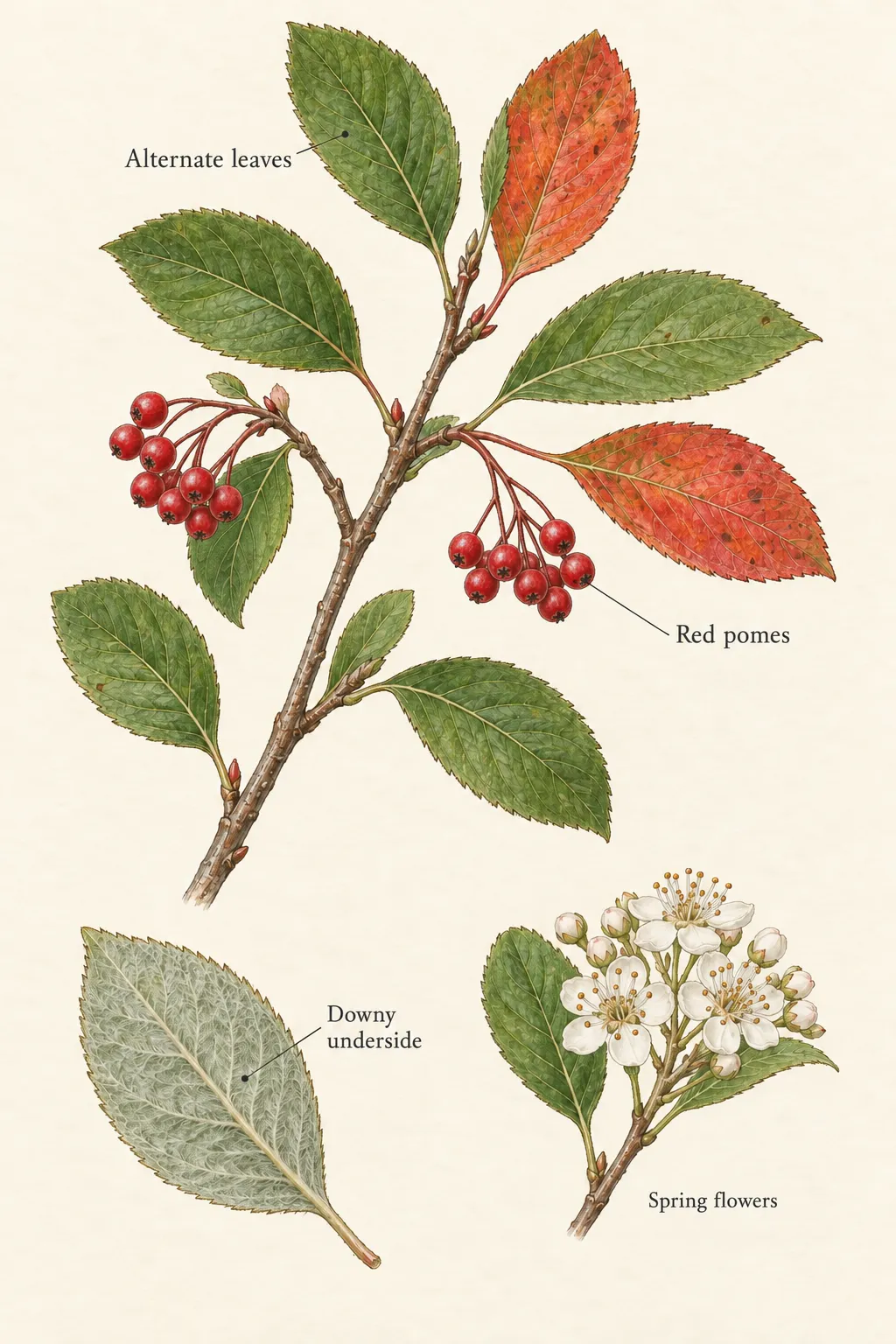
Look at the leaves as well as the fruit. The simple, finely toothed leaves sit alternately along the twig and are generally elliptical to obovate, with a grayish, downy underside. Fruits are small pomes, roughly a quarter inch across, borne in clusters. The identification plate shows a leafy twig, a turned leaf and red fruit together. Use the combination with a reliable nursery label rather than identifying a garden shrub from red berries alone.
Check the complete botanical name when buying. Black chokeberry is Aronia melanocarpa, and purple chokeberry is associated with the hybrid A. × prunifolia; neither is simply a red chokeberry at a different stage of ripeness. Older stock lists may use Photinia pyrifolia or Sorbus arbutifolia for red chokeberry. A label reading only 'aronia' can leave the eventual fruit color, stature and intended garden role uncertain.
Expect a tall, relatively narrow, multi-stemmed shrub that may become open at its base. NC State gives 6–12 feet high and 3–6 feet wide, while Cornell records spread as broad as 12 feet. The difference matters when suckers are allowed to remain. Mark an eventual planting footprint, including room for maintenance, before choosing the number of shrubs. Repeated shearing to keep a naturally expanding colony inside a small box adds work and sacrifices much of its loose seasonal character.
For a moist border, place red chokeberry toward the rear or along a woodland edge with usable summer light. One design option is a small group behind lower perennials, leaving access to inspect the bases and remove unwanted shoots. Lower planting can soften the sparse lower stems as the shrubs age. That is a layout suggestion, not a requirement for dense underplanting: leave each new root ball accessible for watering, and allow enough space that adjacent crowns do not immediately compete with it.
'Brilliantissima' is a widely grown selection for more conspicuous fruit and strong red fall color; Illinois describes larger, glossier fruit and abundant flowering. A nursery photograph shows potential, not the exact display a shaded garden will reproduce. Ask for the cultivar's mature dimensions as well as its name, and compare locally grown specimens if possible. Smaller selections exist, so confirm that a compact plant is a named cultivar rather than a young example of the taller species.
Moisture tolerance is broad, but it does not eliminate establishment care. Cornell includes occasionally saturated soil as well as consistently moist, drained sites, and Maryland describes drought tolerance once established. A newly planted shrub still has a confined nursery root system. Check that original ball during dry spells even beside a damp rain-garden margin. A site under permanent deep water is a different planting problem from a border that becomes wet after rain.
Acid soil is generally preferred. Cornell's recorded tolerance range is pH 5.0–8.0, whereas Maryland favors acidic soil below 6.8 and the RHS recommends acid to neutral conditions. The numeric range here describes reported tolerance, not a target to achieve with amendments. Test an alkaline site and assess local performance before choosing the shrub. Stronger flowering and fruiting favor full sun; partial shade is possible, with the actual display judged over a growing season.
Spring flower clusters attract pollinators, and Maryland and NC State record use of the fruit by birds. Some fruit can remain well into winter, but a heavy crop and a fixed persistence date are both uncertain. Leave space to enjoy the shrub after leaf fall as well as during its color peak, and observe how much fruit local wildlife takes. A planting can offer useful seasonal interest even when its winter branches carry fewer berries than a nursery photograph.
- Family
- Rosaceae
- Range
- Eastern North America, including eastern Canada and the central and eastern United States
- Soil pH
- 5–8
- Spread
- Often 3–6 ft per shrub; an unmanaged colony can spread farther · Often 0.9–1.8 m per shrub; an unmanaged colony can spread farther
Planting & careHow to grow red chokeberry
This profile uses temperate Northern Hemisphere seasons and eastern North American garden guidance. USDA zones 4–9 follow Illinois; NC State extends its listing to zone 3, Cornell gives 4b, and Oregon State is more cautious at (4)5. Check the named selection's local track record near the cold edge. Native status applies within its natural range, not worldwide. The pH range is Cornell's tolerance range; moist acid-to-neutral soil remains a straightforward garden choice. Autumn planting depends on workable ground and time for establishment, not the October 26 planning date.
- 1Choose sound nursery stock and a workable season
For a container-grown shrub, inspect the stem bases and roots before purchase; pass over a severely tangled or deteriorating ball. Autumn or early spring can suit planting in Maryland-type climates. Delay when ground is frozen, waterlogged or unusually dry, and use the local nursery’s timing in colder regions.
- 2Measure from the first structural roots
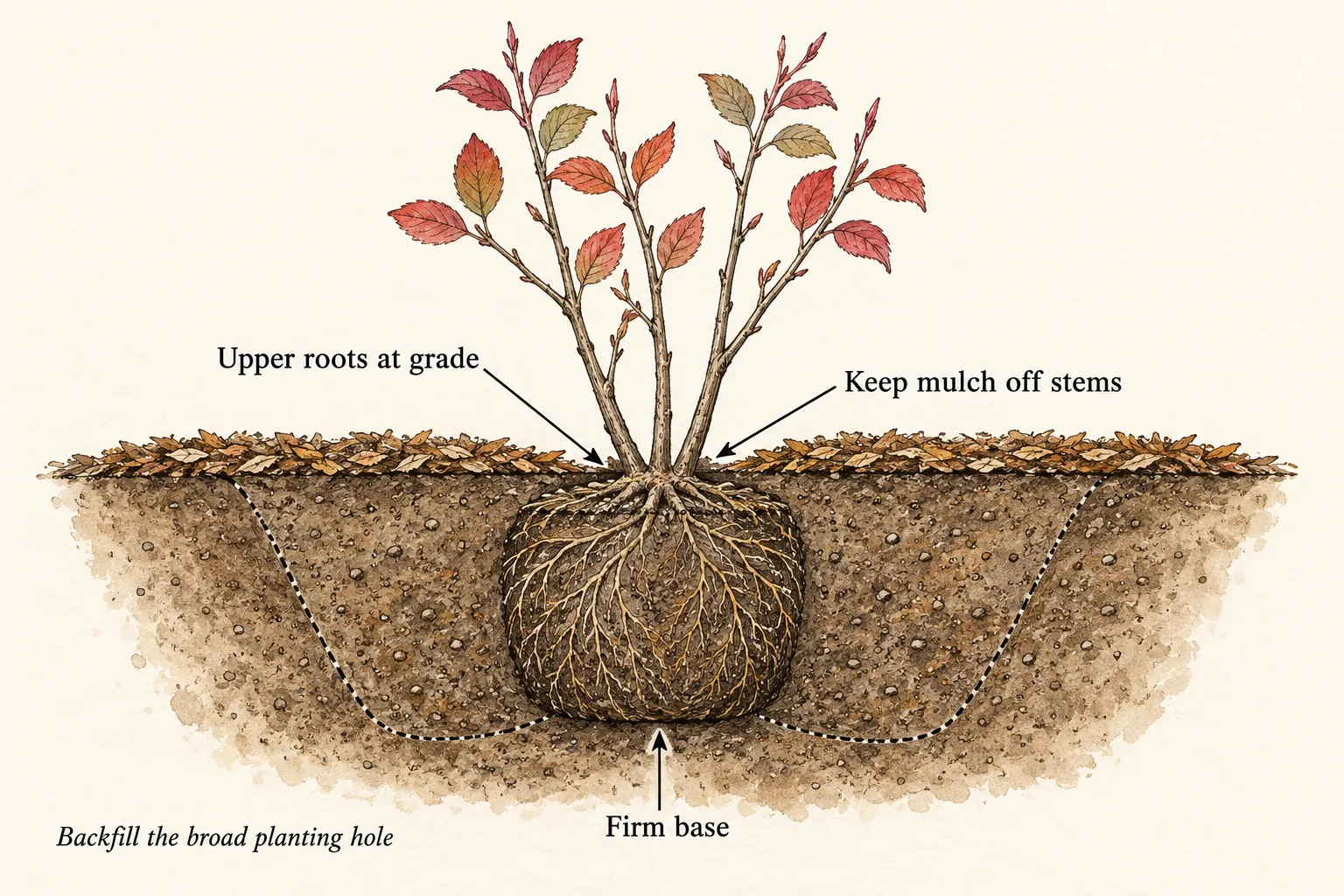
Find where the main stems meet the upper roots, removing excess loose nursery soil if that level is buried. Make a hole at least twice the ball width and no deeper than the corrected root-ball depth. Keep the supporting soil firm so the shrub cannot settle below grade.
- 3Release the roots and set the shrub
Remove the container and address circling roots before backfilling. For balled-and-burlapped stock, remove binding twine and wrapping as the ball is supported in position; seek help if it cannot be handled intact. Keep the upper structural roots at surrounding grade and backfill with the excavated soil.
- 4Water the original ball and nearby soil
Apply water slowly across the root area. Minnesota’s shrub guideline starts with one-quarter to one-third of the nursery container volume per watering: a 3-gallon container suggests about three-quarters to one gallon. Adjust subsequent applications to actual moisture and drainage, and widen the watered area as roots spread.
- 5Mulch and define the colony boundary
Use an organic mulch layer no more than 3 inches deep, with an open gap around the stem bases. Mark the area in which new suckers will be welcome. Keep any path-side shoots visible and accessible so removing them remains a small maintenance task rather than a later excavation.
Pruning red chokeberry
Keep the natural upright framework and remove dead or damaged branches as needed. For an established shrub needing renewal, Maryland recommends removing one-third of the oldest stems; the RHS also allows a lighter pruning approach. To retain the spring flower display, assess selective thinning just after spring flowering, following the RHS early-flowering-shrub timing, and start with fewer stems on a healthy, open young plant. Cut selected old stems near their base rather than shortening every tip. Flowered branches removed at that time also lose their potential fruit, so retain healthy fruiting wood where the autumn display is the priority. Remove unwanted root suckers at their origin when accessible. NC State lists softwood cuttings and dormant sucker removal as propagation options; keep a rooted sucker if you want another plant, while retaining its identity and adequate roots. Seed-grown offspring need not reproduce a named cultivar exactly.
Seasonal care
Spring
Watch the small white or pale pink flower clusters and preserve healthy stems if fruit is important. Plant while local soil conditions suit the work. After flowering, assess only the thinning needed for an established crowded framework; a recently planted shrub mainly needs establishment care.
Summer
Check new root balls during dry weather and expand watering as roots establish. Record summer shade from nearby trees before blaming a sparse crop on poor soil. Inspect the leaves and shoot tips if growth changes suddenly; occasional spots and overall branch decline warrant different levels of attention.
Autumn
Compare leaf color, fruit abundance and mature habit on nearby labeled plants. Plant suitable nursery stock while ground remains workable and water is available. Preserve fruiting branches for the seasonal display and remove only unwanted suckers or damaged growth that needs attention.
Winter
Study the exposed multi-stemmed form and map any boundary expansion. Fruit may persist, with weather and wildlife affecting the amount remaining. Keep mulch clear of the bases and protect young plants where deer browsing is frequent. Plan renewal work around the next flowering period.
Safety and garden spread
No specific toxicity warning is recorded in the retained species profiles. This ornamental profile does not establish that an unidentified red-fruited plant is safe to eat.
Spreads vigorously
Root suckers can extend the planting into a colony. Allow a naturalizing area or remove unwanted shoots as part of border maintenance. This growth habit is not a blanket invasive-species designation.
Reported region: Gardens where clonal spread is unwanted
Common problems
Suckers beyond the intended footprint
- Look for
- New rooted shoots appear outside the original shrub, especially along the border edge.
- Action
- Decide whether that part of the colony is welcome. Remove unwanted shoots near their origin and keep the boundary accessible; repeated top clipping leaves the spreading root system in place.
An open, leggy lower framework
- Look for
- Older stems carry much of their foliage high up, exposing bare lower branches.
- Action
- This can be the species’ normal aging habit. Use selective renewal and appropriate lower planting where useful; assess light and vigor before treating every bare stem as diseased.
Leaf spotting or dying shoot tips
- Look for
- Discrete spots, blighted fruit or twig dieback occur alongside otherwise seasonal foliage.
- Action
- NC State lists leaf spot and twig or fruit blight as possibilities, although serious problems are uncommon. Photograph the whole shrub and close details and seek local diagnosis for spreading damage; a color change alone cannot identify a pathogen.
Browsing and missing young growth
- Look for
- Accessible shoot tips are eaten back or new plants remain unevenly shortened.
- Action
- Check for deer activity and protect vulnerable new shrubs with suitable physical exclusion. NC State and Cornell both flag deer susceptibility; native status does not make this shrub browse-proof.
Disappointing flowers or fruit
- Look for
- A healthy shrub produces a sparse spring display or few red fruit clusters.
- Action
- Review summer light, recent pruning and whether the plant was actually identified as red chokeberry. Full sun supports stronger production. Observe another season before adding fertilizer or assuming that a sparse crop proves root failure.
Sources
- Aronia arbutifolia. NC State Extension. Source record · Accessed 2026-10-12.
- Aronia arbutifolia. Oregon State University. Source record · Accessed 2026-10-12.
- Red Chokeberry. University of Maryland Extension. Source record · Accessed 2026-10-12.
- Aronia arbutifolia. Cornell University Woody Plants Database. Source record · Accessed 2026-10-12.
- Red Chokeberry. University of Illinois Extension. Source record · Accessed 2026-10-12.
- Planting a Tree or Shrub. University of Maryland Extension. Source record · Accessed 2026-10-12.
- Watering newly planted trees and shrubs. University of Minnesota Extension. Source record · Accessed 2026-10-12.
- Aronia arbutifolia. Royal Horticultural Society. Source record · Accessed 2026-10-12.
- Shrubs: pruning early-flowering. Royal Horticultural Society. Source record · Accessed 2026-10-12.
- Plant Description and Habitat of Aronia (black chokeberry). University of Maine Cooperative Extension. Source record · Accessed 2026-10-12.