Pink Turtlehead
Chelone lyonii
A late-summer Chelone lyonii profile for moist woodland edges and rain-garden margins, with identification, mature scale, siting, seasonal care and spring maintenance.
Published Last updated
At a glance
- Light
- Full sun to part shade; part shade is helpful in hot-summer climates
- Water
- Medium to wet, with dependable moisture through growth
- Soil
- Rich, humusy, moist soil that drains between saturating events
- Hardiness
- Zones 3–8
- Bloom
- Late summer into early autumn; flowers are listed from July through September and capsules mature in autumn
- Height
- 2–4 ft · 60–120 cm
In this guide
Overview
Pink turtlehead earns a place where late summer has begun to thin the border but the soil still holds steady moisture. Chelone lyonii forms an upright clump of green stems and opposite toothed leaves, then lifts dense terminal spikes of rose-pink, snapdragon-like flowers. Its strongest garden use is a damp woodland edge, pond margin, rain-garden shoulder or generously watered border where the late flowers can rise above ferns and lower foliage. A dry shade bed is a poor match, and a hot exposed bed may need more afternoon protection than the species name on a plant label suggests.
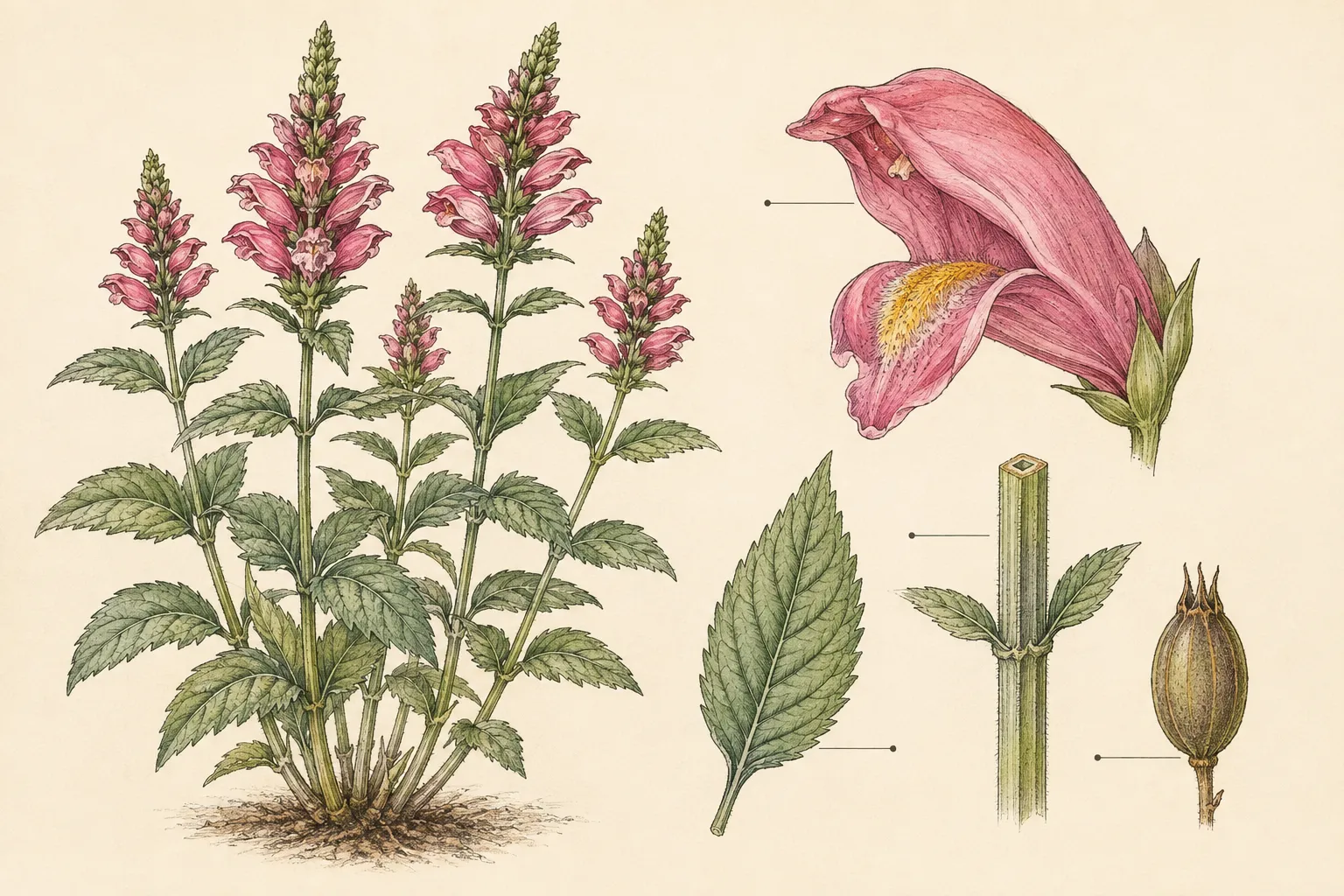
The flower gives the plant its common name. Each tubular, two-lipped bloom has a hooded outline that resembles a turtle's head, with a lower lip marked by yellow hairs. Look below the flowers as well: the stems are upright and typically unbranched or lightly branched, the leaves occur in opposite pairs, and their ovate blades have pointed tips and sharp teeth. The identification plate isolates these traits because a pink flower spike alone is not enough to distinguish pink turtlehead from other late-season border plants.
The accepted botanical name is Chelone lyonii, in the family Plantaginaceae. Pink turtlehead, Appalachian turtlehead and Lyon's shell flower are overlapping common names; older garden references may simply call it turtlehead or shellflower. Keep the botanical name with a purchase, especially when comparing the pink species with white turtlehead, Chelone glabra, or hybrids sold under a cultivar name. The species has a concentrated southern Appalachian range, even though it adapts to gardens beyond that native region and has naturalized in some areas.
Plan for a plant about 2–4 feet tall and 1.5–2.5 feet wide. That is enough visual weight for the middle of a border but still small enough to repeat along a path or at the edge of a pond. The clump reads vertically when flower spikes are in bloom and as a leafy mass beforehand. In deep shade, stems are more likely to lean and may need support; in a cooler climate with reliable moisture, the plant can take more sun. Full sun is useful when the soil does not dry, while part shade is the safer placement where summer afternoons are hot.
Moisture is the non-negotiable part of the site. In the wild, the species occurs in damp or wet ground, including seepages, streambanks and moist woods. In a home garden, use rich, humusy soil and water the whole occupied root zone during establishment. Medium-to-wet does not mean a sealed basin where water remains stagnant: observe the bed after rain, keep air moving through the foliage and direct excess water away from the crown. A good location feels cool and moisture-retentive without turning into a compacted puddle.
The flowering window is one of the plant's main design values. North Carolina sources list blooms from July through September, while the Royal Horticultural Society describes the genus as opening from late summer to early autumn. By October, the small oval capsules darken as seed approaches maturity. Leave some sound stems and capsules when their upright lines help the autumn border; remove them after dormancy when a cleaner edge is more useful. Ferns, astilbes, sedges and other moisture-tolerant companions can carry the composition while the turtlehead is between seasons.
- Family
- Plantaginaceae
- Range
- Southern Appalachian Mountains of the southeastern United States
- Soil pH
- 6–8
- Spread
- 1.5–2.5 ft · 45–75 cm
Planting & careHow to grow pink turtlehead
North Carolina Extension and Missouri Botanical Garden place Chelone lyonii in USDA zones 3–8 and describe it for full sun to part shade with medium-to-wet soil. Kew records the accepted species as native to the southeastern United States, especially Alabama, Georgia, Mississippi, North Carolina, South Carolina and Tennessee. Use the mature species envelope as a planning guide, then read the label for cultivars such as 'Hot Lips', which can differ in color, foliage and stature. In hot climates, part shade protects flowering; in any region, the bed must stay moist without becoming a stagnant pocket.
- 1Buy by the botanical name
Check the label for Chelone lyonii and record any cultivar name. Pink turtlehead, Appalachian turtlehead and shellflower can describe overlapping plants, while white turtlehead and other Chelone species have different flower color and leaf proportions. Use the named selection's stated size when it differs from the species envelope.
- 2Find moisture before digging
Choose a position that stays reliably moist through the growing season: a damp woodland edge, pond margin, seep, rain-garden shoulder or irrigated border. Test the site after rain and reject a bed that dries sharply or holds a stagnant puddle. Part shade is valuable in hot-summer climates; brighter light is workable when moisture is dependable.
- 3Reserve the mature footprint
Allow roughly 2–4 feet of height and 1.5–2.5 feet of spread for the species, with extra clearance from paths and neighboring clumps. Position it in the middle layer where the flower spikes remain visible, and use lower ferns, astilbes or sedges to soften the base without closing air around the leaves.
- 4Prepare a continuous root zone
Work with the bed's existing soil across a broad area so the root ball does not sit in a small pocket of radically different texture. Rich, humusy, moist soil suits pink turtlehead. Keep a route open for excess water, and correct compaction or a low wet spot before planting rather than trying to solve it with a deep layer of mulch.
- 5Set the crown at grade
Plant at the depth held in the nursery container, with the top of the root ball level with the surrounding soil. Backfill gently, water slowly to settle the root zone and keep mulch off the stem bases. The crown should remain readable and the surface should be able to drain after a heavy rain.
- 6Establish steady moisture
Water the full root zone after planting and during dry weather while new roots occupy the surrounding soil. Check below the surface instead of relying on a damp mulch layer. Once the plant is established, continue to protect it from repeated drying; its woodland and streamside ancestry is not a drought adaptation.
- 7Pinch or support with a reason
In spring, pinch the stem tips if a shorter, bushier plant is useful, especially in a shaded site where stems may stretch. Watch the clump as it gains height and add discreet support if it leans into a path or neighboring plant. A brighter position usually reduces the need for staking.
- 8Make the autumn decision early
During the late-summer display, decide whether the garden needs seed capsules and standing stems for autumn structure. Leave selected sound spikes when they contribute to the border, or remove spent material after dormancy when the edge needs to be clearer. Keep the crown marked if surrounding plants make the dormant clump hard to find.
Pruning pink turtlehead
Pink turtlehead needs little routine pruning. Pinch the stem tips in spring when a shorter, more branched clump is preferable, following the guidance used for shaded plants that may need support. During flowering, remove only the spikes that have finished if a tidier display is important; leave selected capsules when their autumn form or seed matters. After the stems are fully dormant, cut them back to the base if the border benefits from a clean winter outline, or leave sound stems until late winter. Keep the crown visible and avoid piling wet debris against it.
Seasonal care
Spring
Remove last year's collapsed stems and check the crown before nearby cultivation begins. Confirm that the root zone is moist but not stagnant, then pinch the stem tips if the clump needs a shorter, bushier outline. Add a discreet support plan before the stems lengthen in a shaded position.
Summer
Maintain dependable moisture as the clump builds height and begins its late-season flowering. Keep foliage open to air, look for powdery mildew where soil has dried or plants are crowded, and support stems before they fall across a path. The flowers can be used as a cut accent when the site produces more spikes than the border needs.
Autumn
Enjoy the final rose-pink spikes into early autumn and allow selected capsules to remain as they darken toward seed maturity. Remove diseased material, decide whether standing stems help the composition and cut back only after the top is fully dormant. Preserve the crown's place in the bed as neighboring plants change color or disappear.
Winter
The herbaceous top is dormant while the crown remains in the soil. Keep the bed freely draining, prevent a dense wet mat from settling over the crown and leave any plant marker in place. Ferns, sedges and other structural companions can hold the space until new stems return in spring.
Safety and garden spread
Common problems
Leaning or floppy stems
- Look for
- Flowering stems reach toward brighter light, fall across companions or need repeated tying in a deeply shaded position.
- Action
- Check seasonal light and the mature footprint first. Pinch stem tips in spring for a shorter, bushier clump, move the plant only when the site cannot provide workable light and moisture, or add discreet support before the spikes become heavy.
Powdery mildew
- Look for
- A pale powdery film on leaves, especially where plants are crowded, air is still or the soil has dried around the root zone.
- Action
- Restore even root-zone moisture, open the spacing and improve air movement through the clump. Remove badly affected debris and seek a local diagnosis before choosing a treatment; the cited extension profiles associate mildew with dry soil or poor circulation.
Sparse flowering
- Look for
- A leafy clump with few terminal spikes, weak stems or growth reaching away from a shaded or dry side of the bed.
- Action
- Compare the site with the plant's needs: full sun to part shade, rich moist soil and protection from repeated drying. Correct the root-zone condition and light exposure before adding fertilizer, and use the named cultivar's expected size when judging a young plant.
Confused turtlehead identity
- Look for
- A plant sold as turtlehead has white flowers, a different mature form or a label that omits the species and cultivar name.
- Action
- Recheck the botanical name and compare the opposite toothed leaves, upright habit and rose-pink two-lipped flowers with the identification plate. Keep Chelone lyonii separate from white turtlehead and unnamed hybrids when planning color, size and placement.
Plant details
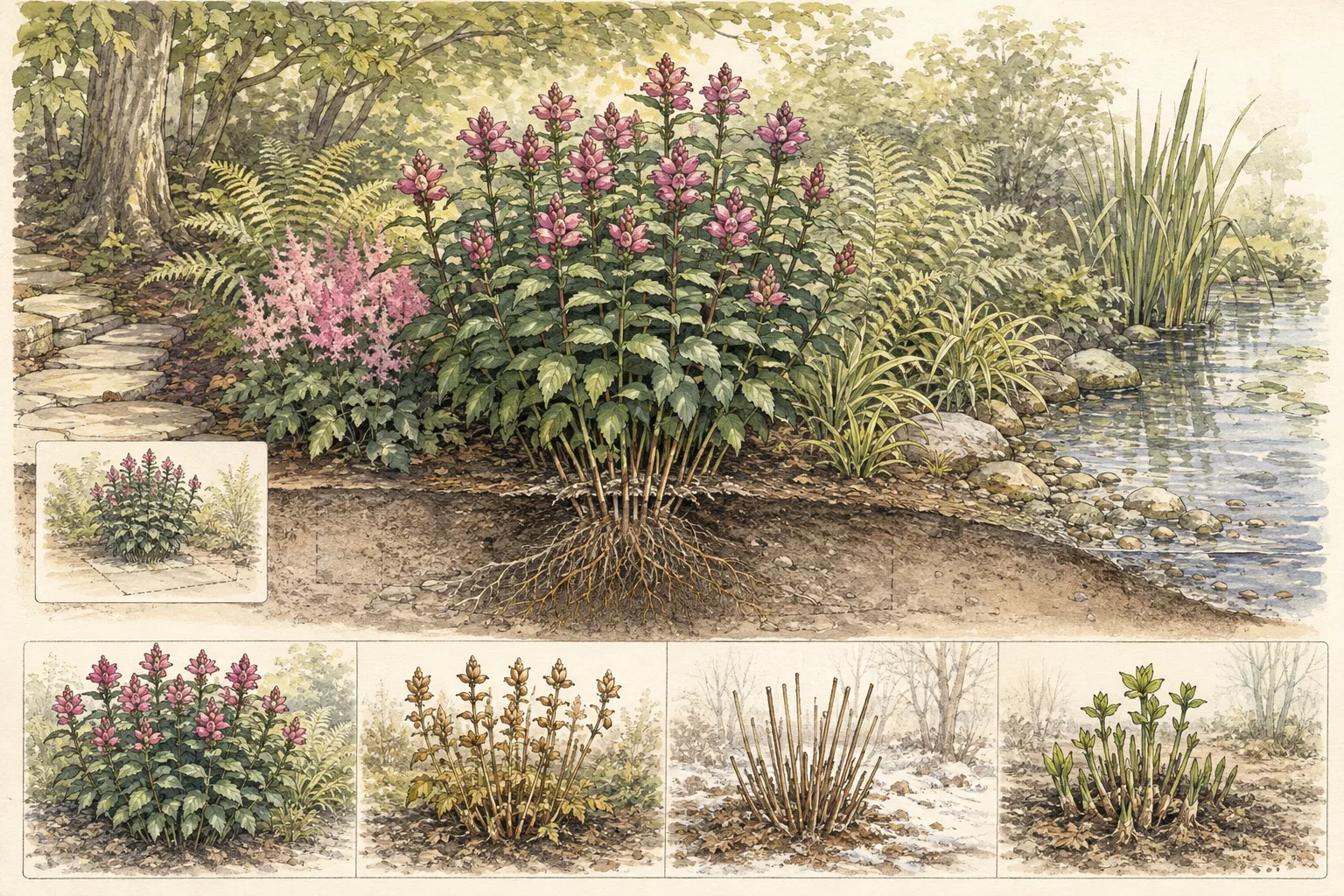
Garden placement study showing pink turtlehead beside ferns at a damp woodland edge, with a moist root zone, pond margin and seasonal growth sequence
Sources
- Appalachian Turtlehead - Chelone lyonii. North Carolina Extension Gardener Plant Toolbox. Source record · Accessed 2026-09-05.
- Chelone lyonii 'Hot Lips' - Plant Finder. Missouri Botanical Garden. Source record · Accessed 2026-09-05.
- Chelone lyonii Pursh. Plants of the World Online, Royal Botanic Gardens, Kew. Source record · Accessed 2026-09-05.
- Chelone lyonii | Lyon's shell flower. Royal Horticultural Society. Source record · Accessed 2026-09-05.