Paperbark Maple
Acer griseum
A slow-growing Chinese maple with three-leaflet foliage, variable red-orange autumn color and curling cinnamon bark that remains conspicuous after leaf fall.
Published Last updated
At a glance
- Light
- Full sun to partial shade
- Water
- Consistently moist, well-drained soil; water during establishment and extended dry spells
- Soil
- Drained loam, sand or clay; protect the root area from compaction
- Hardiness
- Zones 5–7
- Bloom
- Small greenish-yellow flowers in spring; autumn foliage and year-round ornamental bark
- Height
- Usually 20–30 ft; older trees can be taller · Usually 6–9 m; older trees can be taller
In this guide
Overview
Paperbark maple earns a permanent place where its trunk can be seen after the leaves fall. Acer griseum combines cinnamon to copper-brown bark, peeling in thin curls, with three-leaflet foliage that may turn orange and red late in autumn. Give it a sunny or lightly shaded position with moist, draining soil and room for a broadening crown. Early November is a useful time to compare local specimens, but the date of leaf fall and the strength of their color vary with climate and the individual tree.
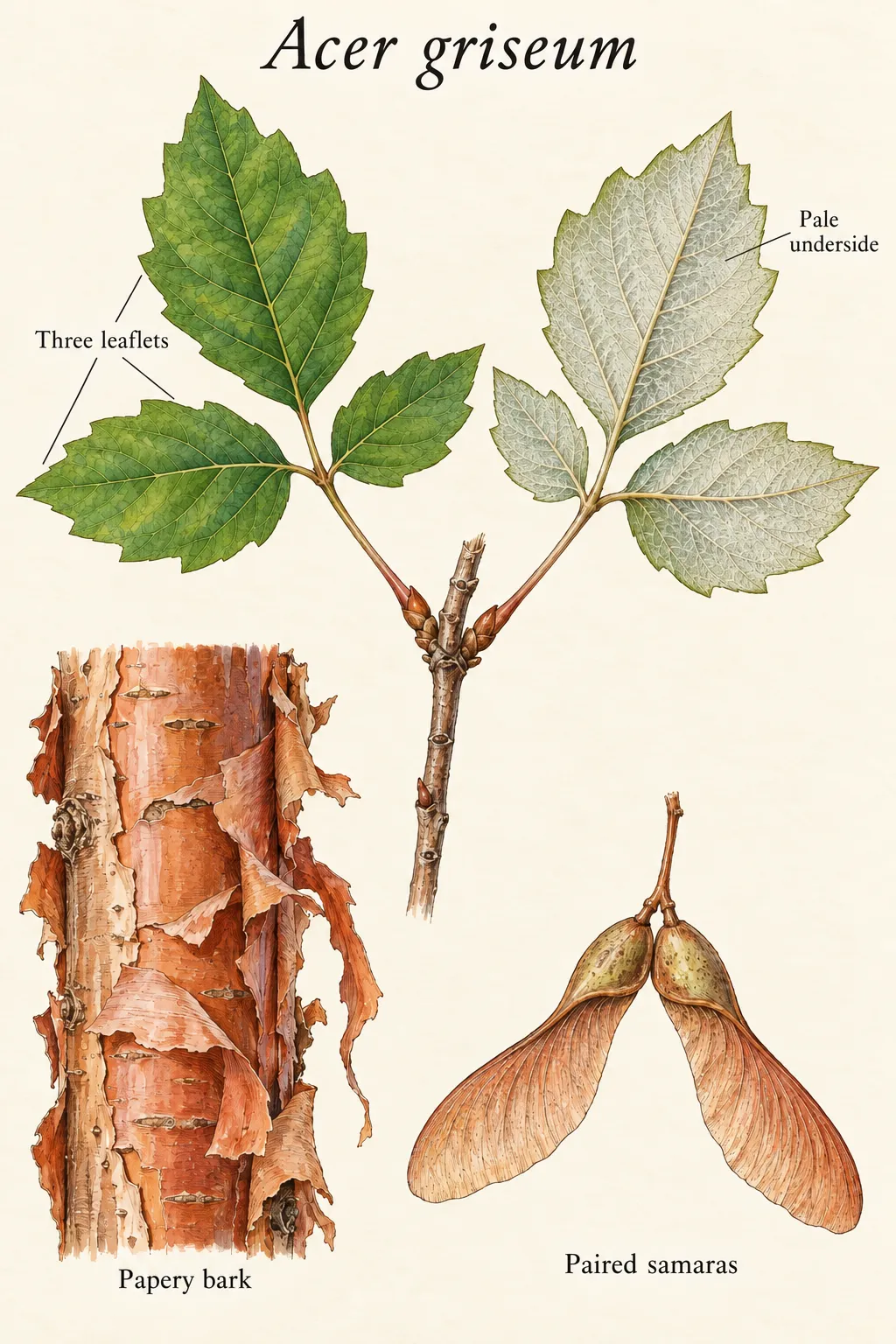
Its leaves provide a particularly useful identity check. Each compound leaf has three separate leaflets, and complete leaves are arranged opposite one another on the twig. The middle leaflet has a short stalk and coarse teeth; the side leaflets have very short stalks and are usually less toothed. The upper surface is green to blue-green, with a pale, finely hairy underside. This is a different structure from the single, deeply lobed blade of a familiar Japanese maple. Check the leaf attachment as well as the outline.
Look for the combination of foliage and bark on labeled nursery stock. The cinnamon-colored outer layers curl away while remaining attached, revealing contrasting bark beneath. Virginia Cooperative Extension notes that peeling can occur on branches about half an inch in diameter and larger, although the amount and color differ among trees. Normal exfoliation is part of the species' appeal. Leave attached curls in place; stripping them for a smoother trunk removes the feature you selected and risks disturbing sound tissue.
Expect a slow-growing tree, not a permanently miniature one. NC State gives a common mature size of 20–30 feet high and 15–25 feet wide; Cornell allows a spread equal to its 20–30-foot height. The RHS lists an eventual height of 8–12 metres over 20–50 years. These descriptions make a narrow nursery crown a poor guide to permanent spacing. Use a generous mature outline on the site plan and check nearby older trees before fitting one between a house wall and a path.
A useful garden position is a lawn edge or broad mixed border visible from a winter window, with low planting that leaves the trunk exposed. Allow access for watering the young root ball and keep mower traffic away from the bark. A dark evergreen background can make copper curls easier to see; that is a design option, with enough separation for both plants to mature. Choose single-stemmed or well-formed multi-stemmed stock to suit the view, then preserve that natural framework as it develops.
Check labels carefully when comparing named plants. Virginia Cooperative Extension identifies ‘Cinnamon Flake’ and Gingerbread as hybrids between A. griseum and A. maximowiczianum, even though they may appear alongside paperbark maple in catalogs. Their names do not establish that they are identical species selections. Ask the nursery for the complete identity, eventual dimensions and locally observed performance. Slow growth and propagation difficulty can affect availability, so selecting sound, correctly labeled stock matters more than finding the tallest plant on the sales bench.
Choose moisture and aeration together. Oregon State records successful growth in clay as well as other soil types, provided drainage is suitable. Cornell flags drought and compaction as problems; Virginia's broader tolerance of somewhat dry soil should not become a reason to neglect a new root ball. A compacted pavement pocket or a hollow that remains saturated after rain is a poor choice. Improve the whole planting area where needed before planting, or choose another location with a workable root environment.
The recorded pH range of 5.0–8.0 comes from Cornell and expresses tolerance, not a prescription to amend soil to an endpoint. RHS and Oregon State also describe broad pH adaptability. Test a questionable site and concentrate first on drainage and rooting space. Full sun to partial shade is suitable; a very shaded position may give a weaker seasonal display. Comparing the light reaching local mature specimens is more useful than assuming that every tree will reproduce a nursery photograph.
Autumn color is an opportunity, not a guarantee of a scarlet canopy. Virginia Cooperative Extension explicitly records variation by tree, year and place, while Oregon State describes colors from green or red-brown to striking red. Bark remains the more dependable winter feature. Small spring flowers are greenish-yellow and inconspicuous; paired winged fruits follow and can persist into winter. Many nutlets are empty, so a tree carrying plenty of samaras has not necessarily produced a useful crop of viable seed.
Propagation can be difficult. The RHS lists seed and grafting, while NC State also records stem cuttings, with young material easiest to root. These are options for a propagator with a suitable protocol, not a promise of quick replacement trees. For a planned garden specimen, buying nursery-grown stock gives a more predictable starting point than relying on fallen seed. Keep the original identity with any propagation attempt, especially when the parent is a named selection or hybrid.
- Family
- Sapindaceae
- Range
- Central China
- Soil pH
- 5–8
- Spread
- Often 15–25 ft; allow for a crown approaching 30 ft · Often 4.5–7.5 m; allow for a crown approaching 9 m
Planting & careHow to grow paperbark maple
Temperate Northern Hemisphere guidance applies. The displayed USDA zones 5–7 follow Virginia Cooperative Extension; NC State lists 4–8, Oregon State gives zone 4, and Cornell is more cautious at 5b. Check local performance and stock provenance near those limits. Native range is central China. November is an observation and planning window: NC State and Cornell specifically favor spring transplanting of container or balled-and-burlapped paperbark maples. RHS guidance permits autumn–winter planting of larger maples in suitable UK conditions. Use local advice, workable unfrozen soil and dependable watering; late-autumn planting is not compulsory.
- 1Select a healthy tree and reserve its mature footprint
Confirm Acer griseum on the label and compare the trunk and three-leaflet foliage. Have the nursery show the root ball and its upper structural roots. Select sound branches, an intact ball and a framework suited to the site; reject severely girdled roots or unexplained trunk wounds. Reserve space for the eventual crown before choosing a single- or multi-stemmed form.
- 2Expose the root flare and measure the hole
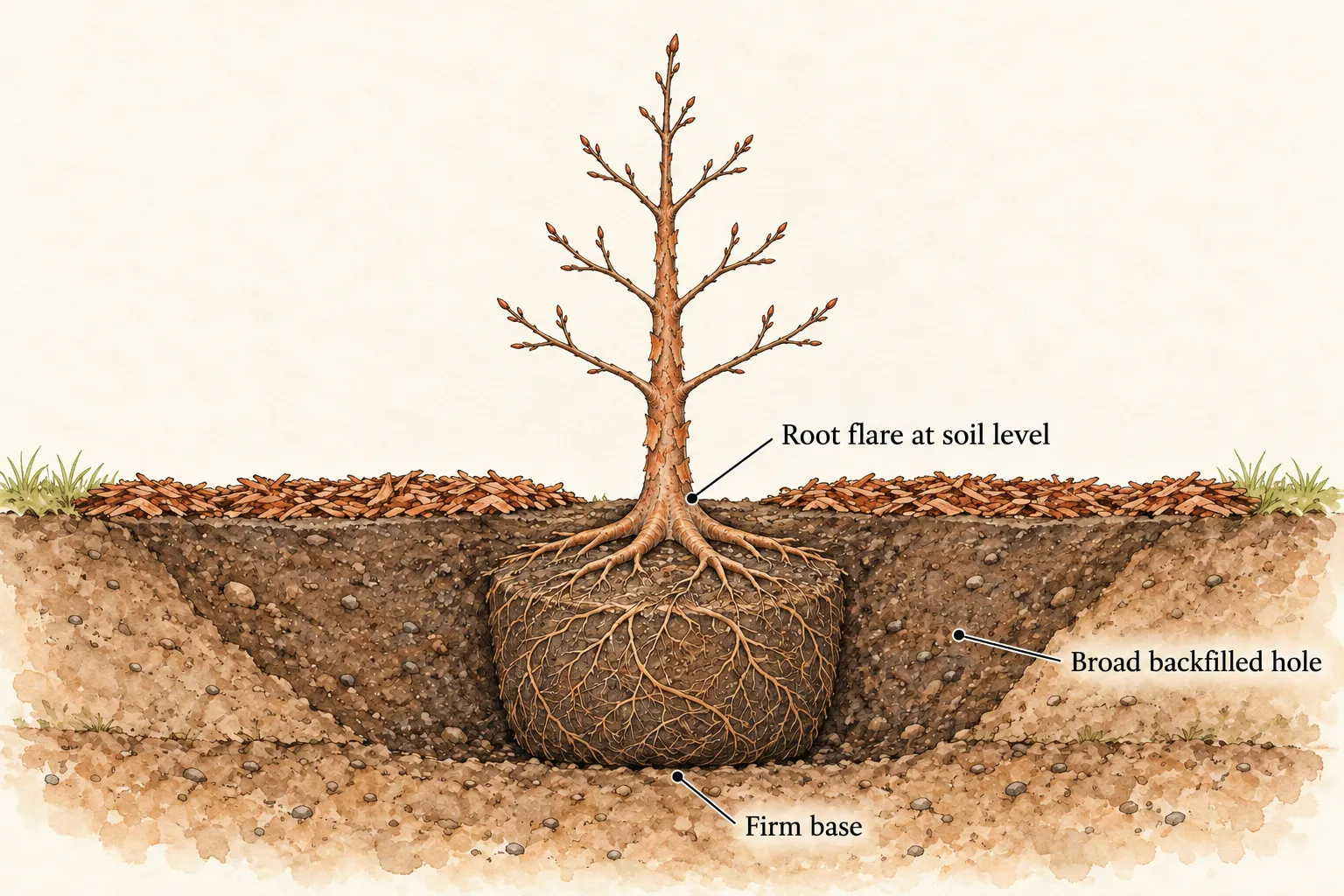
Gently remove excess loose nursery soil until the trunk widens into the first main roots. Maryland Extension specifies a hole at least twice the root-ball width and no deeper than the distance from that flare to the ball base. Keep firm soil underneath. Set the flare at surrounding soil level; the old pot surface can be misleading if the tree was already buried too deeply.
- 3Handle container and wrapped stock differently
Remove a container completely, loosen accessible circling roots and have serious root defects corrected before planting. Support a balled-and-burlapped tree by its ball, retaining its integrity. Once positioned, remove trunk cords and wrapping; remove the wire basket where the ball can remain intact. If full removal would collapse it, Maryland advises removing at least the upper 12 inches of basket and burlap. Large specimens need experienced handling.
- 4Backfill and establish a visible, watered root zone
Use the excavated soil to backfill, settling it with water and gentle hand pressure. Keep the flare exposed and provide a broad mulched area with a clear gap around the trunk. Check both the original ball and nearby soil: water slowly when the ball is drying several inches below the surface, allowing excess to drain. Moist surrounding clay can coexist with a dry nursery ball.
- 5Continue care beyond the planting day
Monitor moisture during dry weather through the first two growing seasons and longer if roots are still establishing. Keep grass and heavy foot traffic away from the root area. Stake only where the tree needs stability, using flexible supports that permit some movement, then inspect the ties regularly. Routine fertilizer is unnecessary for a healthy new tree in suitable soil; investigate poor growth before feeding.
Pruning paperbark maple
Paperbark maple needs little routine pruning. Keep the chosen framework and make small, selective corrections for damaged or rubbing branches as needed. For planned work, RHS maple guidance offers late summer or full dormancy; its UK examples are August–October or November–January, with actual growth stage and local conditions controlling timing. Maples can bleed sap from cuts at other times. Retain the natural trunk and larger branches that carry the bark display, and seek an arborist for major structural work. The hard cut described for some colorful young-stem maples is a different training system and is unsuitable as an automatic annual treatment for this specimen tree. A smaller site calls for a smaller tree choice, not repeated topping of an established paperbark maple.
Seasonal care
Spring
Plant container or balled-and-burlapped stock when local conditions suit the work; the species-specific US sources favor this season. Check the flare after settling and water the original root ball. Look for three-leaflet shoots and the small flowers as growth resumes. Leave routine feeding out of the establishment plan unless a specific need is identified.
Summer
Inspect root-ball moisture during dry spells and keep the broader root zone mulched and free of compaction. Brown leaf margins require a check of heat, water and roots before a disease diagnosis. Assess any minor corrective pruning for the appropriate local late-summer window, preserving the specimen’s natural shape.
Autumn
Compare local foliage color and bark before ordering stock. Keep watering newly planted trees when the root ball dries and the ground remains unfrozen. Collect fallen samaras only as a propagation experiment; many contain empty nutlets. Defer planting where late cold, wet soil or poor watering access makes establishment doubtful.
Winter
Enjoy the exposed cinnamon curls and branch structure. Keep mulch clear of the flare and inspect ties or guards for rubbing. Leave normal exfoliating bark attached. In a suitable dormant pruning window, address only necessary small corrections; obtain qualified advice for cracked unions or large limbs.
Safety and garden spread
The retained species profiles record no specific toxicity warning. This garden profile establishes ornamental use only; it does not assess food, medicinal or animal-feed use.
Common problems
Peeling bark mistaken for damage
- Look for
- Thin cinnamon or copper sheets curl away from otherwise sound branches and trunk. Fresh abrasions, deep cracks or soft, sunken patches have a different appearance.
- Action
- Retain normal exfoliation. Compare suspicious areas with healthy bark on the same tree and photograph changes. Seek a nursery or arborist assessment for expanding wounds or associated dieback; peeling alone is not a reason to strip or treat the trunk.
Brown leaf margins or premature leaf loss
- Look for
- Leaf edges dry or brown during hot, dry weather, especially on a recently planted tree.
- Action
- Check moisture inside the original ball, drainage, planting depth and root-area compaction. Correct the observed cause and protect establishment watering. Persistent or one-sided wilt needs diagnosis; RHS lists leaf scorch and Verticillium wilt among possibilities, but appearance alone cannot separate them.
Slow growth and a buried-looking trunk
- Look for
- The trunk enters the soil like a pole, the flare is hidden, or the canopy thins while the root area stays wet.
- Action
- Check for excess soil or mulch at the base and for circling roots. Expose the condition carefully and seek help for a deep or established root defect. Slow growth by itself is normal for this species; declining leaves and poor root conditions are the reasons to investigate.
Less red autumn foliage than expected
- Look for
- Leaves remain partly green or turn brown-red while another paperbark maple nearby becomes bright orange or red.
- Action
- Allow for individual and annual variation documented by Virginia and Oregon State. Compare exposure and general vigor before changing care. Preserve the tree’s bark and mature shape as winter assets; extra fertilizer is not a justified response to color variation.
Samaras that produce few seedlings
- Look for
- Many winged fruits are present but propagation yields little germination.
- Action
- Check seed quality and use a species-specific propagation protocol. Empty nutlets and difficult propagation are documented characteristics. Keep seed experiments separate from the timetable for a replacement landscape tree, and obtain nursery stock when dependable planting material is needed.
Sources
- Acer griseum. NC State Extension Gardener Plant Toolbox. Source record · Accessed 2026-10-19.
- Acer griseum | paperbark maple. Royal Horticultural Society. Source record · Accessed 2026-10-19.
- Acer griseum — Woody Plants Database. Cornell University. Source record · Accessed 2026-10-19.
- Paperbark Maple, Acer griseum. Virginia Cooperative Extension. Source record · Accessed 2026-10-19.
- How to grow larger acers. Royal Horticultural Society. Source record · Accessed 2026-10-19.
- Acer griseum. Oregon State University. Source record · Accessed 2026-10-19.
- Planting a Tree or Shrub. University of Maryland Extension. Source record · Accessed 2026-10-19.