Obedient Plant
Physostegia virginiana
A long-blooming North American perennial with movable two-lipped flowers, square stems, and shallow rhizomes that need a deliberate boundary.
Published Last updated
At a glance
- Light
- Full sun to partial shade
- Water
- Moderate; moist and occasionally wet
- Soil
- Moist, moderately fertile, well-drained clay, loam, or sand
- Hardiness
- Zones 3–9
- Bloom
- Midsummer to first frost
- Height
- 3–4 ft · 90–120 cm
In this guide
Overview
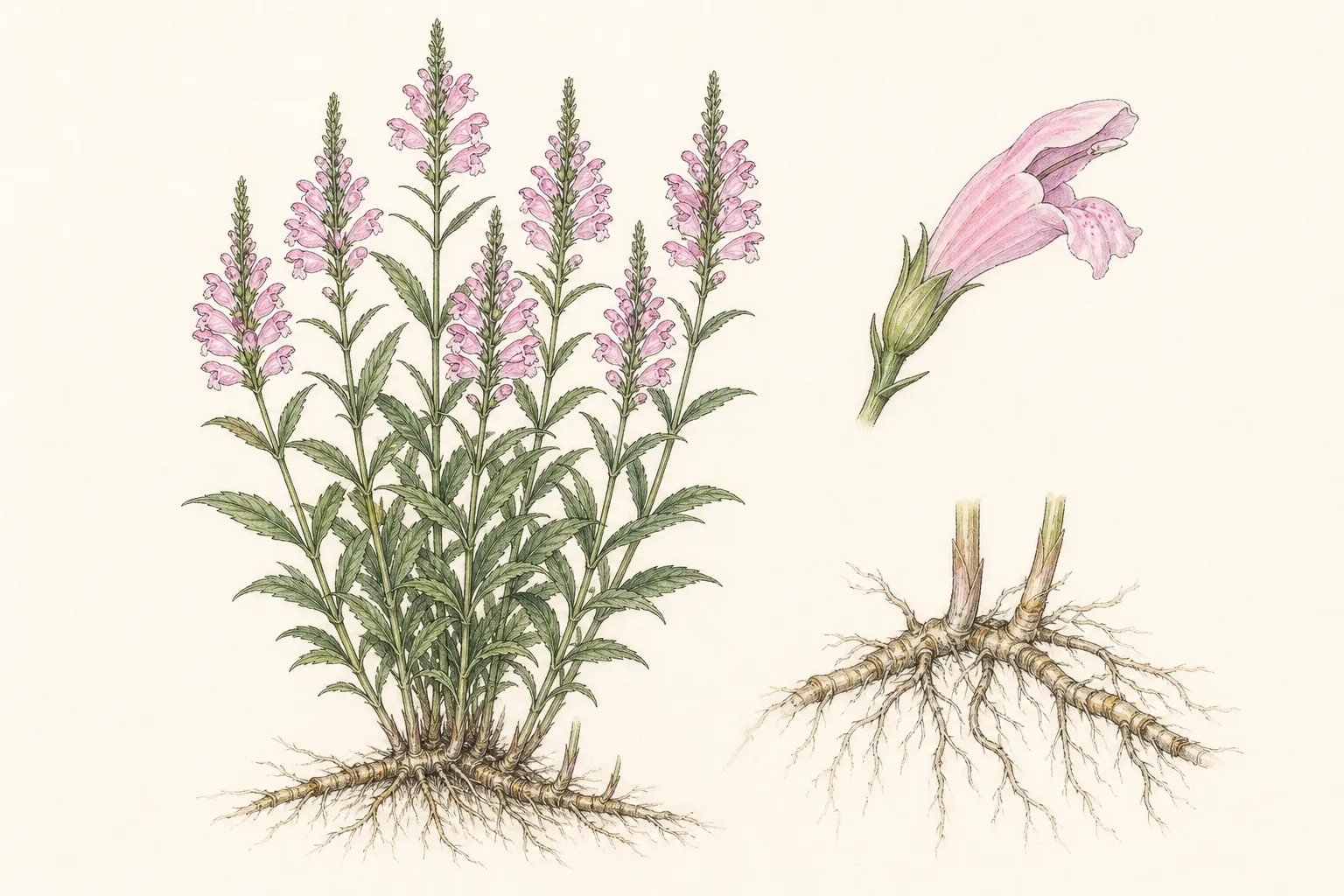
Physostegia virginiana is a rapid-growing herbaceous perennial in the mint family. Smooth square stems carry opposite narrow lance-shaped leaves with sharply toothed margins. Pale pink to rose, lavender, or white two-lipped flowers open from the bottom upward on terminal spikes; each flower can be pushed aside and will remain briefly in that position, which explains the common name.
The flowering stems reach about 3–4 ft high and an individual clump spans 2–3 ft, but shallow rhizomes and self-sown seedlings can carry the colony well beyond that measurement. Use the species in a meadow, rain garden, broad native planting, or a border with an accessible hard edge. A small intricate bed turns its principal trait into constant root removal.
Full sun and moist, moderately fertile soil produce the strongest upright bloom. Partial shade and occasionally wet soil are tolerated, but rich feeding, too much shade, and hot conditions can make tall stems flop. The species accepts clay, loam, or sand and broadly neutral to alkaline conditions; test before changing pH or fertility.
Set each crown at the same grade it held in the container and water through establishment. Do not bury the crown under deep mulch. Mark the intended colony line immediately, preferably beside lawn or paving where new shoots and shallow rhizomes can be found without excavating the whole border.
Where containment matters, inspect the boundary every spring and autumn and divide the patch every one or two years. Trace an escaping shoot to the shallow rhizome and lift the complete outward section. Deadheading reduces self-seeding but does not stop underground spread; allow seed only in a deliberate naturalized planting.
The retained profiles report aphids, spider mites, black spot, and rust as occasional problems rather than reasons for preventive spraying. Diagnose a spreading leaf pattern or sap-feeding insect before treatment. Institutional sources do not present the species as edible, so keep ornamental plant material out of food use.
- Family
- Lamiaceae
- Range
- Canada through the United States to northeastern Mexico
- Soil pH
- 6–8
- Spread
- 2–3 ft · 60–90 cm
Planting & careHow to grow obedient plant
The species is generally grown in USDA zones 3–9. Rhizome and seed spread accelerate in rich moist soil, while stems flop more readily in excessive fertility, shade, or heat. Named cultivars may be shorter or less aggressive, so keep cultivar claims separate from the species profile and check regional native status before naturalizing it.
- 1Choose a maintainable boundary
Place the colony beside lawn, paving, or another clear edge where shallow rhizomes can be found and lifted. Avoid threading the species among slow, delicate crowns.
- 2Allow for stems and spread
Reserve 3–4 ft of flowering height and at least 2–3 ft for the initial clump, plus working room at the chosen edge. A species planting will not remain container-sized.
- 3Match sun and moisture
Choose full sun to partial shade with moist, well-drained soil that can be occasionally wet. Prefer stronger light where tall-stem flopping is already a concern.
- 4Set crowns at soil grade
Plant each crown at its nursery depth, spread roots into the surrounding bed, and backfill without covering the stem bases. Keep mulch shallow and outside the crown.
- 5Water without overfeeding
Settle the roots thoroughly and maintain moisture through establishment. Do not add high-nitrogen fertilizer to already fertile soil, where it encourages floppy stems and faster spread.
- 6Schedule the first edge check
Inspect beyond the boundary in the first spring and autumn, before shoots interlock with neighboring plants. Lift complete escaping rhizomes while they remain easy to trace.
Pruning obedient plant
Cut faded flower spikes to a lower leafy node when self-seeding is not wanted, then remove dead stems at the base after frost or before spring shoots rise. This does not control rhizomes. In spring or autumn, trace and lift every shallow rhizome outside the chosen boundary and divide the interior clump every one or two years where containment matters.
Seasonal care
Spring
Remove last year’s dead stems before new shoots become tall, then inspect outside the colony line. Lift escaping shallow rhizomes and divide a congested patch before neighboring crowns become entangled.
Summer
Maintain moist soil through the long flowering period and deadhead spikes if seedlings are unwanted. If stems lean, check shade, fertility, crowding, and heat before adding supports.
Autumn
After frost, cut dead stems at the base or leave sound seed-bearing spikes only in a naturalized area. Make a second boundary check and replant divisions at crown depth while soil remains workable.
Winter
Keep the dormant crown marked and free of deep wet mulch. Review whether last season’s colony stayed inside its edge so spring division can begin before shoots hide the rhizomes.
Safety and garden spread
The retained institutional profiles do not flag Physostegia virginiana as poisonous, but they are not an edibility assessment. Do not ingest ornamental plant material, and use normal garden hygiene.
Spreads vigorously
Shallow rhizomes spread quickly in rich, moist soil. Allow room to contain the colony; named cultivars may spread less.
Common problems
Growth beyond the allotted patch
- Look for
- New shoots appear beyond the chosen edge or among neighboring crowns, with shallow horizontal rhizomes connecting them to the patch.
- Action
- Trace and lift the complete outward rhizome, then divide the crowded interior if needed. Deadhead to reduce seedlings, recognizing that it will not stop underground spread.
Flopping stems
- Look for
- Tall flower spikes lean or splay, especially in rich soil, partial shade, hot weather, or a crowded patch.
- Action
- Reduce unnecessary fertilizer, improve light where feasible, and divide crowded crowns. Use discreet support for an exposed tall planting only after the cultural causes are addressed.
Black spot or rust-like symptoms
- Look for
- Dark expanding spots, yellow halos, or orange-brown pustules recur across multiple leaves rather than remaining as isolated injuries.
- Action
- Remove heavily affected debris, improve spacing and airflow, and avoid wetting leaves late in the day. Confirm the disease locally before using any labeled treatment.
Aphids or spider mites
- Look for
- Sticky curled tips indicate sap-feeding aphids, while fine stippling and webbing in hot dry weather point toward spider mites.
- Action
- Confirm the pest on leaf undersides, reduce plant stress, and follow local Extension guidance and the product label if damage warrants a targeted control.
Plant details
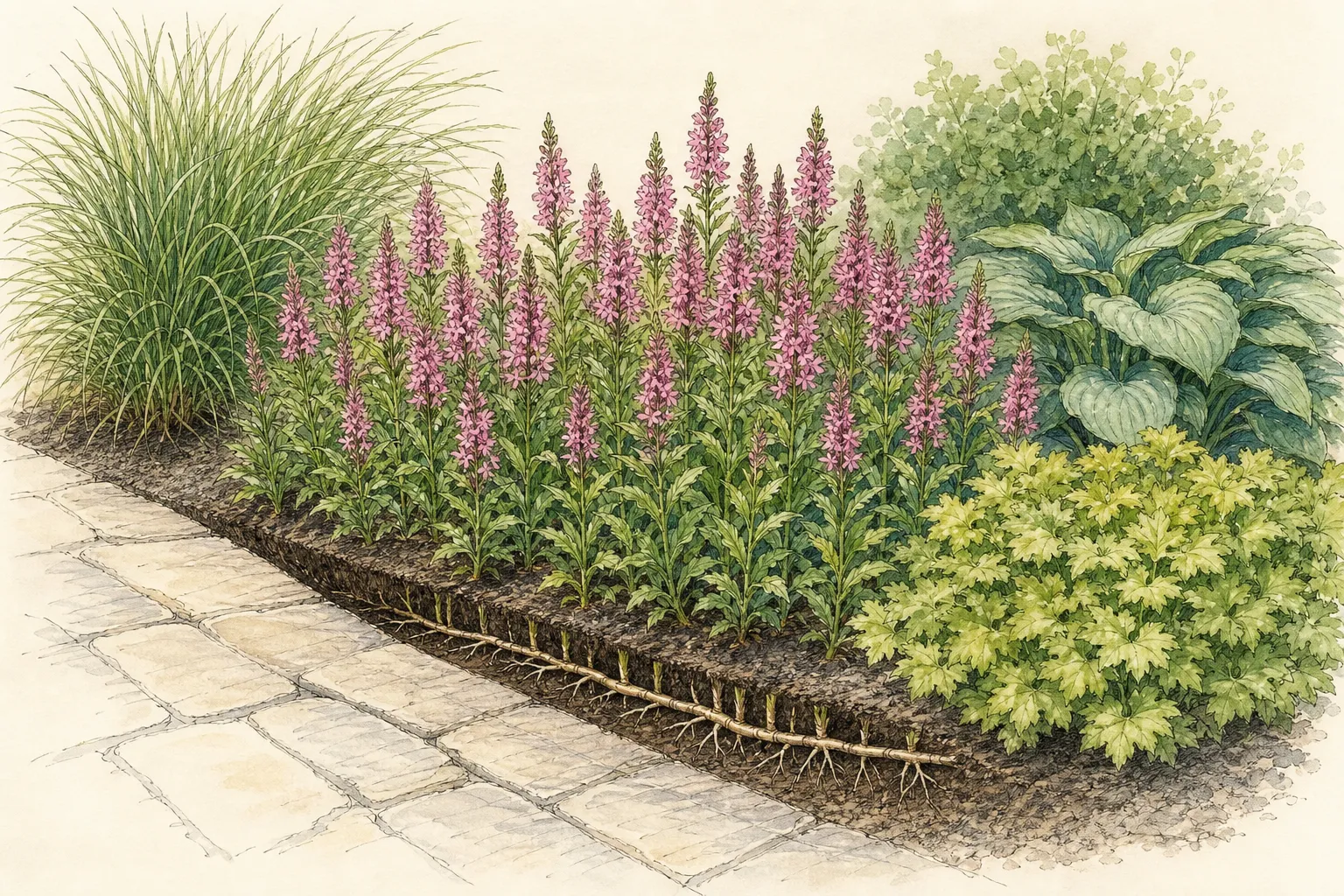
Moist perennial border with pink obedient plant spikes and a cutaway showing shallow rhizomes meeting a maintained path edge
Sources
- Physostegia virginiana. North Carolina State Extension. Source record · Accessed 2026-09-07.
- Physostegia virginiana. Missouri Botanical Garden. Source record · Accessed 2026-08-30.
- Physostegia virginiana (L.) Benth.. Royal Botanic Gardens, Kew. Source record · Accessed 2026-08-30.