Oakleaf Hydrangea
Hydrangea quercifolia
A species-led guide to the southeastern native shrub with lobed foliage, pyramidal summer flowers, burgundy fall color and exfoliating winter bark.
Published Last updated
At a glance
- Light
- Full sun to part shade; favor afternoon protection in hot, dry exposures
- Water
- Even moisture during establishment and dry periods, with no persistent saturation
- Soil
- Organically rich, moist and well-drained soil
- Hardiness
- Zones 5–9
- Bloom
- Late spring through midsummer, usually May to July by region
- Height
- 4–8 ft · 1.2–2.4 m
In this guide
Overview
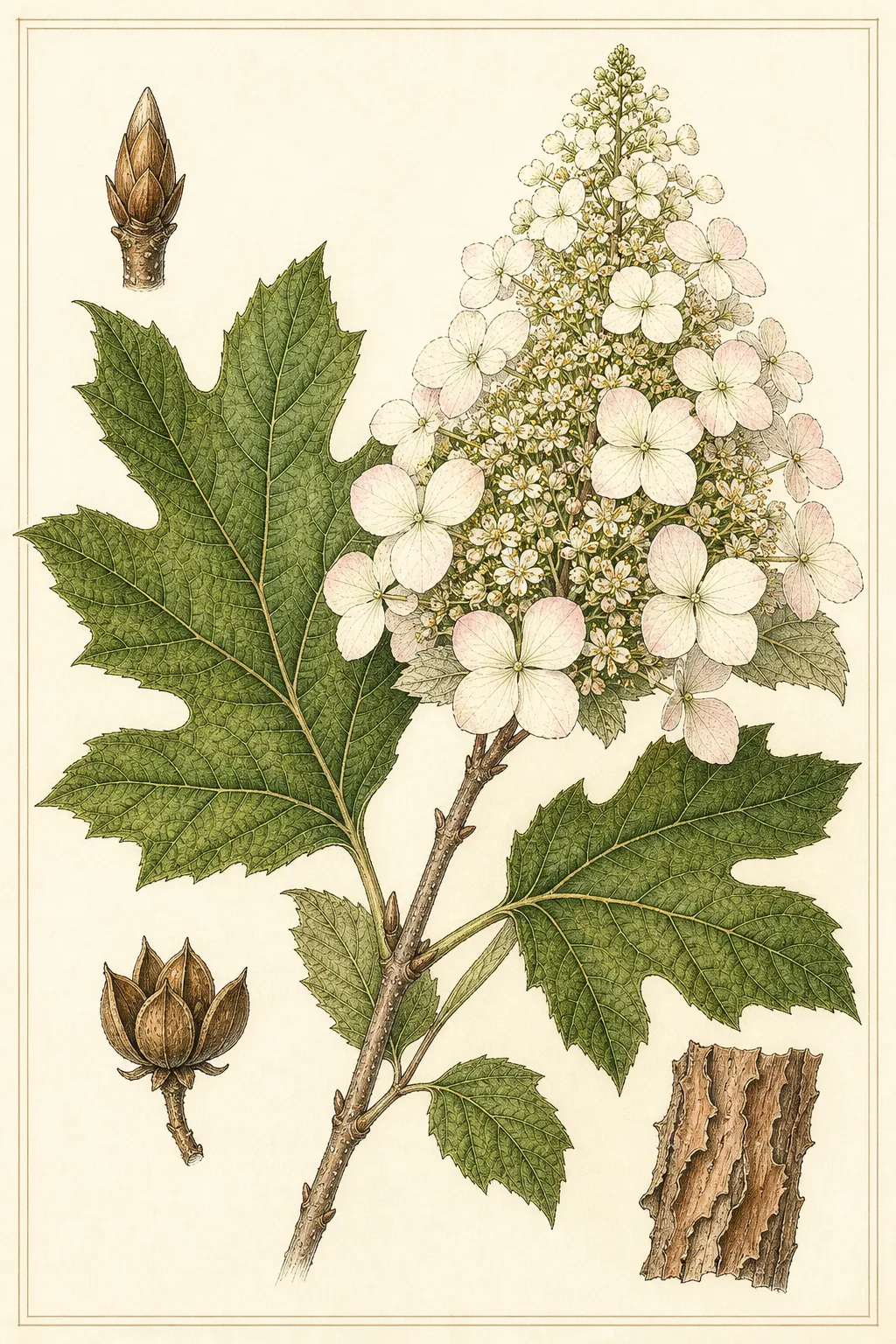
Oakleaf hydrangea is a coarse-textured, many-stemmed shrub whose strongest identification characters remain useful beyond bloom. Its large simple leaves carry three to seven oaklike lobes and serrated margins. Upright pyramidal flower panicles begin creamy white, often age through pink and tan, and may persist dry on the framework. Autumn foliage can turn red, burgundy or purple; older stems peel in cinnamon-brown strips that remain visible after leaf fall.
Read the flower head closely instead of treating it as one oversized flower. Larger showy sterile florets sit among many smaller fertile flowers, producing a looser, more visibly botanical panicle than a solid mophead. Scaled brown terminal buds and stout, lightly branched shoots support identification in the dormant season. A single lobed leaf is suggestive, while the leaf, panicle, bud, bark and broad suckering habit together make a reliable field picture.
The species is an upright to rounded shrub that can spread wider than an ordinary foundation bed. Branches may root or shoots may arise around the base, slowly enlarging the colony. Reserve the mature volume before planting: the natural outline is most useful as a woodland-edge specimen, a broad informal screen or a repeated mass where arching outer stems do not need annual clearance cuts.
Useful light is tied to water and heat. Full sun can support flowering where the root zone stays cool and evenly moist, while part shade buffers harsh afternoon exposure in warm regions. Very deep shade can reduce bloom. A position with bright filtered light or morning sun, open air around the crown and relief from reflected heat is a durable starting point for many home landscapes.
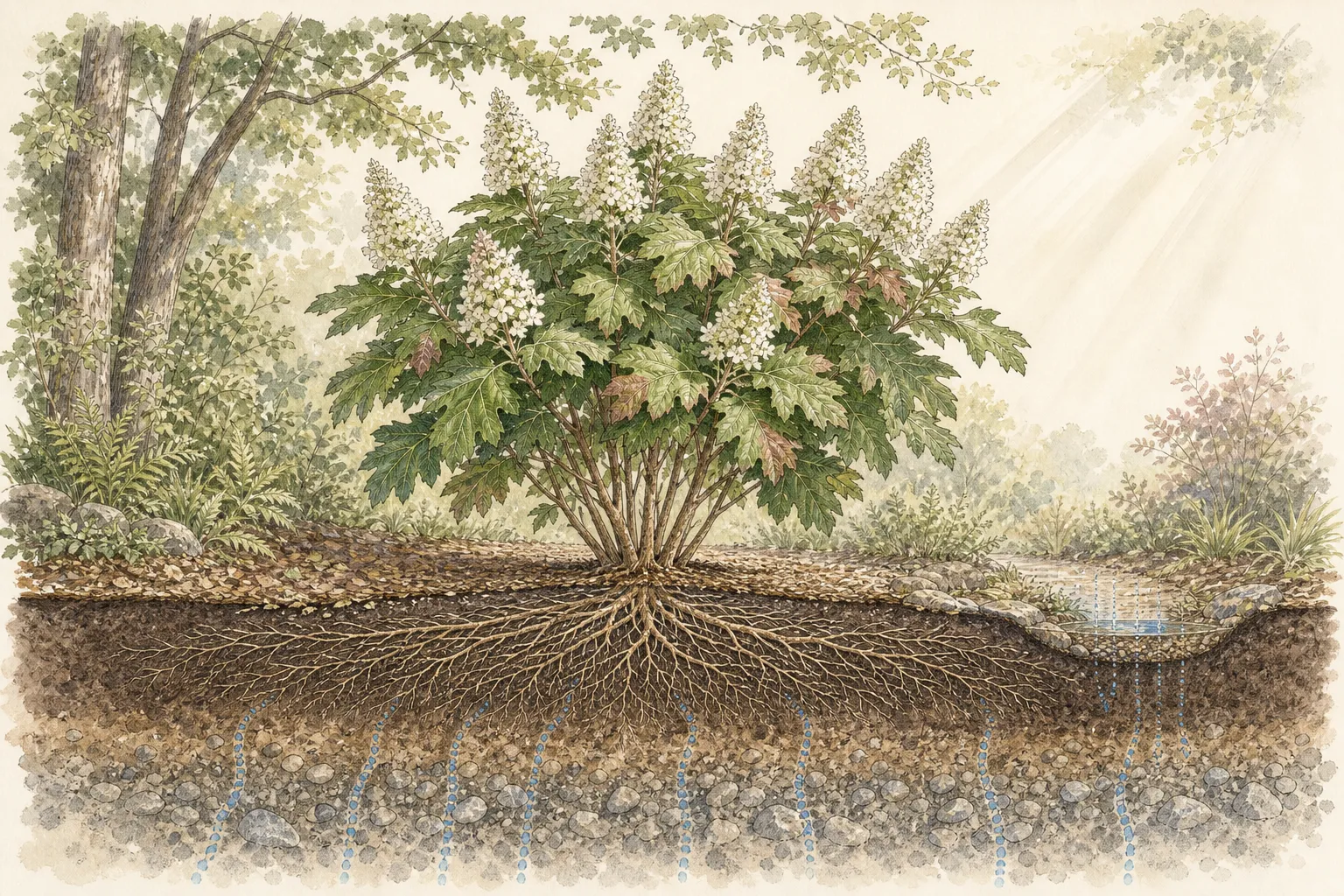
Moisture must arrive with oxygen. Oakleaf hydrangea favors organic soil that holds useful moisture but drains after rain. A shaded basin that remains saturated is not equivalent to a moist woodland slope. Observe runoff and ponding before planting, then test pH before making any correction. Mulch can moderate surface drying when it lies over the root zone and tapers away from every stem.
Flower buds are carried on older stems formed in the previous growing season. Winter injury, browsing and late pruning can remove the display months before the gardener notices. Cultivars vary in mature size, flower form and cold performance, but the species-level old-wood rule remains the safe baseline: preserve living framework and place any size work directly after flowering.
Design with the full seasonal sequence. Spring growth and pale panicles lead to aging blush flowers, coarse summer foliage, saturated autumn color and textured winter bark. Fine ferns, sedges and lower woodland perennials can contrast with the large leaves, provided their crowns do not crowd the shrub base or make moisture checks impossible. Leave one clear access pocket for inspecting the crown and tracing old stems before pruning.
- Family
- Hydrangeaceae
- Range
- Southeastern United States
- Soil pH
- 4.5–6.5
- Spread
- 4–10 ft · 1.2–3 m
Planting & careHow to grow oakleaf hydrangea
Kew accepts Hydrangea quercifolia as a southeastern U.S. species; Extension sources place its broad garden range in USDA Zones 5–9. Zone 5 is a marginal flowering climate because harsh winters can kill old-wood flower buds or top growth even when roots survive. The 4.5–6.5 soil-pH field follows UF/IFAS Putnam County's oakleaf-hydrangea target and is a testing range, not a reason to amend without a soil result. Species plants commonly occupy a broad footprint, while named cultivars can be smaller, larger, more double-flowered or differently hardy. Retain the full label and give cultivar-specific dimensions priority.
- 1Confirm the species and cultivar
Keep the full Hydrangea quercifolia label and any cultivar name. Compare the documented mature height, spread, flower form and hardiness with the species envelope before assigning the permanent space.
- 2Map the finished shrub
Mark the expected crown width on the ground and keep it clear of paths, windows, vents and narrow passageways. Include room for suckering growth or choose a documented compact cultivar where the bed cannot expand.
- 3Observe light and drainage together
Choose full sun to part shade according to regional heat and root-zone moisture. Recheck the site after substantial rain and reject any pocket that remains saturated around the intended crown.
- 4Test before changing pH
Sample the actual planting zone and use a laboratory or Extension result before applying lime, sulfur or fertilizer. The displayed pH range is a planning target, not a substitute for a soil recommendation.
- 5Prepare a broad, firm planting area
Open a hole at least twice the root ball's width and no deeper than the measured root ball. Preserve firm soil beneath it, loosen correctable circling roots and keep amendments compatible with the surrounding soil.
- 6Set the crown at finished grade
Locate the upper structural roots, place them at grade or slightly above where settling is expected, and backfill with the excavated soil. Keep all stems and the crown visible rather than burying them in soil or mulch.
- 7Water the ball and surrounding soil
Water slowly after planting, then check moisture inside the original root ball and in adjacent soil through establishment. Apply a modest organic mulch over the broader root zone and taper it completely away from the stems.
Pruning oakleaf hydrangea
Oakleaf hydrangea normally needs selective correction, not routine shearing. Because it flowers on old wood, make optional size and shape cuts immediately after the panicles finish, tracing an overextended stem to a sound lateral branch or removing it at the base. Leave enough season for retained shoots and new growth to mature before winter. In early spring, wait for swelling buds or leaf emergence to distinguish live wood, then remove only confirmed winter-killed stems. Deadheading means taking the spent panicle and its short stalk without shortening the whole branch. A dormant-season reduction can remove the next flower display even when it leaves a neat green shrub later. Where the plant repeatedly blocks a path or window, move it while manageable or replace it with a cultivar whose documented spread fits the site.
Seasonal care
Spring
Inspect terminal buds, bark and crown as growth begins. Allow live buds to distinguish sound old wood from winter-killed tips before cutting. Restore a thin crown-clear mulch layer, begin moisture checks and note whether late frost or browsing has reduced the flower-bearing framework.
Summer
Maintain even moisture through heat without leaving the root zone saturated. Watch the panicles progress from white toward pink and tan. If a real size correction is needed, make selective cuts promptly after flowering, then leave the developing framework intact for the next bud cycle.
Autumn
Let foliage color and dry flower heads carry the display. Continue watering through prolonged dry weather while the shrub is in leaf, keep fallen material from sealing the crown and skip hard pruning after the next season's flower buds have formed.
Winter
Use the leafless season to inspect exfoliating bark, stem spacing and damage without reshaping healthy wood. In Zone 5 or exposed sites, protect the root zone and bud-bearing stems from severe wind and browsing; keep wet mulch and roof runoff away from the crown.
Safety and garden spread
Common problems
Few or no flowers
- Look for
- Healthy foliage with missing terminal buds, evidence of autumn or winter pruning, browsed stem tips, winter-killed upper wood or a position in very deep shade.
- Action
- Preserve living older stems through a full bud cycle, move any optional pruning to just after bloom and compare light with a successful regional planting before changing fertilizer.
Leaf-edge scorch or persistent wilt
- Look for
- Crisp margins or limp leaves concentrated on the hot, exposed side, paired with a dry root ball, reflected heat, wind or an uneven irrigation pattern.
- Action
- Check moisture inside and beyond the original root ball, correct water distribution and reduce exceptional heat load where practical. Investigate roots and drainage when wilt continues in moist soil.
Wet-soil root decline
- Look for
- Dull or yellowing foliage, weak extension growth and dieback while water lingers around a buried crown or poorly draining root zone.
- Action
- Stop automatic watering, expose the crown if safely possible and assess drainage and root condition. Correct the site or seek local diagnosis before applying fertilizer or replacing the shrub in the same pocket.
Powdery mildew or leaf blight
- Look for
- White powdery surface growth or expanding bounded leaf lesions rather than the continuous crisp margin associated with heat and drought.
- Action
- Confirm the symptom pattern, open crowded neighboring growth, direct irrigation to the soil and remove heavily affected fallen material. Use a local diagnostic service if damage advances or causes early defoliation.
Winter dieback
- Look for
- Upper stems with dry buds and no spring growth while shoots remain alive lower on the shrub, especially after an exposed winter near the cold edge of the range.
- Action
- Wait for growth to reveal living tissue, then cut confirmed dead wood back to a live lateral or the base. Preserve the remaining old wood and improve wind protection without wrapping or burying the crown.
Shrub exceeds its space
- Look for
- Outer stems repeatedly entering a walk, covering a window or being clipped into a dense shell, with new suckers extending beyond the intended bed.
- Action
- Remove a limited number of misplaced stems after bloom and decide whether the mature species can remain. Relocate or replace it with a smaller documented cultivar when recurring cuts would erase the natural framework.
Sources
- Hydrangea quercifolia (Oak Leaf Hydrangea, Oakleaf Hydrangea). NC State Extension Gardener Plant Toolbox. Source record · Accessed 2026-08-30.
- Hydrangea quercifolia W.Bartram. Royal Botanic Gardens, Kew. Source record · Accessed 2026-08-30.
- Native Plants for Georgia Part I: Trees, Shrubs, and Woody Vines. University of Georgia College of Agricultural and Environmental Sciences. Source record · Accessed 2026-08-30.
- Hydrangea quercifolia Oakleaf Hydrangea. UF/IFAS Extension. Source record · Accessed 2026-08-30.
- Sample Putnam Soil pH Test Results. UF/IFAS Extension Putnam County. Source record · Accessed 2026-08-30.
- Houseplants and Ornamentals Toxic to Animals. Merck Veterinary Manual. Source record · Accessed 2026-08-30.