Bowden Lily
Nerine bowdenii
Identify Bowden lily and grow its autumn pink flowers in a sunny, well-drained border, with bulb depth, seasonal watering and cold-climate limits.
Published Last updated
At a glance
- Light
- Full sun in cool northern gardens; morning sun and afternoon shade where summers are hot
- Water
- Regular moisture while leaves are growing; reduce watering as foliage naturally dies
- Soil
- Moderately fertile, moisture-retentive but freely draining loam; protect from winter saturation
- Hardiness
- Zones 8–10
- Bloom
- Autumn; commonly mid-September to late October in UK gardens, with cultivar and climate variation
- Height
- About 14–20 in; some forms reach 28 in · About 35–50 cm; some forms reach 70 cm
In this guide
Overview
Bowden lily puts pink flowers on tall, slender stems when a cool-climate border is beginning to fade. Choose Nerine bowdenii for a sheltered, sunny position where the soil drains freely but supplies water during leafy growth. In UK gardens its usual flowering window runs from mid-September into late October. An established clump can make a strong autumn accent, although a newly planted bulb may need time to settle before it flowers. Buying a labelled plant in bloom lets you see the actual color and habit you are choosing.
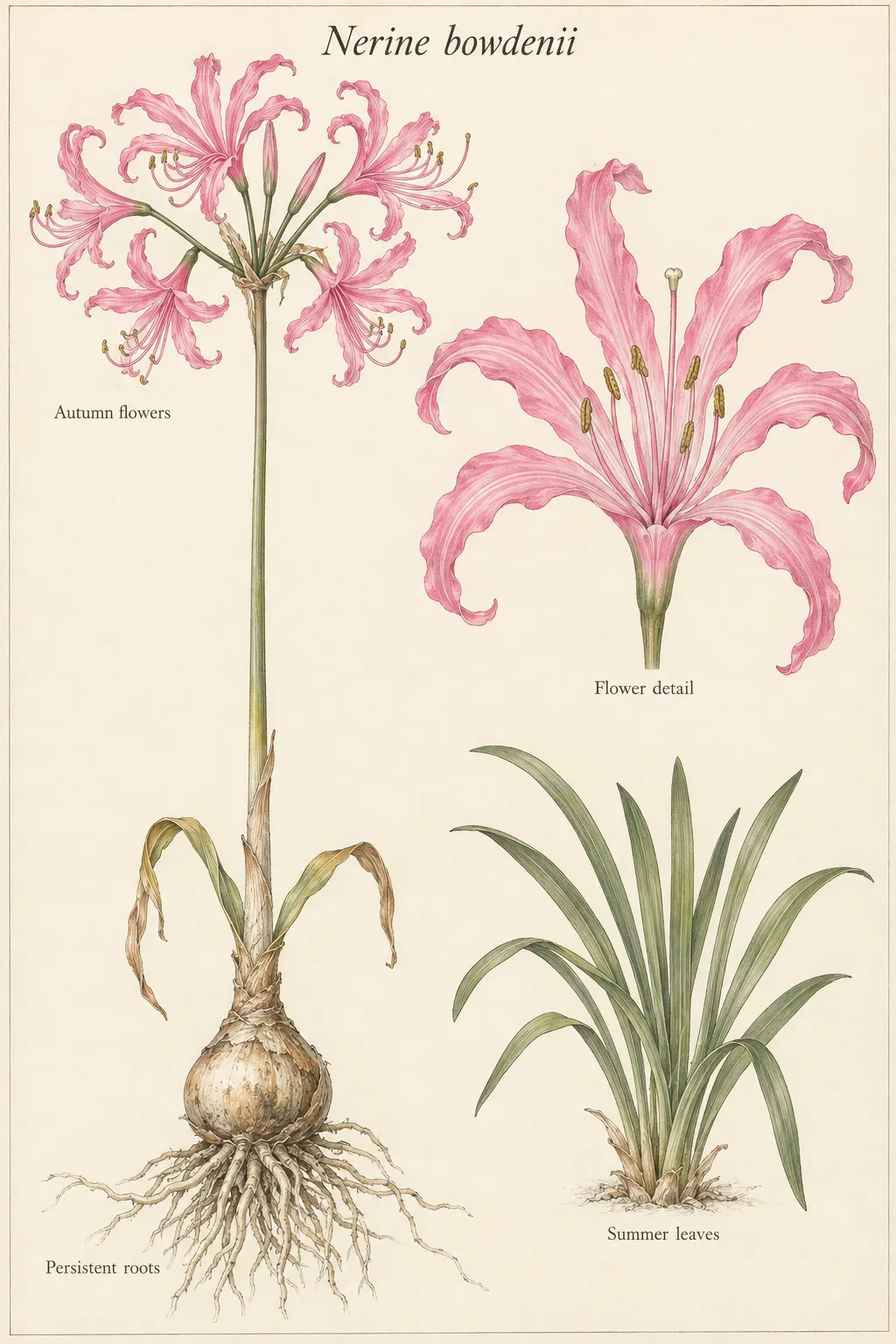
Look for an open rounded flowerhead held at the end of an otherwise bare stem. Each pink flower has six narrow, wavy segments that curl back, with conspicuous curved stamens extending out from the center. The strap-shaped leaves grow from a rounded bulb with a long neck; they may be fading by flowering time. A flowering stem commonly stands around 35–50 cm tall, with taller forms reaching about 70 cm. The loose, spidery flowers are useful identification clues, but the botanical label remains essential when buying dormant bulbs.
Common names can blur quite different plants. Bowden lily and large pink nerine refer to this species, while Guernsey lily is also used for Nerine sarniensis, a more tender species with different seasonal care. Kew accepts Nerine bowdenii in the amaryllis family. It is neither a true Lilium nor an autumn crocus. A packet that says only 'nerine' leaves an important question unanswered: is the plant the hardy garden species, a tender species, or a hybrid with its own requirements? Keep the nursery label with the clump.
A small group near the front of a sunny wall border gives the flowers room to show. Leave a distinct pocket for the bulbs instead of weaving them through vigorous perennials that will shade their leaves. Their narrow individual footprint makes repetition possible along an edge, but offsets gradually enlarge the group. The planting distance is a starting arrangement, not a permanent clump diameter. Choose a position you can leave alone for several seasons; moving the display around each year works against the persistent fleshy roots.
Sun and drought are different conditions. A wall can provide warmth and shelter while also intercepting rain, leaving the root zone too dry. The RHS growing guide specifically challenges the idea that these bulbs need to bake through summer: leafy plants need moisture. Check soil at root depth during dry spells, particularly under eaves. A gravel surface may keep the planting neat, but it neither proves that the soil below drains nor supplies the water needed for growth. A saturated bed and a parched wall pocket require different corrections.
Climate also changes the seasonal picture. SANBI describes this South African species as summer-growing and winter-dormant, with flowering near the end of growth; its South African calendar dates cannot be copied into a northern garden. Generic nerine advice often describes winter-growing tender species. Follow the leaves of your labelled plant: support active green growth, let yellowing foliage finish naturally, and reduce watering during rest. In very hot gardens, morning sun with afternoon shade can be more suitable than a heat-reflecting wall.
Use autumn flowering as a selection goal, not a guarantee of flowers immediately after planting. Roots disturbed during purchase or division, an immature bulb, shade and inadequate growing-season water can all complicate the result. SANBI also records uneven flowering even under good conditions and differences among clones. A locally proven, named selection is useful when reliable seasonal display matters. Record its first flowering date and leaf cycle so next year's care follows the plant you actually have.
- Family
- Amaryllidaceae
- Range
- South Africa, especially the Eastern Cape and KwaZulu-Natal; Kew also records Free State
- Soil pH
- 6–7
- Spread
- About 3–6 in per bulb; clumps expand by offsets · About 8–15 cm per bulb; clumps expand by offsets
Planting & careHow to grow bowden lily
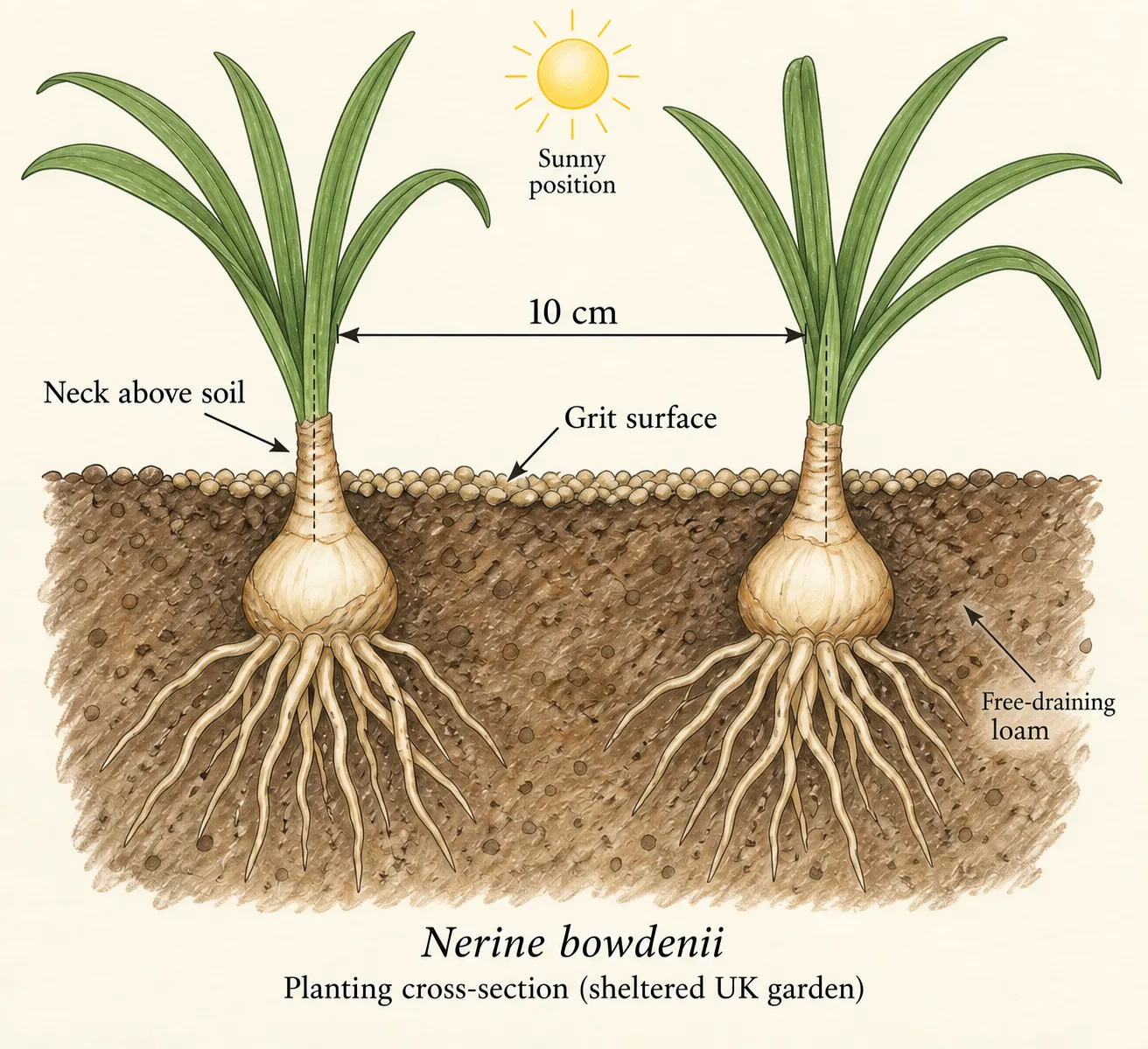
This profile follows the RHS approach for sheltered UK and similar cool northern gardens. The H5 rating applies to UK conditions, not every winter climate. The USDA 8–10 range shown here follows Gardenia; Milner Gardens records zone 7, illustrating the colder margin where local experience matters. Wet winter soil, exposed containers and cultivar differences prevent a zone number from guaranteeing survival. For UK-style planting, the diagram follows the RHS recommendation of 10 cm spacing and a visible bulb neck. SANBI allows the neck up to 3 cm below soil in colder climates with dry winter mulch; use that as a regional alternative, not an instruction to bury every bulb deeply. The pH range of 6–7 is a practical slightly acidic-to-neutral starting target drawn from SANBI's soil preference, not a measured tolerance boundary: RHS also lists alkaline soil as suitable.
- 1Confirm the species and stock
Select firm bulbs or healthy container plants labelled Nerine bowdenii. A named selection with local flowering history gives more useful information than a generic mixed nerine packet. Keep existing fleshy roots intact; this bulb is poorly suited to repeated lifting and drying.
- 2Choose a lasting sunny pocket
Find shelter with open light in a cool garden and inspect the ground after rain. Water should leave the root zone without leaving it chronically dry. If a wall excludes rainfall, include that pocket in growing-season watering checks. Reserve enough clear space that neighboring foliage will not cover the bulbs.
- 3Plant according to the stock available
The RHS detailed guide advises planting promptly after purchase and allows potted Bowden lilies to be planted while leafy or flowering. Its species profile also gives early spring for planting. These are useful stock-dependent opportunities: plant purchased bulbs promptly, preserve the root ball of a flowering pot, and avoid unnecessary disturbance of established clumps in autumn.
- 4Set the neck and spacing
In a sheltered UK-style border, space bulbs about 10 cm (4 in) apart and set the neck just above the soil surface. Cover the rounded bulb body and arrange the roots into the soil without cutting them short. A shallow grit dressing can sit between the necks. Use the colder-climate depth exception only with appropriate regional advice.
- 5Use a draining container mix
For a pot, the RHS suggests equal parts peat-free John Innes No. 3, peat-free multipurpose compost and gritty sand. A 10 cm (4 in) pot can hold one bulb; several bulbs can sit close together without touching in a suitable larger container. Keep the neck exposed and drainage holes clear. Plan where the pot will spend winter before filling it.
- 6Water the growing leaves
For established outdoor plants in UK conditions, the RHS suggests watering during dry spells through the active April-to-July period, with weekly watering as a starting check for rain-sheltered beds. Adjust for rainfall and soil moisture. As leaves naturally die, reduce watering; keep dormant bulbs out of saturated ground. A green plant in an unusually long season still needs assessment beyond the calendar.
- 7Let the colony settle
Leave established groups in place while they flower satisfactorily. Divide only when crowding and declining performance justify it. For hardy nerines in UK gardens, the RHS detailed guide recommends early summer; SANBI recommends early spring in its species account. Follow a locally proven timing for your climate and stock, preserve fleshy roots and replant immediately. There is no reason to split a healthy young clump just because autumn flowers have finished.
Pruning bowden lily
Remove the spent flower stalk when bloom is over if you do not want seed. Leave green strap leaves attached until they yellow and die naturally; there is no shrub-like pruning operation. Tidying the leaves early removes useful growing tissue. Seed propagation is possible, but offsets are the straightforward way to retain a selected plant's identity. If raising seed, SANBI advises sowing it fresh because the fleshy seeds do not have a dry dormant storage phase. Keep routine autumn cleanup separate from lifting or dividing the bulbs.
Seasonal care
Spring
Check the labelled clump for new leaves and resume moisture checks as growth begins. Spring is a useful planting season for newly supplied bulbs. Mark older groups with declining flowering for assessment; UK growers following the RHS detailed guide can defer necessary division until early summer. Keep track of the neck level as soil settles.
Summer
Watch green leaves and the soil beneath them, especially beside a wall that shelters the bed from rain. Supply moisture through active growth and allow natural yellowing to signal reduced watering. In a hot climate, assess afternoon shade if the position becomes excessively hot or dry. Resist repeatedly moving bulbs in search of an instant flowering response. If division is needed in the UK, the RHS places that work in early summer; handle roots carefully and replant at once.
Autumn
Observe the pink flowerheads, record the selection and timing, and remove spent stalks if seed is unwanted. A flowering nursery pot can help you judge color before purchase. Keep late green leaves and intact roots. Check whether the site remains freely draining as autumn rainfall increases.
Winter
Protect marginal outdoor plantings with dry mulch as locally appropriate, following the RHS cold-area guidance, and prevent prolonged saturation around resting bulbs. A container exposes roots to different conditions than an in-ground clump; arrange sheltered winter storage suited to the cultivar and local lows. Recheck the label before applying advice for tender N. sarniensis.
Safety and garden spread
Common problems
Leaves but no flowers
- Look for
- A living bulb produces strap leaves but no autumn flower stalk, particularly after planting or division.
- Action
- Review how recently roots were disturbed, whether leaves had sufficient light and water, and whether the bulb has reached flowering size. Correct the limiting condition and give the plant time. Repeated division or an automatic dose of fertilizer does not establish the cause; clone and climate can also affect flowering.
A wall pocket that dries too far
- Look for
- Soil beside a wall is dry while the nearby open border is moist, and green leaves lose vigor during dry weather.
- Action
- Check below the grit and account for intercepted rain. Water the occupied root zone while the plant is actively growing, then reassess drainage and moisture. The sunny-site recommendation does not call for deliberate drought throughout the leafy season.
Winter wet around resting bulbs
- Look for
- The planting stays saturated after rain, or a container stands in collected water.
- Action
- Clear blocked pot drainage and redirect standing water away from the planting. If the bed cannot provide winter drainage, choose a more suitable site or container for future planting. A soft failing bulb needs inspection; wet ground alone does not identify a particular pathogen.
Slugs and snails on leaves
- Look for
- Fresh holes or chewed leaf margins, with slugs or snails found around the plant.
- Action
- Inspect at dusk and remove the animals you find. Keep the immediate inspection area accessible. RHS and SANBI both record these pests; distinguish actual feeding from natural leaf yellowing before intervening.
Mealybugs in container plants
- Look for
- White waxy clusters around sheltered parts of bulbs or leaves, especially under glass.
- Action
- Separate affected pots from clean plants, inspect adjacent containers and seek a locally appropriate control after confirming the pest. Improve ventilation where possible. SANBI identifies enclosed container conditions as a particular risk; a pesticide recommendation from another country should not be transferred automatically.
Sources
- How to grow nerines. Royal Horticultural Society. Source record · Accessed 2026-09-14.
- Nerine bowdenii | Bowden lily. Royal Horticultural Society. Source record · Accessed 2026-09-14.
- Nerine bowdenii. South African National Biodiversity Institute, PlantZAfrica. Source record · Accessed 2026-09-14.
- Nerine bowdenii W.Watson. Royal Botanic Gardens, Kew. Source record · Accessed 2026-09-14.
- Nerine bowdenii (Guernsey Lily). Gardenia. Source record · Accessed 2026-09-14.
- Plant Pick: Cornish Lily. Vancouver Island University, Milner Gardens & Woodland. Source record · Accessed 2026-09-14.