Mountain Laurel
Kalmia latifolia
A species-focused guide to mountain laurel's spring flowers, cool acidic root zone, old-wood pruning, high toxicity and fire-wise placement.
Published Last updated
At a glance
- Light
- Partial shade to filtered sun
- Water
- Moderate; intolerant of waterlogging and severe drought
- Soil
- Cool, acidic, humus-rich, sharply drained soil
- Hardiness
- Zones 4–9
- Bloom
- Late spring to early summer
- Height
- 4–15 ft · 1.2–4.5 m
In this guide
Overview
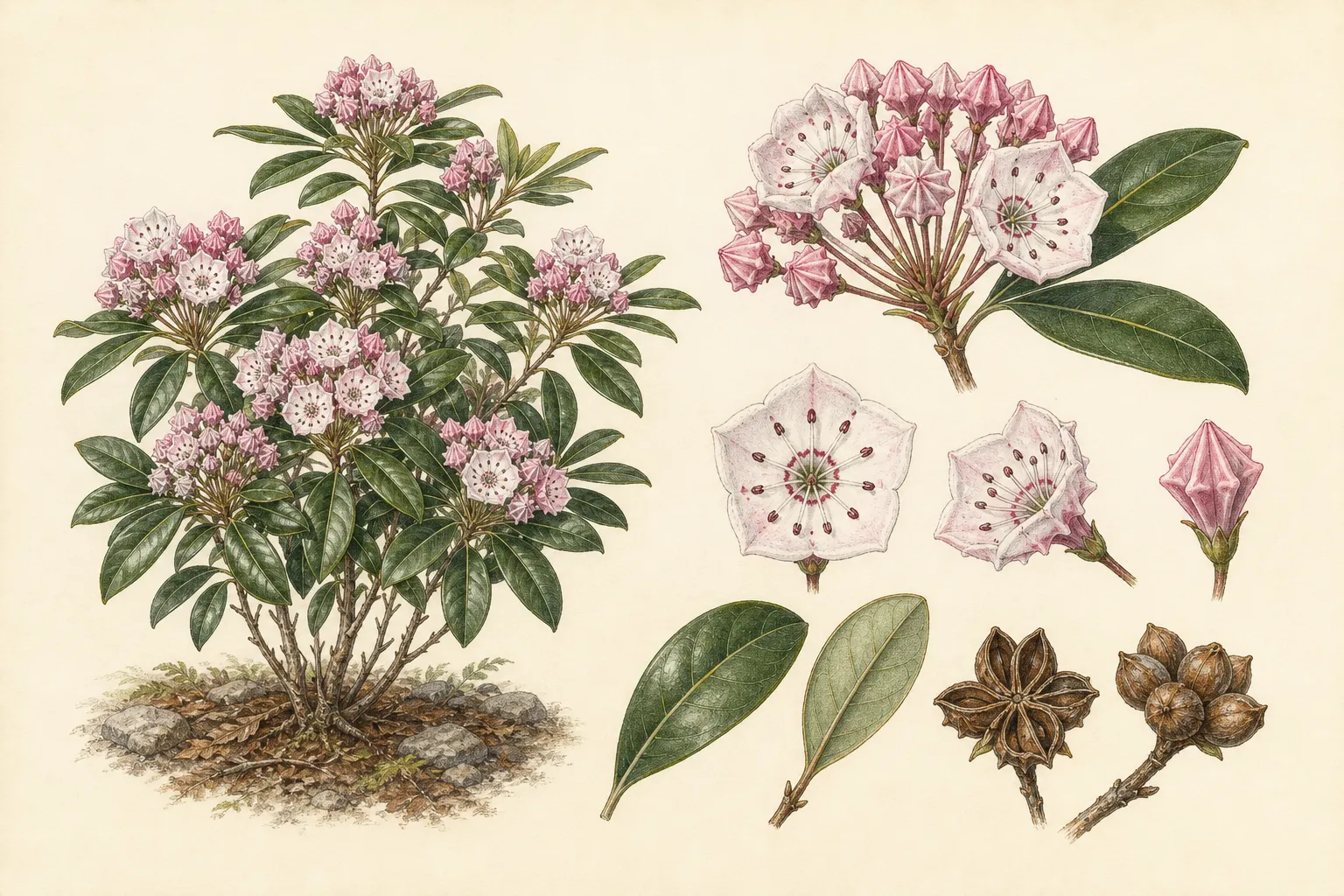
Mountain laurel is a slow-growing broadleaf evergreen shrub or, occasionally, a small tree. Terminal clusters of pink-to-white, cup-shaped flowers open in late spring; ten anthers sit in pockets around each patterned corolla and spring forward when triggered by a pollinator. Leathery elliptic leaves and crooked older limbs remain visible year-round.
A garden specimen commonly matures around 6–10 feet tall, though old plants can become larger and more open. Give the rounded crown woodland-scale room and keep it away from livestock enclosures, edible beds, and children's play areas because every part is highly poisonous.
Partial shade with morning sun and protection from early- to mid-afternoon heat is the most dependable exposure. The species can occur from full sun to full shade, but intense heat and deep shade each create tradeoffs in moisture stress, density, and flowering.
Roots need cool, acidic, humus-rich soil that is moist yet well drained. Heavy clay and wet soil are poor fits. Where drainage cannot be corrected without creating an isolated mound, select a different site; a raised, broad planting may be appropriate only when it integrates with the surrounding grade.
Flowers are produced on old growth. Remove spent clusters and make any light shape correction immediately after bloom, then leave the developing shoots alone. Mountain laurel normally needs little pruning, and repeated shearing hides its naturally contorted framework.
The shrub is both highly poisonous and rated highly flammable by North Carolina Extension. Its nectar does not harm bees, but honey made heavily from mountain laurel can be toxic to people. Use it as an ornamental, not a forage or food plant, and keep it outside the closest defensible space around a fire-prone home.
- Family
- Ericaceae
- Range
- Eastern United States
- Soil pH
- 4.5–6
- Spread
- 4–8 ft · 1.2–2.4 m
Planting & careHow to grow mountain laurel
Mountain laurel is native to eastern North America in acidic forests, rocky or sandy woods, slopes, balds, and woodland margins. Named cultivars differ in flower color, mature size, and heat tolerance. Confirm local provenance and fire-wise placement rather than assuming every cultivar suits every part of USDA Zones 4–9.
- 1Place for mature safety
Reserve at least a 6–10-foot garden footprint, adjusting for the cultivar, and separate the shrub from grazing animals, play areas, edible plantings, and the home's closest fire-defensible zone.
- 2Find cool partial shade
Choose morning sun or dappled light with afternoon protection, then reject heavy clay or any pocket that stays wet after rain.
- 3Keep the root ball shallow
Set the top of the root ball level with the surrounding soil and spread roots into a wide acidic bed; do not bury the stem bases or sink the plant into a water-catching basin.
- 4Balance moisture and air
Water the root ball during establishment and dry periods while allowing excess water to leave the root zone; both severe drought and waterlogging damage this ericaceous shrub.
- 5Cool the roots
Apply an organic mulch over the broad root area to retain moisture and moderate heat, leaving the trunk and lower branches uncovered.
- 6Post a poison boundary
Tell household members that leaves, flowers, and clippings are poisonous, remove pruned material from animal access, and retain the Kalmia latifolia label for emergency identification.
Pruning mountain laurel
Mountain laurel needs only light pruning. Immediately after flowering, remove spent clusters and shorten an occasional wayward or damaged branch to a sound junction if needed; the next blossoms form on old growth. Wear gloves, collect every clipping, and keep the poisonous debris away from children, pets, and livestock.
Seasonal care
Spring
Watch flower clusters expand on old shoot tips, maintain a cool moist root zone, and inspect leaf undersides for lace-bug stippling as weather warms.
Summer
Deadhead and make any light shape correction immediately after bloom, then stop pruning. Check moisture during heat without saturating the roots and remove poisonous clippings from the site.
Autumn
Inspect persistent evergreen foliage and brown capsules, replenish mulch after the soil cools, and water a new planting during dry weather before the ground freezes.
Winter
Leave flower-bearing old growth intact, watch for winter scorch on exposed leaves, and make sure wet winter soil is draining away from the root zone.
Safety and garden spread
Common problems
Lace bug injury
- Look for
- Pale stippling or bronzing on upper leaf surfaces with dark spotting and insects beneath the leaves.
- Action
- Confirm lace bugs on the undersides, reduce avoidable heat and drought stress, and time any control to local Extension guidance while protecting pollinators.
Wet-soil root decline
- Look for
- Wilt, yellowing, branch dieback, or poor growth while heavy clay or the planting basin remains wet.
- Action
- Stop routine irrigation, inspect grade and drainage, and relocate the shrub if the site cannot provide an acidic, aerated root zone.
Leaf spots or blight
- Look for
- Expanding lesions, blighted shoot tips, or premature leaf loss beyond ordinary winter weathering.
- Action
- Obtain a diagnosis, remove confirmed diseased material with gloved hands, and use only a current regional treatment appropriate to the identified pathogen.
Accidental ingestion
- Look for
- Chewed foliage or flowers followed by drooling, digestive upset, weakness, loss of coordination, abnormal heart rate, or collapse in a person or animal.
- Action
- Treat this as an emergency: contact poison control, emergency medical care, or a veterinarian immediately and provide the Kalmia latifolia identification.
Plant details
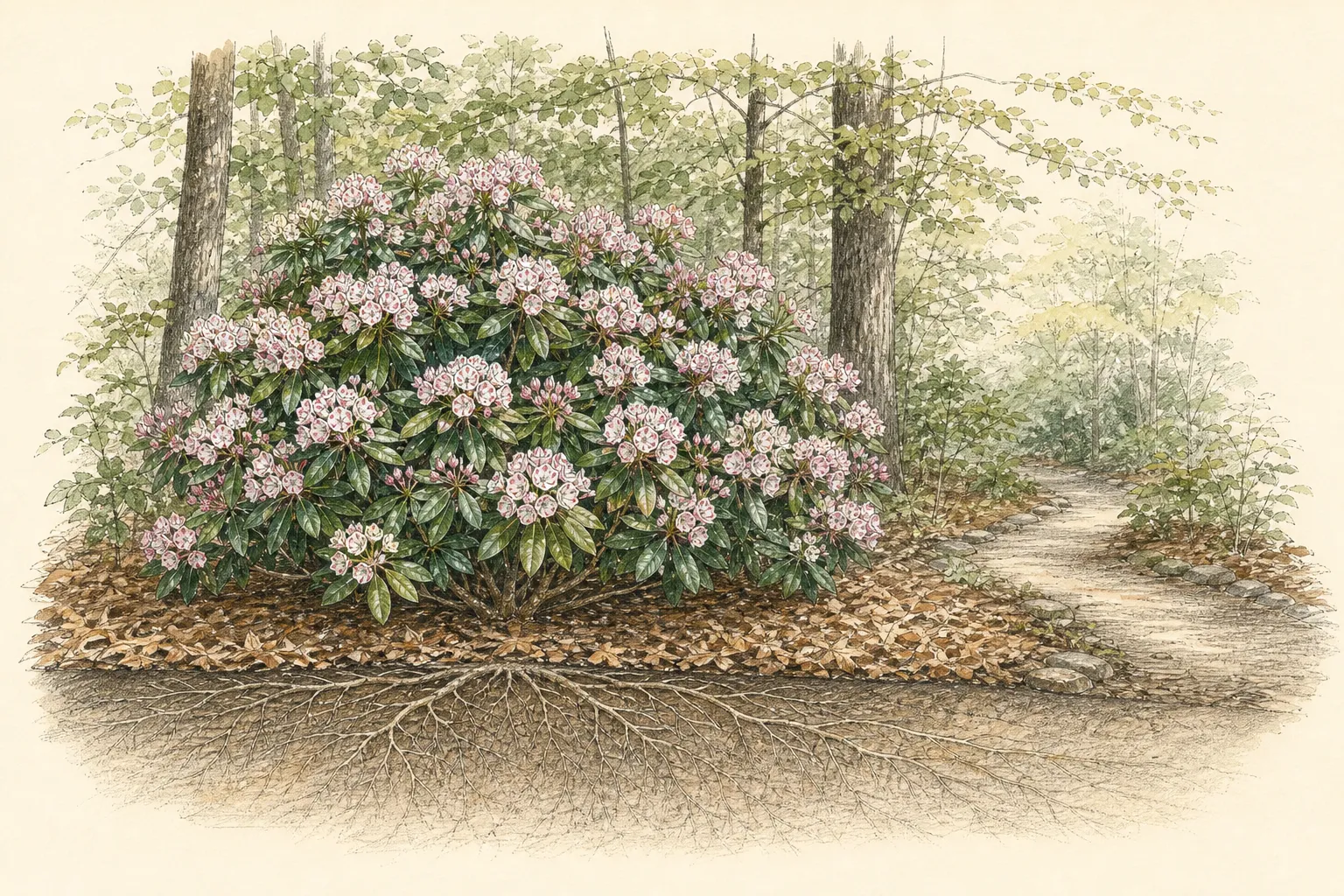
Garden placement study showing mature Mountain Laurel in an ornamental planting
Sources
- Kalmia latifolia. North Carolina Extension Gardener Plant Toolbox. Source record · Accessed 2026-08-20.
- Kalmia latifolia, mountain laurel. US Forest Service Research and Development. Source record · Accessed 2026-08-20.
- Kalmia latifolia L.. Royal Botanic Gardens, Kew. Source record · Accessed 2026-08-20.