Monkshood
Aconitum napellus
A practical species profile of Aconitum napellus, with identification, garden placement, soil and seasonal care guidance.
Published Last updated
At a glance
- Light
- Full sun in cool climates to partial shade
- Water
- Consistent moisture; do not allow prolonged drought
- Soil
- Deep, fertile, moist but well-drained soil
- Hardiness
- Zones 3–7
- Bloom
- Mid- to late summer
- Height
- 3–5 ft · 90–150 cm
In this guide
Overview
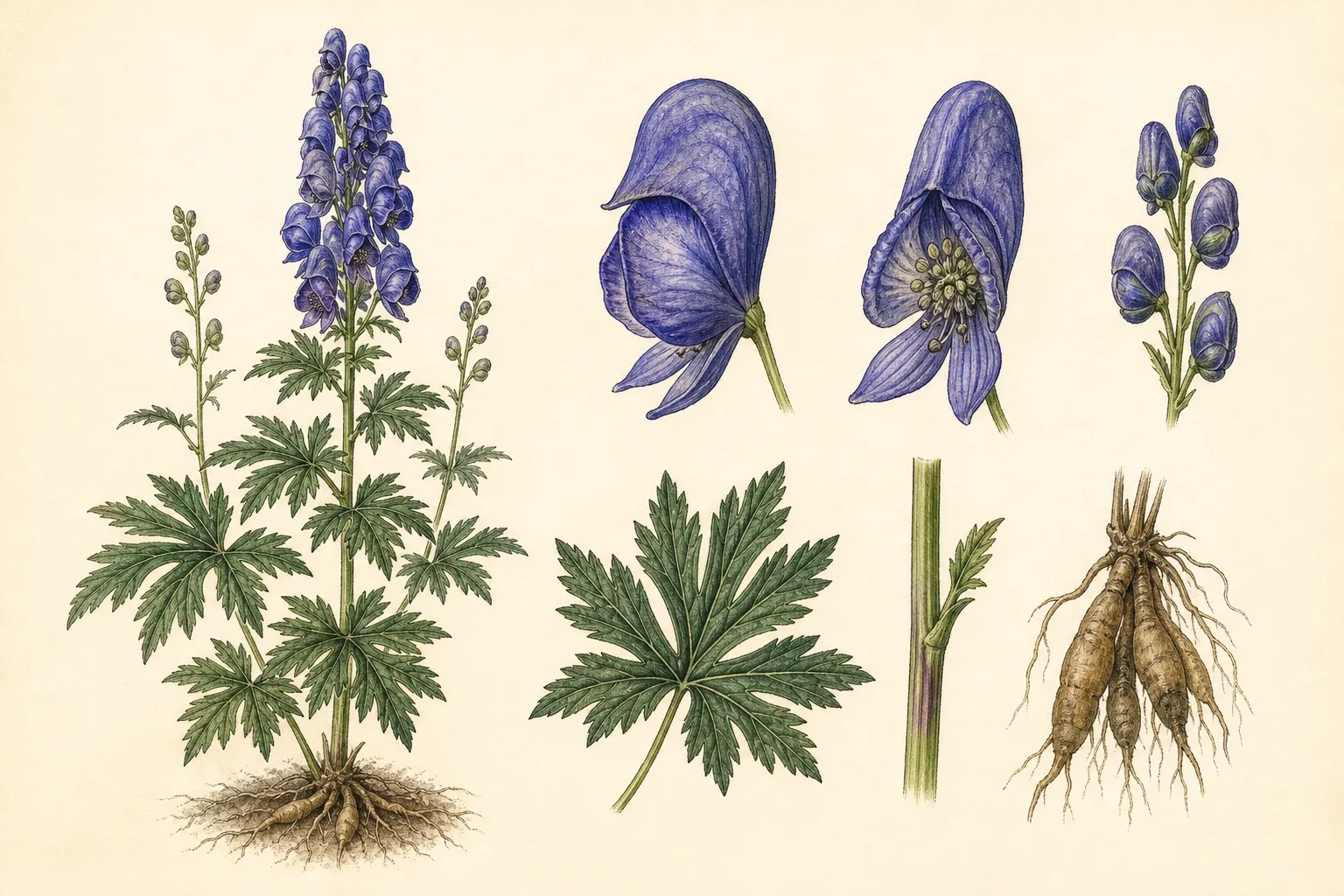
Monkshood is a clump-forming deciduous perennial, not a shrub. Upright stems carry deeply divided, toothed leaves and dense spires of blue-violet hooded flowers in mid- to late summer. The hooded upper sepal is the useful floral identifier behind names such as monkshood and helmet flower; the whole plant dies back to its crown after the growing season.
Aconitum napellus belongs in a cool, moist ornamental border where its 3–5-foot flowering stems can stand without leaning into a path. Partial shade and shelter are especially valuable where summers are warm. Full sun is workable only when the climate is cool and the deep, humus-rich soil remains evenly moist.
Moist does not mean stagnant. The crown needs drainage, and NC State lists crown rot among the plant's problems. Site the herbaceous crown at the container soil level, supply water during dry periods, and keep mulch from covering the stem bases. A low wet pocket is not repaired by feeding or by cutting the stems shorter.
All parts are highly poisonous. The fleshy roots are especially hazardous if confused with an edible crop, so NC State advises against planting monkshood near a vegetable garden. RHS also warns against skin contact. Gloves and protective clothing belong to planting, deadheading, division, cleanup, and disposal—not only to emergency work.
The summer spires are carried on the current herbaceous stems. NC State notes that cutting back after flowering can promote rebloom, while RHS says routine pruning is unnecessary apart from dead stems. Taken together, the practical treatment is limited deadheading or post-bloom shortening when desired, followed by removal of dead stems; there is no woody framework to thin or shape.
Division is possible in autumn or late winter, but RHS cautions that plants may be slow to re-establish. Every division and fragment must remain labeled and controlled as poisonous material. Do not share an unidentified root piece, add it to a food-garden compost stream, or leave it where an animal can reach it.
- Family
- Ranunculaceae
- Range
- Mountainous regions of western and central Europe
- Soil pH
- 5.5–7
- Spread
- 1–2 ft · 30–60 cm
Planting & careHow to grow monkshood
Monkshood performs best in cool-summer climates with deep soil that remains moist while draining. NC State advises afternoon-sun protection in the southern part of its range, and RHS likewise favors a sheltered position. In hot regions, a hardiness-zone number does not offset warm soil or repeated drought; use local performance evidence and do not force the plant with constant irrigation in an unsuitable site.
- 1Make the safety decision first
Choose monkshood only where children, pets, and food-growing activity can be kept separate from the plant and its debris. Keep a permanent Aconitum napellus label, plan protected disposal, and have gloves and other protective equipment ready before opening the container.
- 2Reserve a cool, sheltered position
Allow 3–5 feet for flowering height at the back of a border, out of reach across a path. Use partial shade in warm districts and shelter the tall stems; full sun suits only a cool site whose soil can remain moist.
- 3Check deep soil and drainage
Prepare humus-rich soil that holds steady moisture below the surface yet drains after rain. Reject a compacted wet basin that would keep the crown saturated, and avoid a dry tree-root zone that cannot support the plant through summer.
- 4Set the crown at soil level
With gloves on, place the root mass at the nursery depth so the herbaceous crown is level with the finished surface. Backfill gently, water to settle the roots, and leave the stem bases visible rather than burying them beneath soil or mulch.
- 5Establish consistent moisture
Monitor the soil at root depth and water before prolonged drought develops, especially in summer. Keep the crown aerated and stop if irrigation is leaving the site saturated; cool moisture and drainage must occur together.
- 6Control every plant part
Collect dropped labels, broken stems, divided roots, and trimmings while gloved. Keep debris from pet areas and edible compost, wash tools and hands after work, and leave the permanent poison label in place during winter dormancy.
Pruning monkshood
There is no woody branch framework. Wear gloves and protective clothing for every cut. Healthy herbaceous stems carry the mid- to late-summer display; after flowering, NC State allows cutting back to encourage another flush, while RHS limits required pruning to dead-stem removal. Deadhead or shorten spent stems only for that defined purpose, then cut fully dead stems at the base during dormancy without injuring new crown buds. Bag or otherwise control all poisonous debris according to local disposal guidance and clean tools after use.
Seasonal care
Spring
Work in gloves around emerging crown shoots. Remove any remaining dead stems, keep the permanent poison label visible, and divide only when necessary because replanted pieces may establish slowly. Restore cool, even moisture without covering the crown.
Summer
Maintain moist, draining soil and afternoon protection in warm regions. Support tall stems before flowers open if the site is exposed. Watch for powdery coating, wilt, or basal rot, and keep children and pets away from flowers and fallen plant parts.
Autumn
After flowering, deadhead or shorten stems only if a second flush is desired, always wearing protection. As foliage dies, collect stems and leaves rather than leaving poisonous debris loose. Autumn division is possible, but every root piece must stay labeled and contained.
Winter
The herbaceous top is dormant. Confirm the crown is not sitting in winter water and that the poison marker remains readable. Remove missed dead stems with gloves before spring growth; do not dig near the dormant roots when their identity could be lost.
Safety and garden spread
Common problems
Heat or drought stress
- Look for
- Wilting, scorched foliage, shortened stems, or poor flowering during warm dry periods while the crown remains firm.
- Action
- Check moisture below the surface, restore even watering, and provide afternoon shade in the warm part of the range. If the site cannot stay cool without constant saturation, move the plant while protected or replace it with a heat-adapted perennial.
Crown rot
- Look for
- Soft or discolored tissue at the crown, collapse despite wet soil, and poor return from a buried or persistently saturated base.
- Action
- Stop excess irrigation, expose the crown surface, and obtain a local diagnosis before handling decayed roots. Remove affected material with gloves, contain it safely, and correct drainage before considering a replacement.
Powdery mildew or wilt
- Look for
- White powder on leaves, progressive stem wilt, or one-sided collapse that does not improve when soil moisture is corrected.
- Action
- Photograph symptoms, avoid moving soil or divisions, and ask an Extension or plant-diagnostic service to distinguish powdery mildew, Verticillium wilt, and cultural stress. Follow diagnosis-specific sanitation and treatment while wearing protective equipment.
Poisoning or skin-contact concern
- Look for
- Possible ingestion by a person or pet, sap on unprotected skin, an unlabeled fleshy root near edible crops, or loose trimmings within reach.
- Action
- Stop exposure and contact the appropriate poison center, veterinarian, or emergency service immediately; do not wait for symptoms or induce vomiting unless directed. Preserve the label for identification, avoid bare-hand contact, and secure the remaining plant material.
Plant details
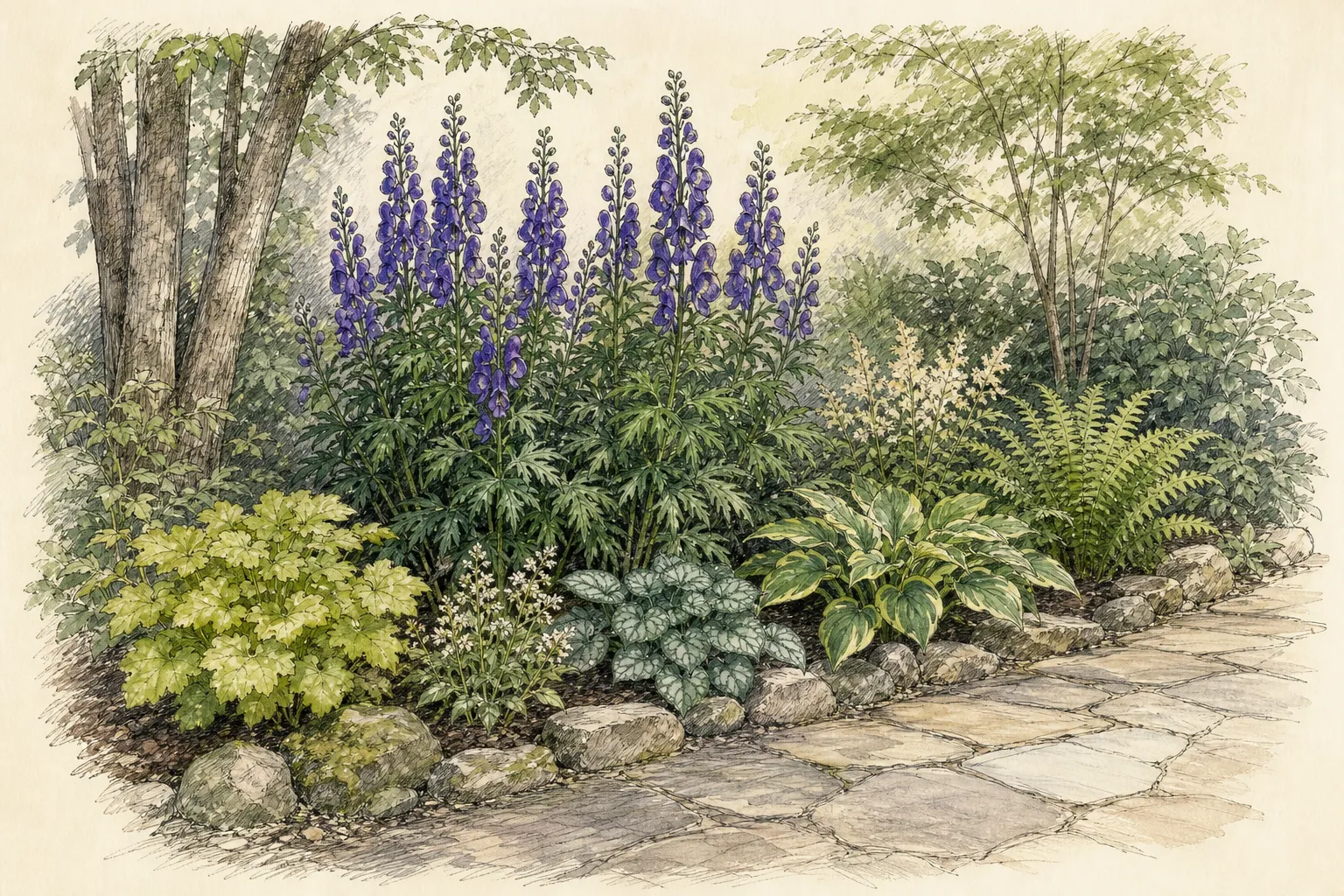
Garden placement study showing mature Monkshood in an ornamental planting
Sources
- Aconitum. North Carolina Extension Gardener Plant Toolbox. Source record · Accessed 2026-09-07.
- Aconitum napellus. Royal Horticultural Society. Source record · Accessed 2026-09-07.
- Aconitum napellus L.. Royal Botanic Gardens, Kew. Source record · Accessed 2026-08-30.