Mondo Grass
Ophiopogon japonicus
A species-focused guide to mondo grass as a stoloniferous evergreen ground cover, with crown-level planting, division and early-spring foliage care.
Published Last updated
At a glance
- Light
- Partial shade to shade
- Water
- Moderate; established plants tolerate short dry periods
- Soil
- Humus-rich, moist but well-drained soil
- Hardiness
- Zones 6–10
- Bloom
- Small flowers in summer
- Height
- 6–12 in · 15–30 cm
In this guide
Overview
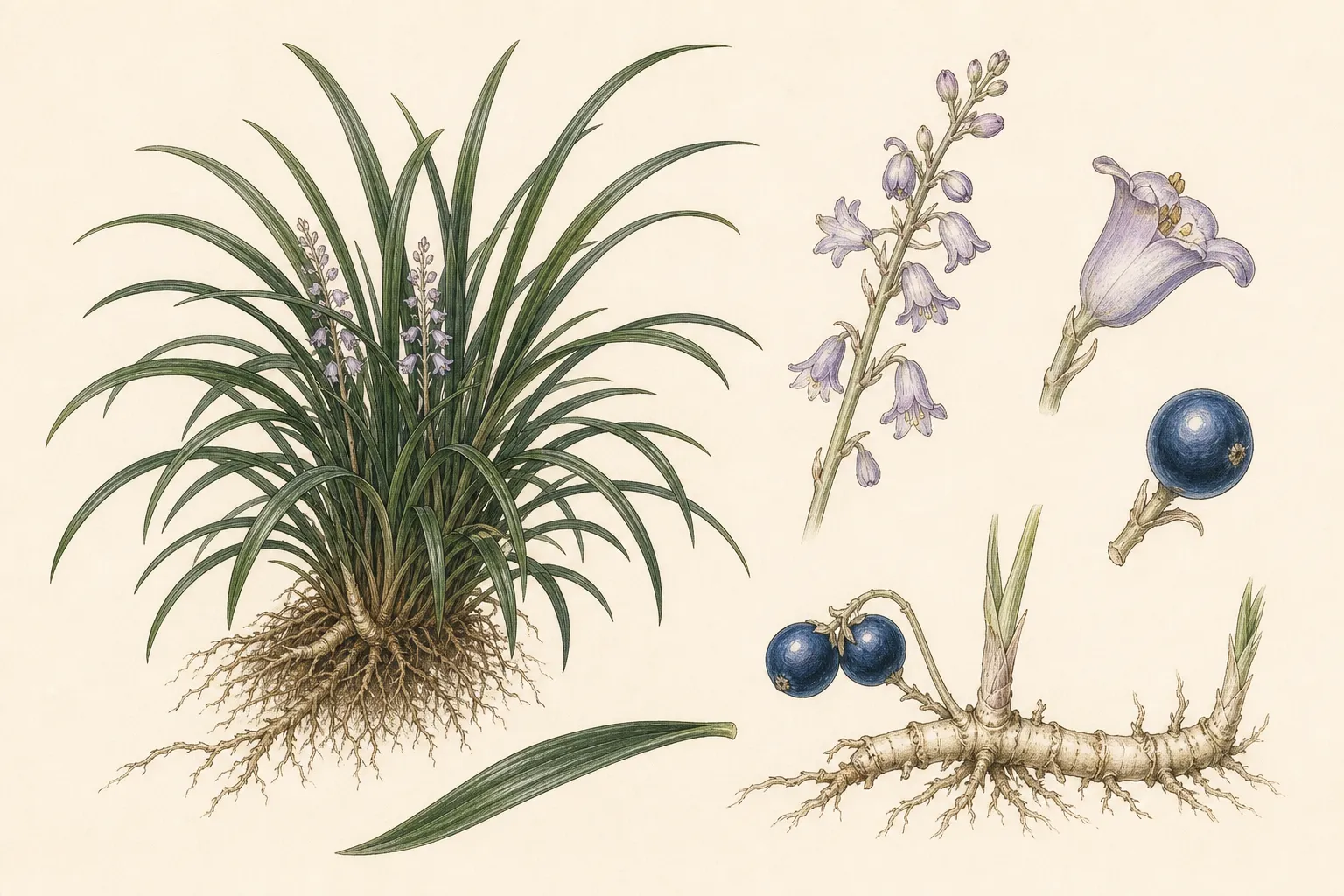
Mondo grass is not a true grass. It is an evergreen herbaceous perennial in the asparagus family, forming 6–12-inch mounds of narrow, arching leaves. Short summer racemes of pale lilac-to-white flowers are often hidden inside the foliage, followed by metallic or cobalt-blue fruit.
Underground stolons end in daughter plants, allowing a clump to become a dense mat. That habit suits shaded edging, spaces between stepping stones, slopes, or a lawn alternative under trees, but the living boundary should be monitored near delicate small perennials.
Filtered sun to full shade gives the classic dark-green foliage. The species can tolerate sun where water is sufficient, but a hot exposed site is not equivalent to the shaded, moist conditions preferred by most plantings.
Ordinary clay, loam, or sandy garden soil can work when it remains moist and drains well. Plant the rooted crowns at the depth they grew in the nursery and keep soil out of the leaf bases. Its planting reference is the crown, and its maintenance concerns leaves and stolons.
Late-winter foliage may look ragged. Shear or mow the old leaves in early spring before new shoots rise through them, keeping the cut high enough to avoid emerging crowns. This is a once-a-year foliage reset, not woody pruning.
Clemson Extension identifies anthracnose as the most common disease and false oleander scale as an important pest. Removing infected leaves or scale-infested old foliage can be useful, but any oil or fungicide decision should follow current local diagnosis and labeling.
- Family
- Asparagaceae
- Range
- China, Japan, Korea, and nearby East Asia
- Soil pH
- 5.5–7.5
- Spread
- 6–12 in · 15–30 cm
Planting & careHow to grow mondo grass
Ophiopogon japonicus is native to China, Korea, and Japan and is cultivated as an evergreen ground cover elsewhere. North Carolina Extension lists USDA Zones 6–10. Do not confuse it with true grasses or with broader-leaved Liriope; local winter appearance and spread vary with climate and selection.
- 1Confirm Ophiopogon
Check for narrow leaves, hidden short racemes, and blue fruit so the plant is not confused with broader-leaved Liriope sold under the same monkey-grass name.
- 2Map a spreading mat
Allow each rooted division roughly 6–12 inches of initial width and define where daughter plants may fill between stones or along an edge.
- 3Choose moist shade
Use filtered sun to full shade in ordinary soil that holds useful moisture but releases excess water; increase sun only where irrigation and climate prevent scorch.
- 4Set rooted crowns level
Place each crown at its nursery depth with roots spread below and leaf bases above the soil surface; firm and water the soil without burying the foliage.
- 5Divide complete sections
When dividing an established clump, keep a substantial root system and several leaves on every section; Clemson recommends eight to ten leaves for an easily established division.
- 6Water until the mat knits
Keep new divisions moist while roots establish, then check soil before irrigating; established plants can tolerate short dry periods but perform best with dependable moisture.
Pruning mondo grass
Mondo grass has leaves, crowns, and stolons rather than a woody framework. In late winter or very early spring, before fresh blades emerge, shear or mow ragged old foliage above the crowns and remove the cut material. Divide or lift daughter plants when the mat crosses its boundary; there are no branches to thin or coppice.
Seasonal care
Spring
Cut ragged old leaves before new growth rises, remove the debris, divide crowded clumps with roots and leaves attached, and reset crowns at their original depth.
Summer
Maintain moist, drained soil as hidden pale flowers appear within the leaves. Inspect expanding brown lesions for anthracnose instead of treating every sun-scorched blade as disease.
Autumn
Watch for blue fruit inside the foliage, lift daughter plants that cross paths or crowd small neighbors, and keep newly divided sections watered during dry weather.
Winter
Assess cold-damaged or scale-infested leaves and schedule the annual foliage cut for just before spring growth, when removed material can be taken out of the bed.
Safety and garden spread
Common problems
Anthracnose
- Look for
- Tan-to-brown lesions enlarge along leaves and join into blighted areas rather than appearing only on exposed tips.
- Action
- Remove infected foliage, reduce prolonged leaf wetness, and confirm the disease locally before considering a labeled fungicide.
False oleander scale
- Look for
- Small fixed white armored scales on leaves with yellowing, reduced vigor, or declining patches in the mat.
- Action
- Confirm the armored scale, remove and discard infested old foliage during the late-winter cut, and time any horticultural oil to current Extension guidance and the product label.
Buried or cut crowns
- Look for
- Weak new leaves emerge from soil-covered bases, or fresh shoots are clipped off after a late spring mowing.
- Action
- Reset divisions at their original depth and schedule the foliage cut before new blades rise; keep soil and mulch out of the leaf bases.
Stolons leave the intended edge
- Look for
- Daughter clumps root between paving joints or inside neighboring low perennials beyond the planned ground-cover mat.
- Action
- Lift the rooted daughter plants with their connecting stolons, replant sound divisions where useful, and restore a clear living boundary.
Plant details
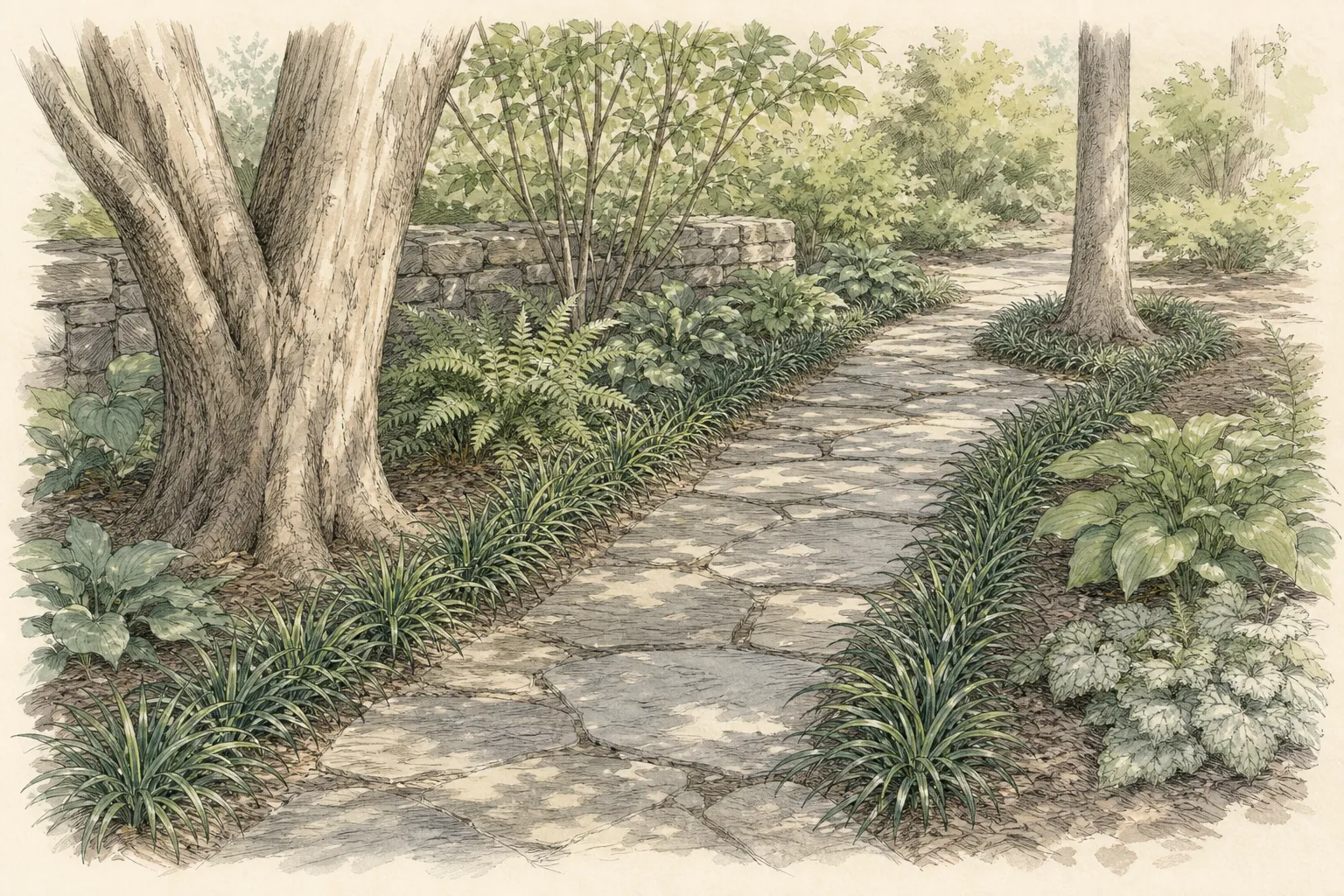
Garden placement study showing mature Mondo Grass in an ornamental planting
Sources
- Mondo Grass. Clemson Cooperative Extension. Source record · Accessed 2026-08-20.
- ENH854/EP107: Low-Maintenance Landscape Plants for South Florida. University of Florida IFAS Extension. Source record · Accessed 2026-08-20.
- Ophiopogon japonicus. North Carolina Extension Gardener Plant Toolbox. Source record · Accessed 2026-08-20.