Lily-of-the-Valley
Convallaria majalis
Identify lily-of-the-valley, plant its rhizomes at the sourced depth, contain its spreading colony, and handle every poisonous part safely.
Published Last updated
At a glance
- Light
- Partial to full shade
- Water
- Evenly moist while in active growth
- Soil
- Humus-rich, moisture-retentive, well-drained soil
- Hardiness
- Zones 3–7
- Bloom
- Mid- to late spring
- Height
- 6–10 in · 15–25 cm
In this guide
Overview
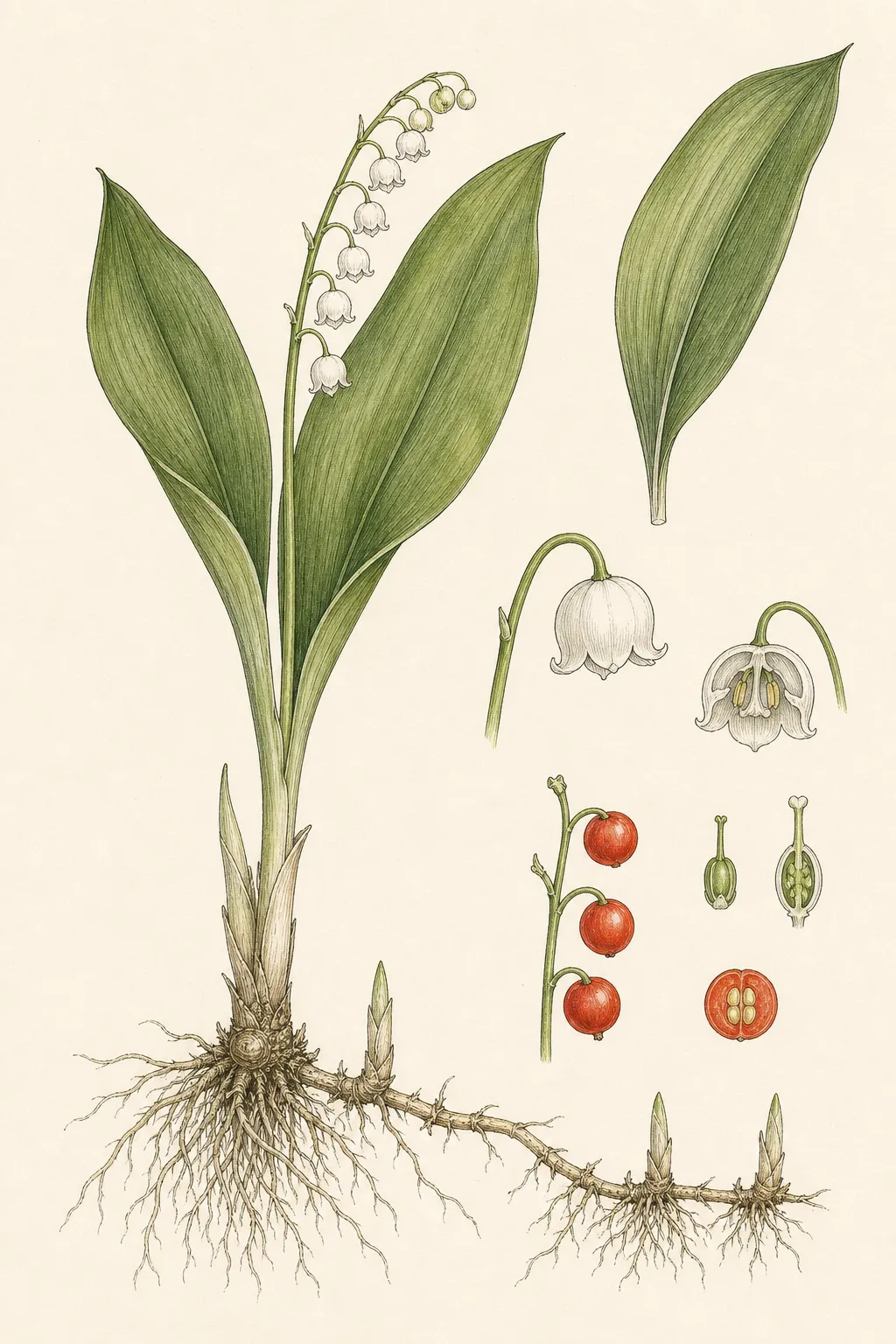
Lily-of-the-valley is a deciduous rhizomatous groundcover, not a bulb lily. Each shoot usually carries two or three broad, parallel-veined leaves around a one-sided raceme of fragrant white bells. Red berries form only sometimes, but both the berries and the less conspicuous underground rhizomes belong to the same poisonous plant.
Individual shoots stand about 6–10 in tall, while underground rhizomes can extend a colony indefinitely beyond its first 1–2 ft patch. Use it only where that spread is acceptable and physically manageable. A contained shade bed or an area bounded by paving is safer than a mixed woodland collection whose roots cannot be separated later.
Dappled, partial, or full shade and fertile humus-rich soil support the best foliage and bloom. Keep the soil moist during spring growth, but established colonies tolerate some summer dryness. Hot, humid climates can cause early foliage decline even when watering is adequate, so regional suitability matters more than forcing the plant with extra irrigation.
NC State specifies planting with the base of the rhizome about 3 in below the surface. Spread the roots, position the growing point upright, and water the soil closed around it. Mark the planted boundary immediately because foliage will die down and the underground colony will otherwise be easy to disturb or overlook.
Rhizomes may grow slowly at first and then form a dense mat in favorable cool, moist conditions. Inspect the outer edge each spring and lift entire unwanted pieces before they weave through neighboring crowns. Leaf removal alone does not control the underground stems, and cut fragments must be handled as poisonous plant material.
All parts contain cardiac glycosides and must not be eaten. Wear gloves for division and cleanup, keep prunings and attractive berries away from children and animals, and seek medical or veterinary advice after suspected ingestion rather than inducing vomiting. Green leaves should remain until they yellow naturally.
- Family
- Asparagaceae
- Range
- Europe to the Caucasus
- Soil pH
- 5–8
- Spread
- 1–2 ft initially; colony expands · 30–60 cm initially; colony expands
Planting & careHow to grow lily-of-the-valley
The species is introduced across much of temperate North America and is reported invasive in Wisconsin and Arkansas. It also performs poorly in hot, humid summers; consult local guidance before planting.
- 1Reserve the mature footprint
Plan for 6–10 in of top growth and an underground colony that will extend beyond its first 1–2 ft patch. Choose a boundary that can be inspected and dug without disturbing valued neighbors.
- 2Choose cool shade
Use dappled to full shade with fertile, humus-rich soil that stays moist during spring. Avoid treating a hot, humid exposure as suitable merely because irrigation is available.
- 3Set the rhizome base about 3 inches deep
Arrange each rooted division with its growing point upright and the base of the rhizome about 3 in below the surface. Spread the roots, refill with site soil, and water thoroughly.
- 4Establish an even spring moisture level
Keep newly planted roots evenly moist through active growth without leaving them in stagnant soil. Established mats can tolerate a dry interval, so check below the surface before adding water in summer.
- 5Mark and monitor the boundary
Place durable markers around the intended colony while the shoots are visible. Top-dress lightly with leaf mould in autumn, then inspect outside the markers for wandering rhizomes each spring.
- 6Plan poisonous-waste handling
Wear gloves when lifting excess rhizomes, gather every cut piece and berry, and dispose of them where children, pets, and livestock cannot reach them. Wash hands and tools after the work.
Pruning lily-of-the-valley
No shaping prune is needed. Leave green foliage after bloom, remove it only after yellowing, and control spread by lifting complete unwanted rhizomes in spring or autumn while wearing gloves.
Seasonal care
Spring
Map the emerging shoots against the marked boundary, lift wandering rhizomes before they enter other crowns, and keep the spring root zone evenly moist.
Summer
Let leaves finish their work after flowering. Water new plantings during dry spells, but recognize that mature foliage may decline early in hot summers even when the rhizomes remain dormant below.
Autumn
Remove yellow foliage and any red berries with gloves, divide if the colony needs reduction, and top-dress the bed lightly with leaf mould without losing the boundary markers.
Winter
The colony is dormant underground. Do not dig or plant into the marked area, and check that stored prunings or lifted rhizomes remain inaccessible to people and animals.
Safety and garden spread
Regional invasive risk
Rhizomes can crowd out neighboring plants. NC State reports invasive behavior in Wisconsin and Arkansas; consult local guidance before planting.
Reported region: Wisconsin and Arkansas, United States
Common problems
Rhizomes beyond the boundary
- Look for
- New paired leaves emerge outside the marked patch or among neighboring woodland plants.
- Action
- Trace each shoot to its rhizome and lift the whole unwanted section while the soil is workable. Recheck the same edge the next spring; cutting leaves does not stop underground spread.
Hot-summer foliage decline
- Look for
- Leaves yellow or collapse early during sustained heat and humidity despite adequate spring growth.
- Action
- Check soil moisture and rule out rot, then allow natural dormancy rather than forcing soft new growth with fertilizer. In marginal climates, replace the colony with a locally suitable groundcover.
Leaf spot or stem rot
- Look for
- Spots expand on leaves, or shoots soften at the soil line in a persistently wet, crowded mat.
- Action
- Remove affected material with gloves, avoid wetting foliage late in the day, and improve air movement. Ask an extension service to identify progressive disease before applying a labeled treatment.
Dense leaves but fewer flowers
- Look for
- An established mat remains leafy in spring but produces fewer racemes than in earlier years.
- Action
- Divide an overcrowded section in spring or autumn and replant selected rhizomes at the correct depth. Do not increase fertilizer without a soil-based reason.
Plant details
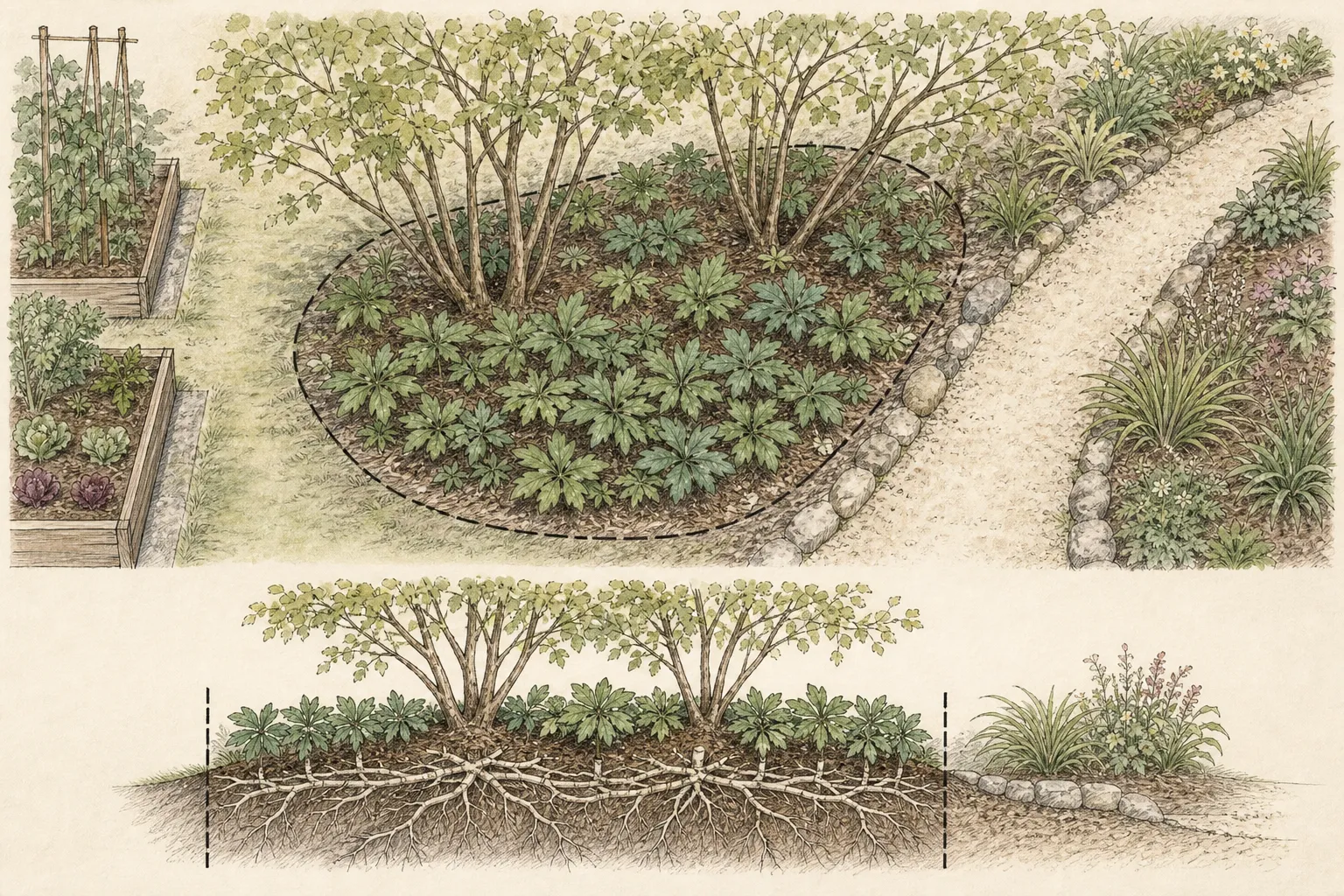
Garden study showing the placement and growth habit of Lily-of-the-Valley
Sources
- Lily-of-the-Valley cultivation profile. NC State Extension. Source record · Accessed 2026-09-07.
- Convallaria majalis plant profile. Royal Horticultural Society. Source record · Accessed 2026-08-30.
- Convallaria majalis taxonomy and native range. Royal Botanic Gardens, Kew. Source record · Accessed 2026-08-30.
- Potentially harmful garden plants. Royal Horticultural Society. Source record · Accessed 2026-08-30.