Japanese Forest Grass
Hakonechloa macra
A slow-spreading deciduous grass from southern Honshu, forming cascading green mounds in cool, moist, well-drained shade.
Published Last updated
At a glance
- Light
- Partial to full shade; gentle morning sun is suitable
- Water
- Consistent moisture, especially during summer heat
- Soil
- Humus-rich, consistently moist, well-drained soil
- Hardiness
- Zones 5–9
- Bloom
- Fine flower panicles in late summer
- Height
- 12–18 in · 30–45 cm
In this guide
Overview
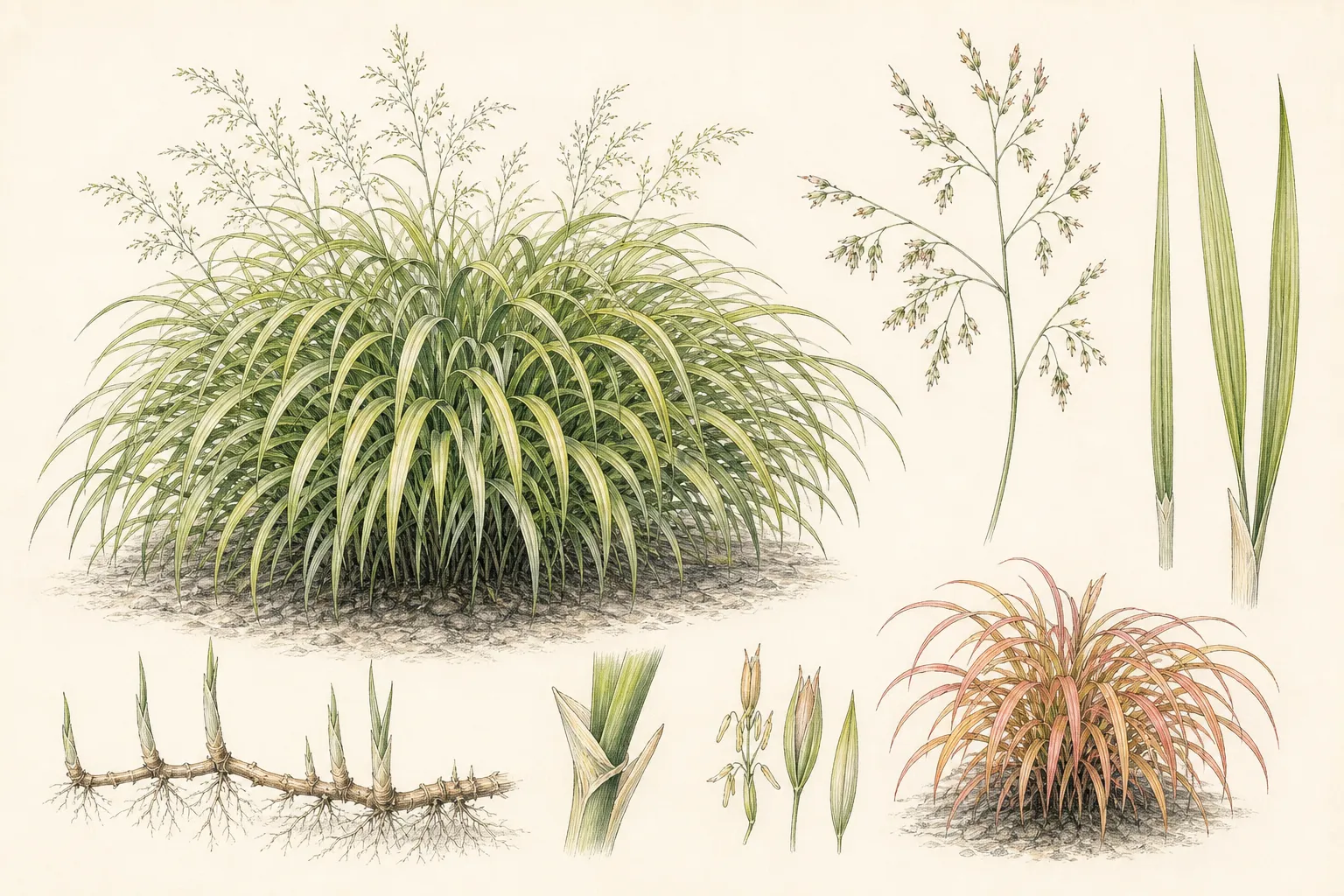
Hakonechloa macra is a deciduous perennial grass from moist woods and rocky slopes in southern Honshu. Narrow, bamboo-like blades arch in one direction to make dense cascading mounds 12–18 inches tall and up to about 24 inches wide.
The species is green, while common cultivars add gold, white striping or red autumn color. Those leaf colors do not change the need for shade: strong sun, especially with inconsistent moisture, scorches the blades and washes out variegation.
Rhizomes and stolons enlarge the mound slowly without the aggressive running habit of many bamboos. Use that measured spread beside shaded steps, over rocks, along a woodland path or at the front of a cool container planting.
Airy yellow-green panicles appear within the foliage in mid to late summer, but the principal display is the moving leaf mound. The foliage dies completely to the ground in winter and is renewed from the perennial crown.
- Family
- Poaceae
- Range
- Southern Honshu, Japan
- Soil pH
- 5.5–7.5
- Spread
- 18–24 in · 45–60 cm
Planting & careHow to grow japanese forest grass
Guidance fits USDA zones 5–9, but the grass performs best with cool summers and may struggle in the hottest parts of zones 8–9. Winter mulch is most useful where freeze-thaw cycles heave the crown.
- 1Choose cool shade
Allow a mound 12–18 inches tall and 18–24 inches wide in partial to full shade, with only gentle morning sun in hot climates.
- 2Prepare moist drainage
Use humus-rich soil that remains consistently moist yet drains; avoid heavy compacted clay, standing water and very dry root zones.
- 3Set the grass crown level
Plant the herbaceous crown at its nursery soil line, spreading the rhizomes outward and leaving the bases of the blades uncovered.
- 4Maintain steady moisture
Water the full root zone before it dries, particularly during summer heat, while confirming that excess water can leave the planting area.
- 5Protect against heaving
Apply a winter mulch around, not on top of, the crown where repeated freezing and thawing can lift the shallow root mass.
Pruning japanese forest grass
Japanese forest grass has no woody framework. Leave the foliage through autumn, then cut the entire dead mound to ground level in late winter or very early spring before new blades emerge; divide the slow-growing rhizomatous crown in spring only when expansion or renewal is needed.
Seasonal care
Spring
Cut old foliage to the ground before new blades emerge, reset any frost-heaved crown at soil level and divide established clumps only when needed.
Summer
Keep the soil consistently moist and shaded during heat, watching pale or crisp leaf margins as an early sign of excessive sun or drying.
Autumn
Let the blades color red, pink or gold according to cultivar and continue watering if the root zone dries before the foliage becomes dormant.
Winter
The foliage dies to the ground; maintain a loose protective mulch around the crown in heaving-prone sites and keep winter water from pooling there.
Safety and garden spread
The retained horticultural sources do not identify a specific garden-contact toxicity hazard; this is not a statement about edibility.
Common problems
Leaf scorch
- Look for
- Bleached, crisp or brown blade margins during hot weather.
- Action
- Restore consistent moisture and move containers or plants away from intense afternoon sun; variegated forms are especially sensitive to exposed heat.
Winter root heaving
- Look for
- The crown lifted above the surrounding soil after repeated freezing and thawing.
- Action
- Gently reset the crown at grade when soil is workable and use a loose winter mulch around it before the next freeze-thaw cycle.
Crown decline in wet soil
- Look for
- A soft crown, sparse spring shoots or loss of the mound in a waterlogged site.
- Action
- Correct drainage and replant healthy divisions in moist but freely drained soil; constant moisture does not mean saturated clay.
Very slow establishment
- Look for
- A living but scarcely enlarged mound after one or two seasons.
- Action
- Check for dry soil, hot exposure or poor drainage before feeding; this species is naturally slow-growing and may take years to need division.
Plant details
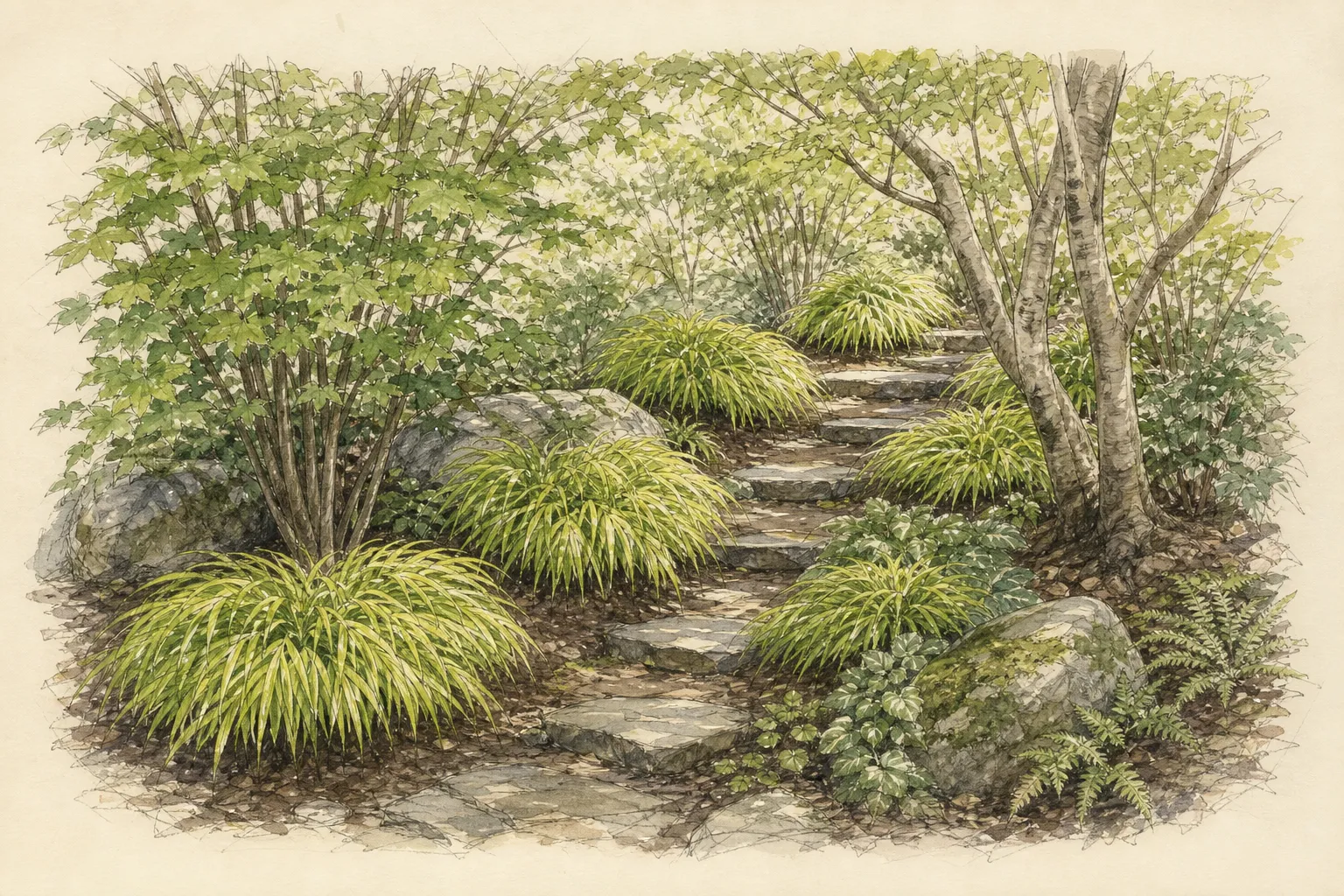
Garden placement study showing mature Japanese Forest Grass in an ornamental planting
Sources
- Japanese Forest Grass cultivation profile. North Carolina Extension Gardener Plant Toolbox. Source record · Accessed 2026-08-20.
- Hakonechloa macra horticultural guidance. Missouri Botanical Garden. Source record · Accessed 2026-08-30.
- Hakonechloa macra taxonomy and distribution. Royal Botanic Gardens, Kew. Source record · Accessed 2026-08-30.