Japanese Aralia
Fatsia japonica
A broadleaf evergreen for sheltered shade, with large hand-shaped leaves, white autumn flower clusters and black winter fruit on mature plants.
Published Last updated
At a glance
- Light
- Partial to full shade; shelter from drying wind and strong afternoon sun
- Water
- Moist, well-drained soil during establishment; established plants tolerate some dry shade
- Soil
- Fertile, humus-rich, draining soil; clay or sand can suit when moisture and aeration are balanced
- Hardiness
- Zones 8–10
- Bloom
- Autumn, often October–November; black fruit may follow in winter
- Height
- Often 8–13 ft; larger in favorable climates · Often 2.5–4 m; larger in favorable climates
In this guide
Overview
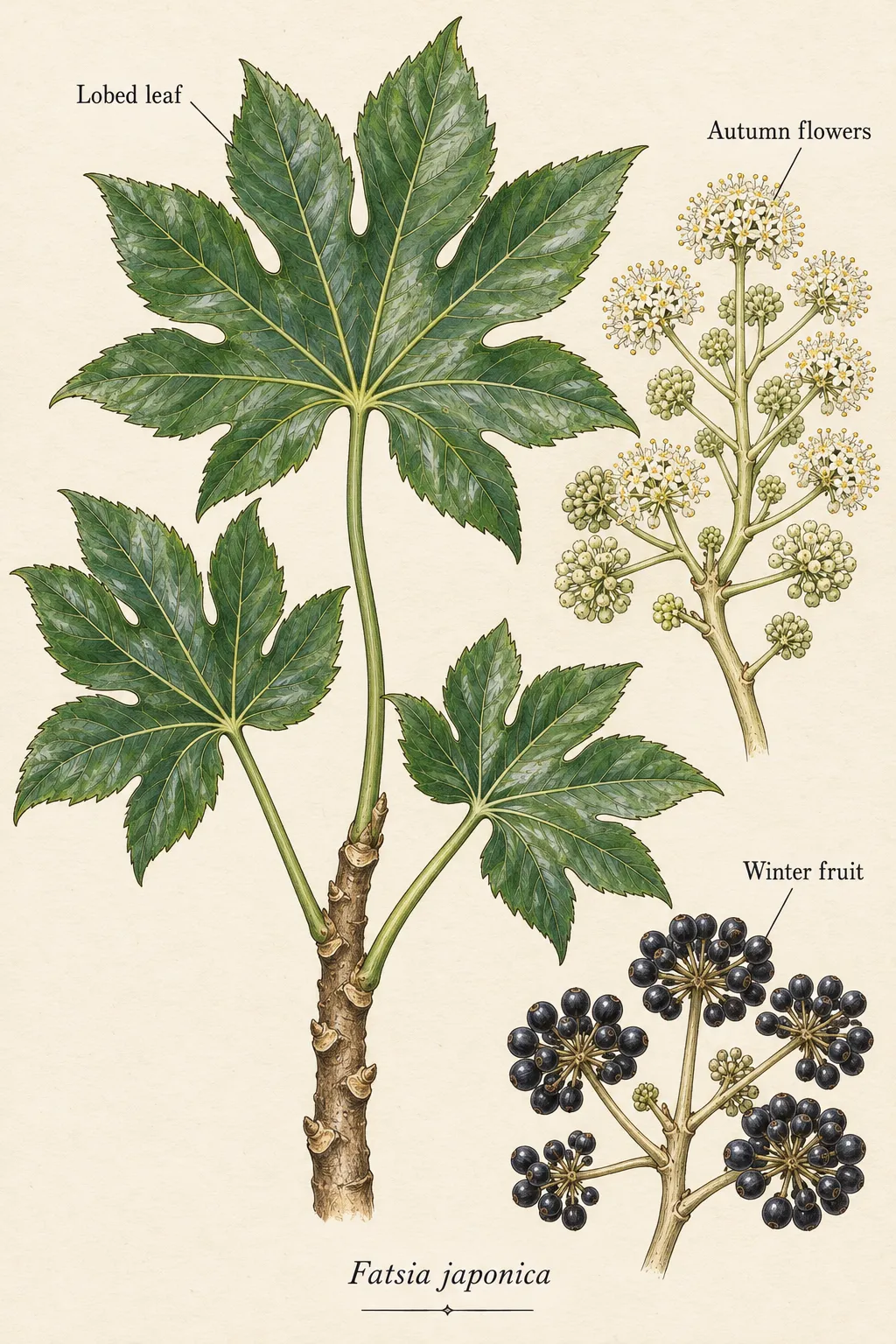
Japanese aralia makes a substantial evergreen presence in sheltered shade. Fatsia japonica carries large, glossy, hand-shaped leaves on stout stems, with rounded clusters of small creamy-white flowers in autumn. Give it fertile, draining soil and room to develop its broad outline. In a mild garden, early November can reveal both the leaf structure and the late flower display, but flowering depends on maturity and local conditions.
Each leaf is one continuous blade divided into deep lobes, rather than a set of separate leaflets. Oregon State describes seven to nine serrated lobes and leaves commonly 15–35 cm across; NC State records seven to eleven lobes and larger blades. Leaves attach alternately along the stem on long stalks. Check that attachment and the connected blade when identifying a plant: the palm-like outline does not make this a palm.
The flowers form pale, rounded umbels gathered into a larger branching cluster at the ends of stems. NC State, Oregon State and the University of Florida all place outdoor bloom in autumn; the RHS detailed care guide specifies October and November. Small black fruits may follow in winter on mature plants. Leave the spent clusters if you want that seasonal transition. The fruits are ornamental, so keep them separate from anything harvested for food.
Allow space for an open, spreading shrub. The RHS species account gives an eventual height and spread of 2.5–4 m, about 8–13 ft, over 10–20 years. Oregon State describes many plants at 6–8 ft, occasionally 10 ft, while NC State records substantially taller mature specimens. These differences reflect the range of garden conditions and plant development. A small indoor nursery pot gives little indication of the space the same species can occupy outdoors.
A practical position is the back or side of a broad shaded courtyard bed, where the leaves can be seen from a window and the mature canopy stays clear of a doorway. Reserve access to the root zone for watering and to the stems for occasional pruning. Lower ferns or other shade planting can provide a finer texture nearby, with enough separation for both to grow. This is a specimen arrangement; close nursery spacing is not a mature layout.
Shelter is as important as shade. NC State warns that exposed wind and full sun can brown leaves, and Oregon State favors full shade. The RHS allows full sun where fertile soil stays sufficiently moist, but partial shade gives a more forgiving starting point. Choose a position protected from drying wind and strong afternoon exposure. A deeply shaded corner can suit the foliage, provided roots have usable soil and establishment water.
Established fatsias can tolerate dry shade, as the RHS and NC State note. A newly planted root ball still needs reliable moisture while roots spread into the surrounding soil. Good drainage remains essential: wet soil and adequate water are different from standing saturation. A shaded position beneath a roof overhang can be dry even in a rainy garden, while a low pocket beside a downspout can remain wet. Check the actual planting area before choosing the plant.
The displayed pH range of 5.5–8 follows GroenRijk's species entry and represents a broad practical range, not exact physiological limits. RHS and NC State also describe tolerance across acidic, neutral and alkaline soils, while Oregon State and Florida favor acidic or slightly acidic soil. Use a soil test when a site is questionable. There is little reason to alter a suitable bed aggressively merely to reach a particular number when shelter, drainage and moisture are the more immediate constraints.
Read the complete nursery name. Fatsia japonica is also listed under the older names Aralia japonica and Aralia sieboldii. Fatsia polycarpa is a different, less hardy species in RHS guidance. The ivy hybrid × Fatshedera lizei is another plant, flagged by NC State as a frequent confusion. Within F. japonica, ‘Spider's Web’ has white-speckled variegation and ‘Variegata’ has pale markings toward the lobe tips. Match the cultivar's intended leaf pattern before interpreting pale areas as damage.
Container culture is useful where space or winter shelter requires mobility, but the RHS describes it as a short-term solution for a shrub that eventually grows large. Use a drained container and soil-based, peat-free growing medium, with regular moisture checks and growing-season feeding. A plant from an indoor sales area needs a gradual introduction to outdoor exposure after frost risk has passed. Keep its current root ball intact during that transition, then choose a permanent garden position when conditions suit establishment.
Propagation is possible from semi-ripe or semi-hardwood cuttings, with the RHS favoring cuttings as the quickest route. Select suitable firming current-season growth during the warmer growing season and use a protected propagation setup. Seed from ripe dark fruit is another option, but it provides a different route from maintaining a named selection. For a specific variegated cultivar and a planned garden layout, correctly labelled nursery stock gives the clearest starting point.
- Family
- Araliaceae
- Range
- Japan and southern Korea
- Soil pH
- 5.5–8
- Spread
- Allow roughly 8–13 ft for an open mature shrub · Allow roughly 2.5–4 m for an open mature shrub
Planting & careHow to grow japanese aralia
The displayed USDA zones 8–10 are a conservative garden range within NC State's 7b–10b listing; Oregon State gives zone (7) 8. The RHS rates Fatsia japonica H5 under UK conditions, but exposed leaves and container roots still need their own assessment. These systems are not direct equivalents or guarantees for every plant. Native range is Japan and southern Korea. November is a viewing and planning window. RHS recommends spring or autumn planting in suitable UK soil; Maryland's broader evergreen guidance favors spring. Near the cold edge, choose spring establishment and a protected site instead of treating late-autumn planting as compulsory.
- 1Choose outdoor-ready stock and a full-size position
Confirm Fatsia japonica and any cultivar name, then examine the connected lobed leaves and stout stems. Ask to inspect the root ball: firm roots and a stable plant are preferable to a severely tangled mass or soft, failing roots. Reserve mature canopy space clear of paths and doors. Introduce indoor-grown stock to sheltered outdoor conditions gradually after frost risk passes.
- 2Check drainage and locate the root collar
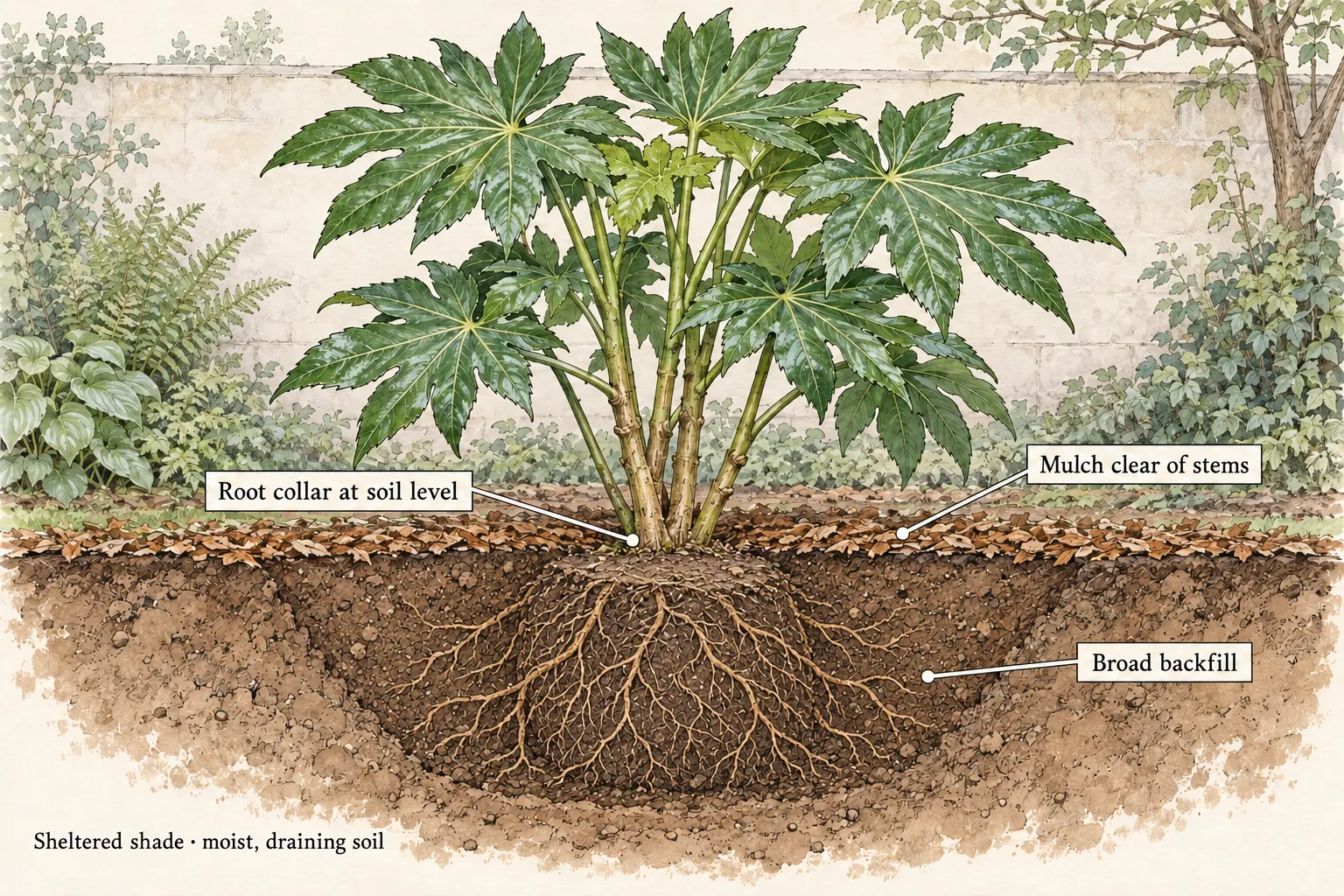
Water a dry nursery ball before planting and inspect the proposed bed after rain. Remove the container completely and identify the upper structural roots and stem base, gently clearing excess loose potting medium if necessary. The old pot surface may be above the true root collar. Keep the plant supported by its root ball while checking depth.
- 3Open a broad hole with a firm base
Maryland's shrub-planting guidance calls for a hole at least twice the root-ball width and no deeper than the ball measured from its root collar. Keep firm soil beneath the ball so the shrub settles at surrounding grade. Loosen accessible circling roots; severe root defects warrant nursery help before planting. Keep the woody stem bases out of a newly raised soil mound.
- 4Backfill and water the original ball
Return the excavated soil around the ball, settling it with water and gentle hand pressure. Confirm the collar remains at soil level. Spread organic mulch across the surrounding root area with a clear gap at the stems. Check moisture within the original ball as well as nearby soil during establishment; damp garden soil can conceal a drying nursery ball.
- 5Maintain access and adjust after establishment
Water when the root ball is drying below the surface, allowing excess to drain. Continue checks through dry weather while roots establish. In fertile garden soil, the RHS favors regular organic mulching over automatic additional feeding. Container plants need more frequent checks and spring–summer feed according to the product directions. Reassess mature space before pruning simply to keep the shrub inside a small gap.
Pruning japanese aralia
Fatsia japonica needs no routine clipping when it has room for its natural shape. Follow the RHS garden schedule for selective removal of wayward, dead or damaged shoots in mid- to late spring. Inspect the stem you intend to remove and preserve the remaining framework and leaf display. Older overgrown plants can be reduced by cutting back old stems in spring, when new growth can follow; plan the reduction around the shape you want to retain. NC State permits broader timing, but the spring schedule is the more specific choice used here for an outdoor specimen. Autumn flowering is a reason to leave the late-season canopy and terminal clusters in place. Regularly shearing the leaf tips produces a different appearance from the broad architectural shrub. Semi-ripe cuttings are an optional propagation job, not a reason to remove healthy branches from a plant that already fits its site.
Seasonal care
Spring
Plant where local conditions favor establishment, especially near the cold edge of the range. Check the root collar after settling and water the original ball. Make necessary selective pruning in mid- to late spring, retaining the natural outline. Refresh organic mulch clear of the stems. Gradually acclimate plants that spent winter indoors before exposing their large leaves to outdoor wind and sun.
Summer
Monitor recently planted shrubs during dry spells, including those in shade. Containers need regular checks beneath the surface and growing-season feeding. Inspect leaves for browning on the exposed side before assuming a disease. Select suitable firming shoots only if taking cuttings is part of the plan; preserve enough foliage for the parent plant's form.
Autumn
Look for the rounded white flower clusters on mature outdoor plants. Retain the heads for the possible winter fruit display. Plant only where mild conditions, workable soil and watering access support establishment. Check shelter for a movable container and confirm the plant's identity before borrowing the more tender F. polycarpa's care or assuming every fatsia shares the same hardiness.
Winter
Enjoy the evergreen outline and any black fruit that develops. Keep the fruit ornamental. Check containers for drying and trapped runoff, using the actual mix condition to decide on water. Protect vulnerable pots according to local exposure and retain a suitable shelter option. Assess weather-damaged foliage when spring growth makes the condition of the shrub clearer.
Safety and garden spread
Common problems
Brown leaf margins on the exposed side
- Look for
- Outer leaves brown or dry where afternoon sun or wind reaches the plant, especially after a change of position.
- Action
- Check shelter, sunlight and root-ball moisture together. NC State associates browning with full sun and wind exposure. Move a container to a more protected shaded position when appropriate, and restore establishment water if the ball is dry. Persistent decline despite suitable conditions needs a closer root and leaf assessment.
Yellowing or decline in persistently wet soil
- Look for
- Several leaves deteriorate while the potting mix or garden soil remains saturated, sometimes with weak growth.
- Action
- Check blocked outlets, collected runoff and the water source. NC State identifies excess moisture as a cause of root rot risk, but leaf color alone is not a diagnosis. Correct obvious drainage problems and obtain help for soft roots or continued decline. Additional fertilizer is not the first response to a wet root system.
Pale patches on a named variegated plant
- Look for
- White speckling or cream areas recur in the expected pattern of ‘Spider's Web’ or ‘Variegata’.
- Action
- Compare the foliage with the cultivar label and normal leaves on the same plant. Expected variegation differs from new brown, brittle or spreading damaged areas. Preserve healthy patterned leaves and investigate changes in texture, vigor or distribution before treating a normal cultivar feature as disease.
Leaf spots or insects under cover
- Look for
- Discrete expanding spots, sticky deposits, visible scale-like bumps or other unusual damage on leaves and stems.
- Action
- Inspect leaf undersides and stems and identify the cause before treatment. RHS lists leaf spot and several possible insect pests; NC State notes indoor pest problems in particular. Keep a suspicious container separate from other plants when practical and use locally appropriate advice for a confirmed problem. Appearance alone does not justify a pesticide.
A leggy shrub that crowds a path
- Look for
- Long stems and a broad head lean into access space while the plant continues to grow.
- Action
- Check whether the original site allowed for mature spread. University of Florida describes older stems bending and new shoots arising near their bases. Plan selective spring reduction using the RHS schedule, preserving an intentional framework. A permanently undersized bed may need a different planting arrangement.
Few autumn flowers
- Look for
- A young or repeatedly trimmed plant makes leaves but little or no visible flower display.
- Action
- Check maturity, recent pruning and local seasonal development. NC State notes that flowering is uncommon indoors; a leafy nursery plant is not a promise of flowers that autumn. Retain the terminal growth when it fits the site and judge garden performance over time. Healthy evergreen foliage remains the principal landscape feature.
Sources
- Fatsia japonica. NC State Extension Gardener Plant Toolbox. Source record · Accessed 2026-10-26.
- How to grow Fatsia. Royal Horticultural Society. Source record · Accessed 2026-10-26.
- Fatsia japonica | Japanese aralia. Royal Horticultural Society. Source record · Accessed 2026-10-26.
- Fatsia japonica. Oregon State University. Source record · Accessed 2026-10-26.
- Fatsia Japonica. University of Florida IFAS Gardening Solutions. Source record · Accessed 2026-10-26.
- Vingerplant — Fatsia japonica. GroenRijk. Source record · Accessed 2026-10-26.
- Planting a Tree or Shrub. University of Maryland Extension. Source record · Accessed 2026-10-26.