Ivy-Leaved Cyclamen
Cyclamen hederifolium
Identify autumn-flowering Cyclamen hederifolium and grow it in drained partial shade, with shallow tuber planting and care through summer dormancy.
Published Last updated
At a glance
- Light
- Partial shade, especially beneath deciduous trees
- Water
- Moisture during autumn-to-spring growth; drier during summer dormancy
- Soil
- Humus-rich, loose and freely draining; tolerates established dry shade
- Hardiness
- Zones 5–9
- Bloom
- Late summer to autumn; timing varies with climate and rainfall
- Height
- About 4–6 in · About 10–15 cm
In this guide
Overview
Choose Cyclamen hederifolium for small autumn flowers and patterned winter leaves beneath deciduous trees, provided the ground drains well. Its tolerance of dry shade is useful once established, but the leafy plant still needs moisture during dry spells. Summer is its resting season. A bed watered continually for thirsty summer bedding is a poor match for this cycle. By mid-October, some gardens will be enjoying flowers while others already have the developing leaf display.
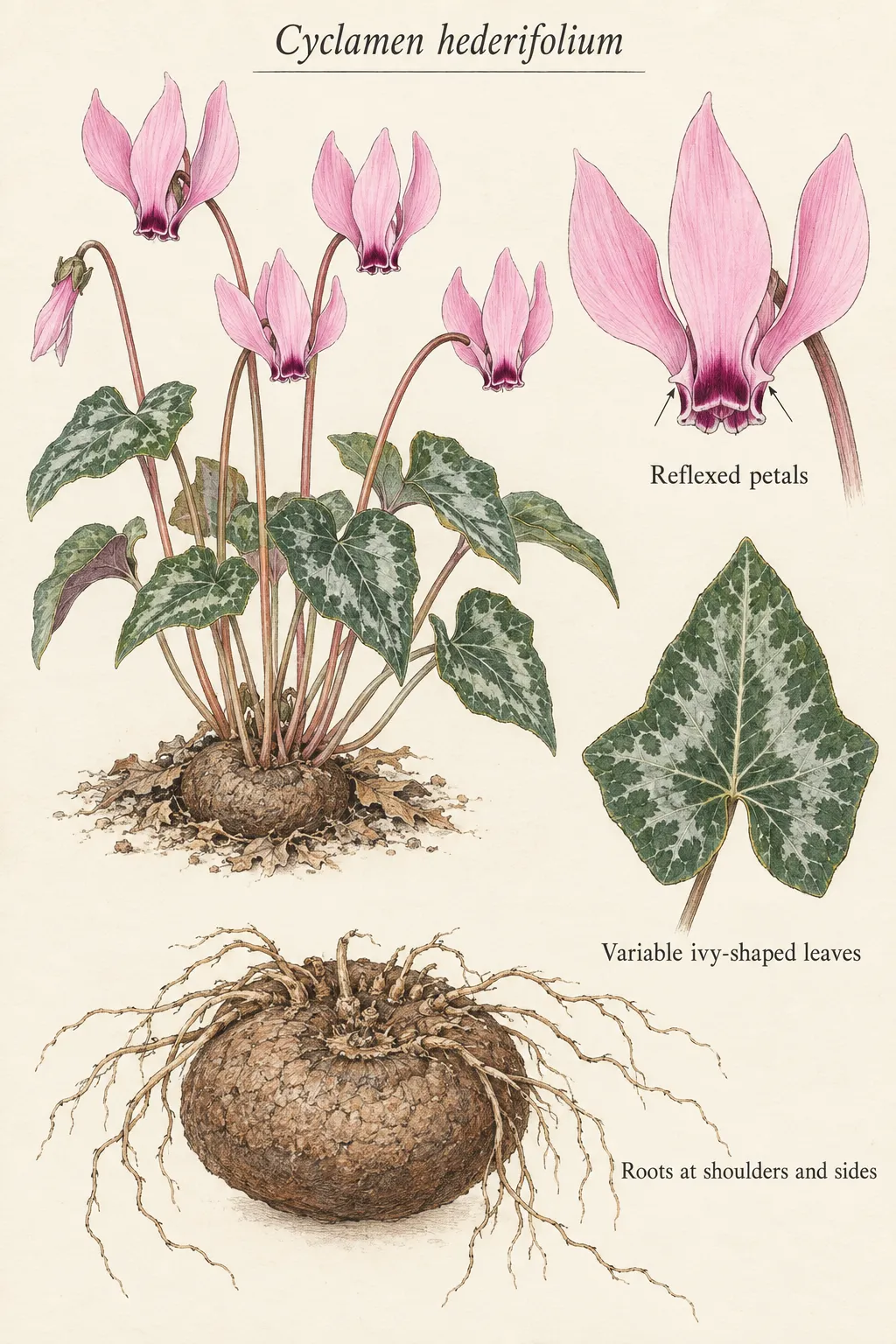
Each slender stem carries one nodding flower with five petals swept upward. Pink is typical; white forms also occur. The Cyclamen Society describes small ear-like projections at the petal bases and a darker mark around the flower mouth. Leaves vary considerably, from pointed, angular ivy shapes to broader hearts, often patterned in silver or pale green. Leaf pattern alone cannot establish a cultivar name. Buy a labelled nursery plant when a particular flower color or foliage pattern matters.
The underground organ is a persistent, flattened tuber. It expands with age instead of renewing itself annually like a crocus corm. Roots arise around its shoulders and sides, with much of the underside bare. This matters when orienting dormant stock: a smooth lower surface is not a root plate to point upward. Keep the growing points uppermost and the rooting shoulders beneath soil. The detached tuber in the identification plate shows anatomy, not a recommendation to excavate an established plant.
Hardy cyclamen is an ambiguous buying label. C. coum flowers in winter or early spring, whereas C. hederifolium belongs to the late-summer and autumn sequence. Florist cyclamen, C. persicum, is a different choice and is not an outdoor winter substitute in Pennsylvania. Check the full species name even when all three are sold with silver-patterned foliage. A flowering pot provides more information than a mixed packet of anonymous dormant tubers.
Place this low plant beside a path or near a doorway where its flowers can be seen closely. A suggested arrangement is a small pocket in front of a deciduous shrub, with a clear strip between the cyclamen and larger perennial crowns. Treat that as a layout idea, not a fixed companion recipe. Observe where neighboring foliage falls in summer before planting. An apparently empty dormant patch needs a durable marker so later planting and weeding leave its tubers intact.
Kew records flowers from August and leaves developing from mid-October at Wakehurst in southeast England. The Cyclamen Society records August-to-October wild flowering dependent on autumn rain. These observations explain why a plant can flower before it makes an obvious leaf rosette. They also show why an October purchase cannot promise an immediate carpet of flowers. The foliage itself continues the display into the cooler months; the precise handover varies by garden.
A colony develops through seed as well as enlargement of individual tubers. Leave some spent flower stems if you want seedlings: the stems coil toward the ground and the capsules mature later. Reserve a patch where small seedlings can remain without frequent hoeing. For a named selection, ask how the nursery maintains its characteristics; seed-grown offspring can vary. Cutting an old tuber into pieces is a risky shortcut, and established cyclamen need no routine division.
- Family
- Primulaceae
- Range
- Mediterranean Europe east to western and southwestern Turkey, including many Mediterranean islands
- Soil pH
- 6–8
- Spread
- About 6–12 in per plant; colonies expand through seedlings · About 15–30 cm per plant; colonies expand through seedlings
Planting & careHow to grow ivy-leaved cyclamen
The USDA 5–9 range follows NC State; Penn State specifically discusses zones 5–7. RHS rates this species H5 under UK conditions. These systems describe different climate contexts and do not guarantee container survival or compensate for saturated soil. The displayed pH 6–8 is a practical neutral-range starting point, not a measured tolerance limit: RHS and NC State also list acidic and alkaline soils. Site drainage deserves more attention than adjusting an otherwise suitable soil to a narrow pH target. This guide concerns northern temperate gardens; southern-hemisphere seasons shift.
- 1Buy nursery-grown stock
Choose a clearly labelled, healthy potted plant or a plump dormant tuber. Reject badly shrivelled stock. Penn State recommends nursery-grown material because wild collection has harmed some cyclamen populations. A potted specimen is especially useful in autumn when you want to inspect the actual flower and leaf form.
- 2Choose the whole seasonal site
Look for partial shade and loose soil enriched with organic matter. Check the position after rain and consider summer irrigation nearby. A shallow hollow that holds water needs a different site. Beneath a tree, find a small planting gap between roots rather than cutting major roots to create a bed.
- 3Match planting season to the stock
Penn State favors dormant-tuber planting in late summer. The RHS also allows autumn through early spring when the ground is unfrozen and recommends stock in root growth for establishment. For an autumn nursery pot, keep its root ball intact and plant into workable soil; retain the existing growing level unless nursery guidance indicates a correction.
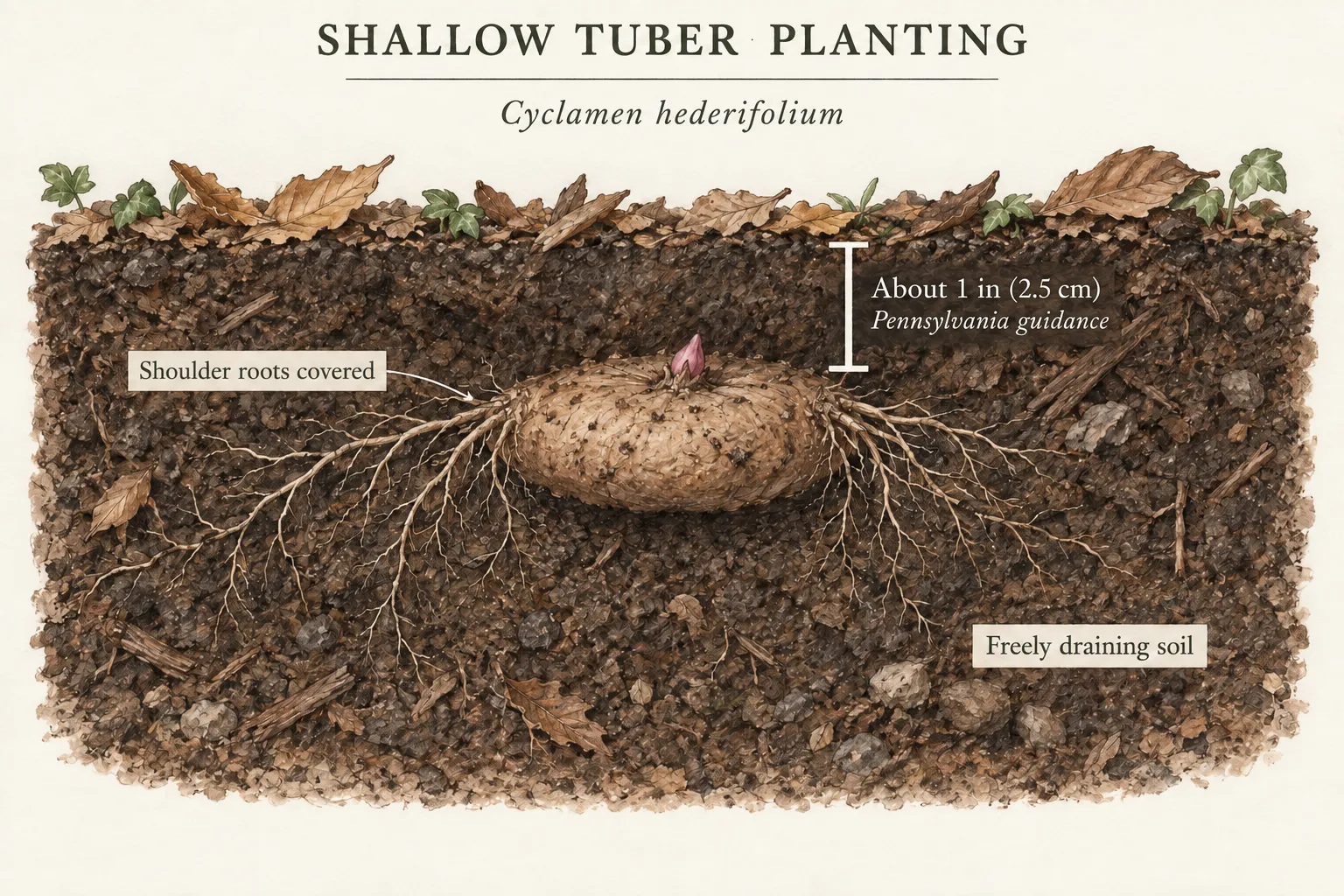
- 4Cover the rooting shoulders shallowly
For the Pennsylvania approach illustrated here, cover a dormant tuber with about 1 inch (2.5 cm) of loose soil or less, keeping its shoulders covered. UK RHS guidance gives 3–5 cm, with its species page specifying 5 cm. Use the regional recommendation appropriate to your stock and site; these are alternatives, not depths to add together. Keep the buds uppermost.
- 5Allow room for leaves and seedlings
Use the listed 6–12 inch (15–30 cm) individual spread to judge how many plants a pocket can hold. A proposed initial layout at about 12 inch (30 cm) centers leaves room to observe each rosette; it is a design choice, not a universal planting rule. Leave space between cyclamen and neighboring crowns so the small leaves remain visible.
- 6Settle the soil and mark the patch
Water the newly planted root zone to settle soil, then judge subsequent watering from rainfall and moisture beneath the surface. Label the dormant footprint. Apply only a light leaf mulch for the Pennsylvania approach, and prevent fallen leaves from accumulating into a heavy mat over emerging flowers and foliage.
Pruning ivy-leaved cyclamen
No routine pruning is needed. Retain green leaves through their natural season, then lift away fully dead material gently. Kew recommends removing heavy autumn leaf fall by hand because raking can damage the plants. Keep coiling flower stalks where seed is wanted. For controlled propagation, RHS recommends fresh seed soaked overnight, covered lightly in a freely draining seed mix; this is separate from transplanting an established tuber.
Seasonal care
Spring
Keep the remaining marbled foliage in place and check moisture during dry weather. Natural yellowing toward the end of the leafy season signals approaching rest. Mark the colony before its leaves disappear, especially if nearby spring bulbs also retreat.
Summer
Let resting tubers experience the drier part of the cycle. Redirect routine bedding irrigation away from the patch. Inspect coiled seed capsules if collecting seed; Kew describes ripe capsules becoming soft. Late summer is the dormant-stock planting window described by Penn State.
Autumn
Watch for flower stems before or alongside leaves. Kew advises watering during dry spells as growth resumes. Clear heavy fallen foliage by hand so the small plants receive light. A new labelled pot can help you compare forms, but bloom stage varies with the season.
Winter
Keep drainage outlets clear and retain healthy leaves. In Pennsylvania, Penn State recommends a light protective covering of leaves or evergreen boughs; snow can insulate but is unreliable. Inspect the patch after storms without digging up sound tubers to check them.
Safety and garden spread
Common problems
An empty patch in early summer
- Look for
- Foliage has yellowed gradually after its cool-season display, leaving the labelled patch apparently bare.
- Action
- Treat the normal seasonal retreat as dormancy. Leave the tubers undisturbed and check whether irrigation from adjacent plants is keeping the site unnecessarily wet.
Soft tubers in wet ground
- Look for
- A failing plant is associated with persistent saturation; any exposed damaged tuber feels soft.
- Action
- Correct the water source or choose a better-drained position for replacement stock. Poor drainage supports a rot concern but does not identify a specific pathogen. Additional watering cannot correct a saturated root zone.
Missing or disturbed tubers
- Look for
- Fresh excavation or displaced plants appears in the cyclamen patch.
- Action
- RHS lists mice and squirrels among possible causes. Inspect for actual disturbance before assuming winter cold killed the plant. Restore loose soil around intact displaced stock and assess the animal activity before choosing protection.
Flowers without a full leaf rosette
- Look for
- Healthy autumn flowers stand above bare soil or a few small emerging leaves.
- Action
- This can be the normal sequence for C. hederifolium. Allow the leaf display to develop. Recheck the species label if the expected flowering season is different; do not force a fertilizer response to a normal developmental stage.
Sources
- Cyclamen hederifolium. NC State Extension. Source record · Accessed 2026-09-28.
- Cyclamen hederifolium. Cyclamen Society. Source record · Accessed 2026-09-28.
- Hardy Cyclamen for the Home Garden. Penn State Extension. Source record · Accessed 2026-09-28.
- Cyclamen hederifolium | ivy-leaved cyclamen. Royal Horticultural Society. Source record · Accessed 2026-09-28.
- Cyclamen: hardy. Royal Horticultural Society. Source record · Accessed 2026-09-28.
- Cyclamen are seasonal treasures. Royal Botanic Gardens, Kew. Source record · Accessed 2026-09-28.
- Cyclamen. ASPCA. Source record · Accessed 2026-09-28.