Inkberry Holly
Ilex glabra
A species-focused guide to inkberry holly's acidic-soil needs, male-female pollination, root suckers, basal renewal and low-toxicity black fruit.
Published Last updated
At a glance
- Light
- Full sun to partial shade
- Water
- Moderate; appreciates even moisture
- Soil
- Acidic, moist but well-drained soil
- Hardiness
- Zones 4–9
- Bloom
- Small flowers in late spring
- Height
- 5–8 ft · 1.5–2.4 m
In this guide
Overview
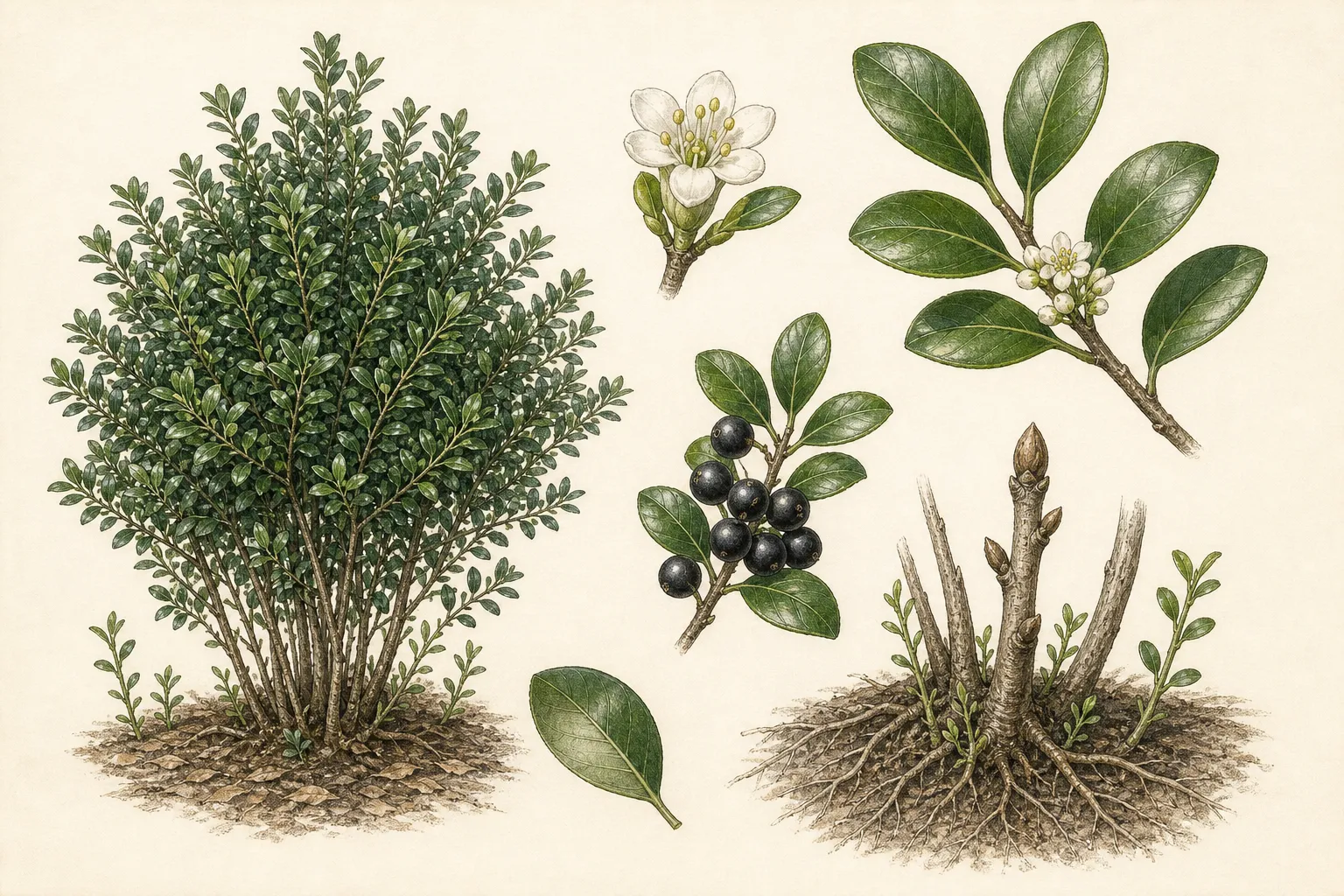
Inkberry is a slow-growing, broadleaf evergreen holly without the spiny leaves associated with many Ilex species. Its small glossy leaves are widest above the middle and toothed near the tip. Inconspicuous greenish-white flowers open in late spring, and pollinated female plants develop black drupes in autumn.
Male and female flowers are normally carried on separate plants. A female cultivar needs a compatible male holly flowering at the same time for reliable fruit, so a row of female labels alone should not be sold as a guaranteed berry screen.
Species plants typically reach 5–8 feet tall and broad and spread gradually by root suckers. Use them for a loose screen, rain garden, pollinator planting, or informal hedge. Older shrubs often become open at the base, which makes a clipped boxwood substitute an unrealistic design expectation.
Full sun to partial shade and acidic soil around pH 4.5–6 are dependable conditions. Inkberry accepts sand or clay and can tolerate periodic flooding, drought, and salt exposure after establishment, reflecting its range from sandy dunes to bog edges.
If a mature plant opens at the bottom, remove a few stems in early spring before new growth to encourage shoots near the base. University of Maryland Extension specifically advises thinning instead of shearing; compact cultivars are a better fit where a dense low outline is required.
The black drupes feed birds and small mammals but can cause a minor toxic reaction if people ingest them. North Carolina Extension also gives inkberry a high flammability rating, so keep it outside the defensible space closest to a fire-prone home.
- Family
- Aquifoliaceae
- Range
- Nova Scotia south through the eastern United States to Texas
- Soil pH
- 4.5–6
- Spread
- 5–8 ft · 1.5–2.4 m
Planting & careHow to grow inkberry holly
Inkberry is native to the Atlantic and Gulf coastal plain, where it occurs near swamps and bogs, in sandy woodland, and on dunes. It spreads slowly by rhizomatous root suckers and can form a colony. Confirm local native status, fire-wise placement, and whether the selected cultivar is male or female.
- 1Choose the sex and size
Match a documented species or cultivar height to the site and, if black fruit matters, include a compatible male pollinator for the female selection.
- 2Confirm acidic ground
Choose full sun to partial shade and test uncertain soil; a pH around 4.5–6 is more suitable than an alkaline foundation bed.
- 3Set the root ball at grade
Place the top of the root ball level with the surrounding soil, loosen circling roots, and leave the multiple stem bases free of added soil and mulch.
- 4Establish before testing tolerance
Water the root ball and adjacent soil during establishment. Treat flood, drought, and salt tolerance as traits of an established root system, not reasons to neglect a new planting.
- 5Leave room for suckers
Mulch lightly beyond the root ball, keep the stems uncovered, and mark the edge where new rhizomatous shoots may be allowed to thicken the mass.
- 6Place for fire safety
Keep this high-flammability evergreen outside the home's closest defensible-space zone and follow local fire-wise landscape guidance for spacing and maintenance.
Pruning inkberry holly
Inkberry needs little pruning unless it is used as a hedge or has opened at the base. In early spring before new growth, remove a few selected old stems near their origin to stimulate lower shoots. Avoid routine shearing, which leaves a surface shell of foliage without correcting the aging interior; choose a compact cultivar where repeated height control would otherwise be necessary.
Seasonal care
Spring
Thin selected old stems before new growth if the base is bare, identify male and female flowers in May or June, and refresh mulch without covering suckers or stem bases.
Summer
Check young plants during drought and inspect the undersides of leaves for leafminer, wax scale, or southern red mite injury. Preserve beneficial insects until a diagnosis shows control is needed.
Autumn
Look for black drupes on pollinated female plants from September into November, remove unwanted root suckers at the colony edge, and water new evergreens if the soil is dry before freeze-up.
Winter
Assess foliage retention after severe cold, keep dry combustible debris out of the shrub mass, and plan any basal renewal thinning for early spring.
Safety and garden spread
Common problems
No black fruit
- Look for
- A healthy female plant flowers but produces no drupes, especially in a planting made from one female cultivar.
- Action
- Confirm the plant's sex and provide a compatible male Ilex that overlaps its bloom period; fertilizer cannot replace pollination.
Bare lower stems
- Look for
- Green foliage remains at the top while the interior and base become open as the shrub matures.
- Action
- Thin a few old stems near ground level in early spring to encourage basal growth, or replace an unsuitable tall selection with a compact cultivar.
Leafminer, scale, or mite injury
- Look for
- Mines inside leaves, fixed waxy bumps on stems, fine stippling, bronzing, or premature foliage loss.
- Action
- Identify the pest and life stage before treatment; timing differs among leafminers, armored scales, and mites, so use current local Extension guidance.
Alkaline-site stress
- Look for
- Pale new foliage and weak growth in a high-pH foundation bed despite adequate soil moisture.
- Action
- Test the soil before adding nutrients. If pH is outside inkberry's acidic range, relocate the shrub or follow a soil-test recommendation rather than guessing at an amendment.
Plant details
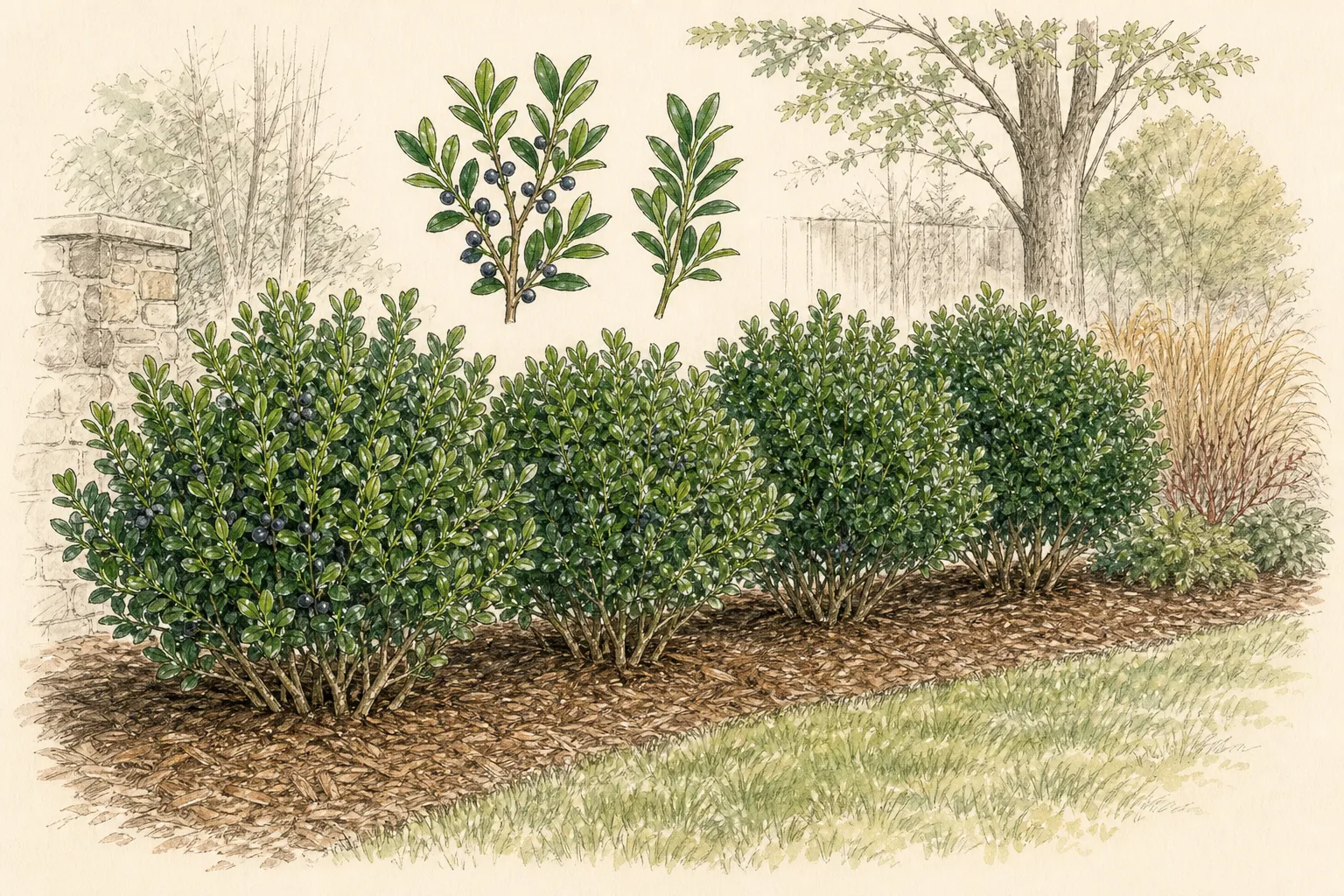
Garden placement study showing mature Inkberry Holly in an ornamental planting
Sources
- Inkberry Holly. University of Maryland Extension. Source record · Accessed 2026-08-20.
- Ilex glabra. North Carolina Extension Gardener Plant Toolbox. Source record · Accessed 2026-08-20.
- Ilex glabra (L.) A.Gray. Royal Botanic Gardens, Kew. Source record · Accessed 2026-08-20.