Hardy Begonia
Begonia grandis
A late-summer to early-autumn Begonia grandis profile for moist shade, with identification, spreading habits, winter limits and practical placement guidance.
Published Last updated
At a glance
- Light
- Partial to deep shade; dappled or afternoon shade is appropriate
- Water
- Medium to consistently moist during growth; never allow the root zone to dry fully
- Soil
- Humus-rich, moist and well-drained loam or sandy soil; avoid waterlogging
- Hardiness
- Zones 6–9
- Bloom
- Summer through early autumn, often continuing toward frost in suitable climates
- Height
- 1.5–3 ft · 45–90 cm
In this guide
Overview
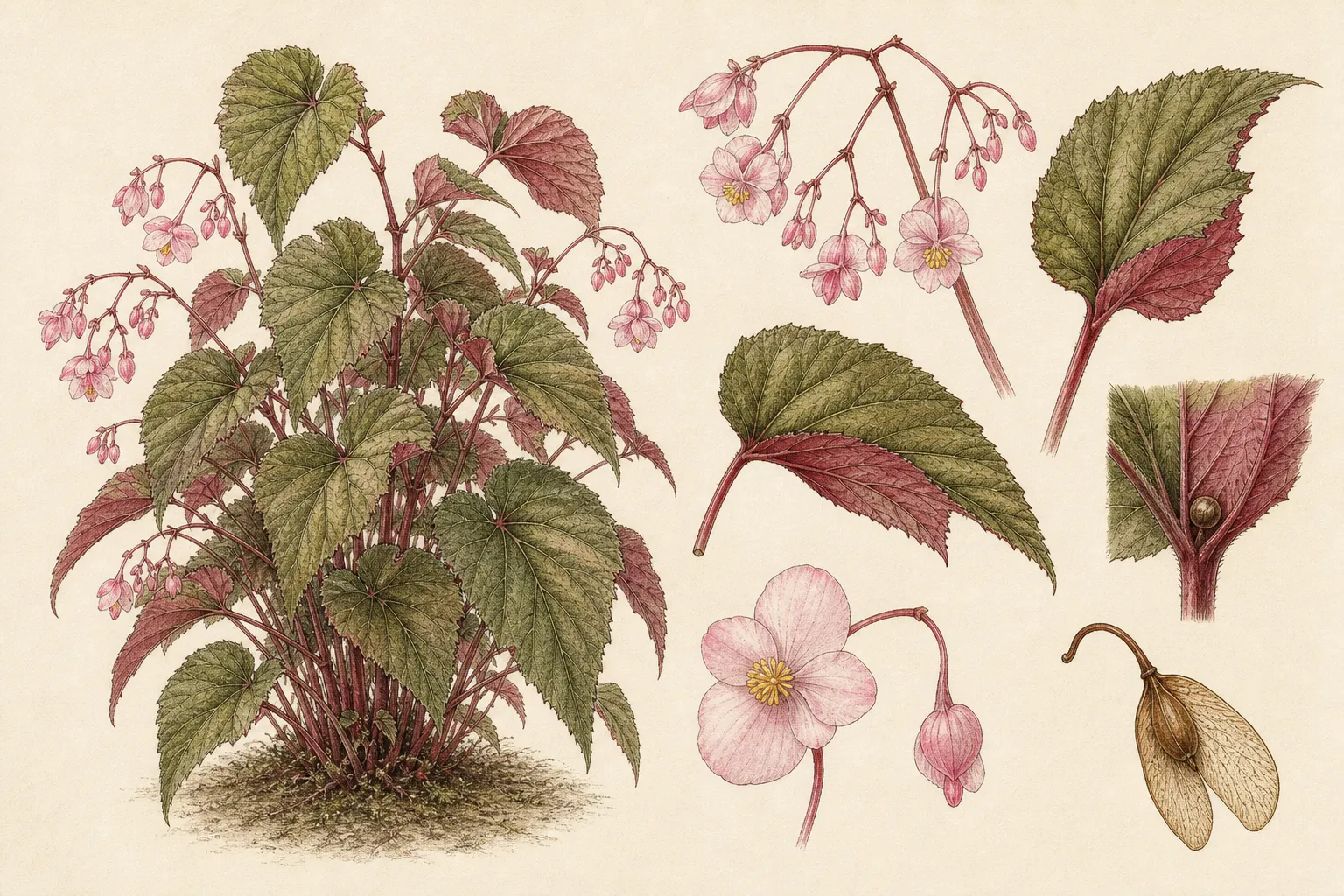
Hardy begonia is the begonia that earns a place outside the summer bedding scheme. Begonia grandis forms a bushy, mounding clump on branching reddish stems, with asymmetrical, serrated olive-green leaves and a pink or red-tinged underside. Loose, pendant clusters of small pale-pink flowers appear above the foliage from summer into early autumn, when many shade borders are losing their strongest color.
The leaf is as useful as the flower for identification. Look for an uneven, heart-like base rather than a symmetrical blade, a pointed tip, and a reddish underside crossed by colored veins. The stems arch instead of forming a stiff upright spike. Hardy begonia is a tuberous perennial, not a tender bedding begonia that happens to be planted outdoors for one season.
Give it partial, dappled or deep shade and soil that holds moisture without becoming stagnant. A humus-rich bed beside a sheltered path, woodland edge or north-facing border can work well; a dry root zone or a puddled hollow cannot. The RHS describes the cultivated hardy form as a plant for partial shade and well-drained, acid-to-neutral ground, while North Carolina Extension also records moist and occasionally wet soils when drainage remains good.
The plant’s scale is modest but not miniature: expect roughly 1.5–3 feet of height and 1.5–2 feet of spread, with arching flowers that occupy more visual space than the crown suggests. Set it behind a low foreground or along a path rather than at the front edge of a formal line. Ferns, hostas and other shade plants can frame the clump, but leave enough open ground that the leaves and red stems remain visible.
Hardy begonia can make a colony without a division knife. As the days shorten, small bulbils form in the leaf axils and drop to the ground; seeds follow the flowers. Bulbils reproduce the parent plant more faithfully than seed, while seedlings can vary. That spread is usually easy to edit, but a single specimen can become a loose drift after several seasons, so decide whether new plants belong before the first bulbils fall.
Winter performance depends on both cold and drainage. North Carolina Extension reports tolerance to about 23°F but notes that zones 6 and 7 may need heavy mulch and may still be unreliable. The top dies back as the plant goes dormant, and the crown must not sit beneath a cold, saturated blanket. In a colder garden, treat this as a trial in a sheltered site rather than as a promise that every nursery plant will return.
- Family
- Begoniaceae
- Range
- Central and southern China
- Soil pH
- 5.5–8
- Spread
- 1.5–2 ft · 45–60 cm
Planting & careHow to grow hardy begonia
This profile follows Kew’s accepted species record for Begonia grandis, which places the native range in central and southern China. North Carolina Extension lists USDA zones 6a–9b but warns that the plant may not be reliably hardy in zones 6 and 7; use heavy winter mulch there and confirm local performance. Cultivated material may be sold as Begonia grandis subsp. evansiana or under older synonyms, so keep the botanical name with the plant.
- 1Confirm the botanical identity
Buy and label Begonia grandis, noting when the nursery uses the cultivated name B. grandis subsp. evansiana or an older synonym; tender bedding begonias have different outdoor limits.
- 2Read shade and shelter
Choose partial, dappled or deep shade beside a sheltered path, wall or woodland edge. Avoid a site that receives harsh afternoon exposure or loses its shade in the season of strongest heat.
- 3Reject standing water
Dig into the proposed bed after rain and look for a moist profile that drains rather than a persistent puddle. Improve the site or move the plant before setting a tuberous crown into saturation.
- 4Reserve the mature footprint
Allow about 1.5–2 feet of spread and up to 3 feet of height, with extra room for the arching flower stems. Keep the front edge low enough that leaves and red stems can be seen.
- 5Set the crown at grade
Plant at the nursery depth, firm the surrounding soil without burying the crown and keep mulch away from the stem bases. A shallow, visible crown is easier to monitor than one hidden under a wet blanket.
- 6Establish even moisture
Water the occupied root zone after planting and during dry weather, checking the soil rather than following a fixed daily schedule. Keep moisture steady while ensuring excess rain can leave the bed.
- 7Choose a spread policy
Before late summer, decide whether a small colony is welcome. Leave selected bulbils to fall where renewal is useful, or remove them and deadhead some flowers where the border must stay contained.
Pruning hardy begonia
Routine pruning is unnecessary. Deadhead spent flower clusters when extending the display or reducing seed matters, but do not shear the plant while it is carrying useful late-season foliage. Let the top die back naturally as dormancy arrives, then remove collapsed stems and diseased debris; in colder zones, apply protective mulch only after the crown is dormant and keep that mulch from becoming waterlogged.
Seasonal care
Spring
Expect a slow start, identify the emerging crown before clearing nearby growth, remove only winter debris that is no longer needed and keep the soil evenly moist without burying the shoots.
Summer
Hold the bed in partial or deep shade, check the root zone through dry spells and deadhead selectively as pendant flowers fade. Watch that vigorous companions do not close over the clump.
Autumn
Enjoy the late flowers, look for pea-sized bulbils in the leaf axils and edit unwanted propagules before they drop. Once dormancy begins, remove diseased debris and mulch colder plantings.
Winter
Keep the dormant crown sheltered and well drained, especially in zones 6 and 7. Use a loose protective mulch where local experience requires it, but do not allow wet material to smother the crown.
Safety and garden spread
Common problems
Waterlogged crown or tuber
- Look for
- Repeated collapse, soft dark tissue or loss after rainy weather while the surrounding soil stays saturated.
- Action
- Stop automatic irrigation, inspect the drainage pattern and move or rework the site before replacing the plant. Surface mulch cannot correct a persistently wet root zone.
Dry-site decline
- Look for
- Limp foliage, browned margins, premature flower loss or a clump that repeatedly stalls during dry weather.
- Action
- Check soil moisture at root depth, add water slowly to the occupied zone and restore a site with reliable shade. Do not compensate with frequent shallow splashes in a poor bed.
Unwanted bulbils or seedlings
- Look for
- Tiny rounded propagules in leaf axils or numerous young plants appearing beyond the intended clump the following spring.
- Action
- Remove bulbils before they fall, deadhead selected flowers and pull small seedlings while the colony is still easy to edit. Leave only the drift that fits the border.
Powdery mildew after dormancy
- Look for
- White powder on foliage or declining leaves as the plant enters autumn dormancy, especially in crowded or humid growth.
- Action
- Open the planting, improve air movement and remove affected fallen debris. Confirm the diagnosis locally before applying any treatment.
Failure to return after winter
- Look for
- No spring shoots after a cold season, particularly in an exposed zone 6 or 7 site or where the dormant crown stayed wet.
- Action
- Compare local winter temperature and drainage with the plant’s limits, then trial a sheltered, mulched replacement or choose a more reliably hardy shade perennial.
Plant details
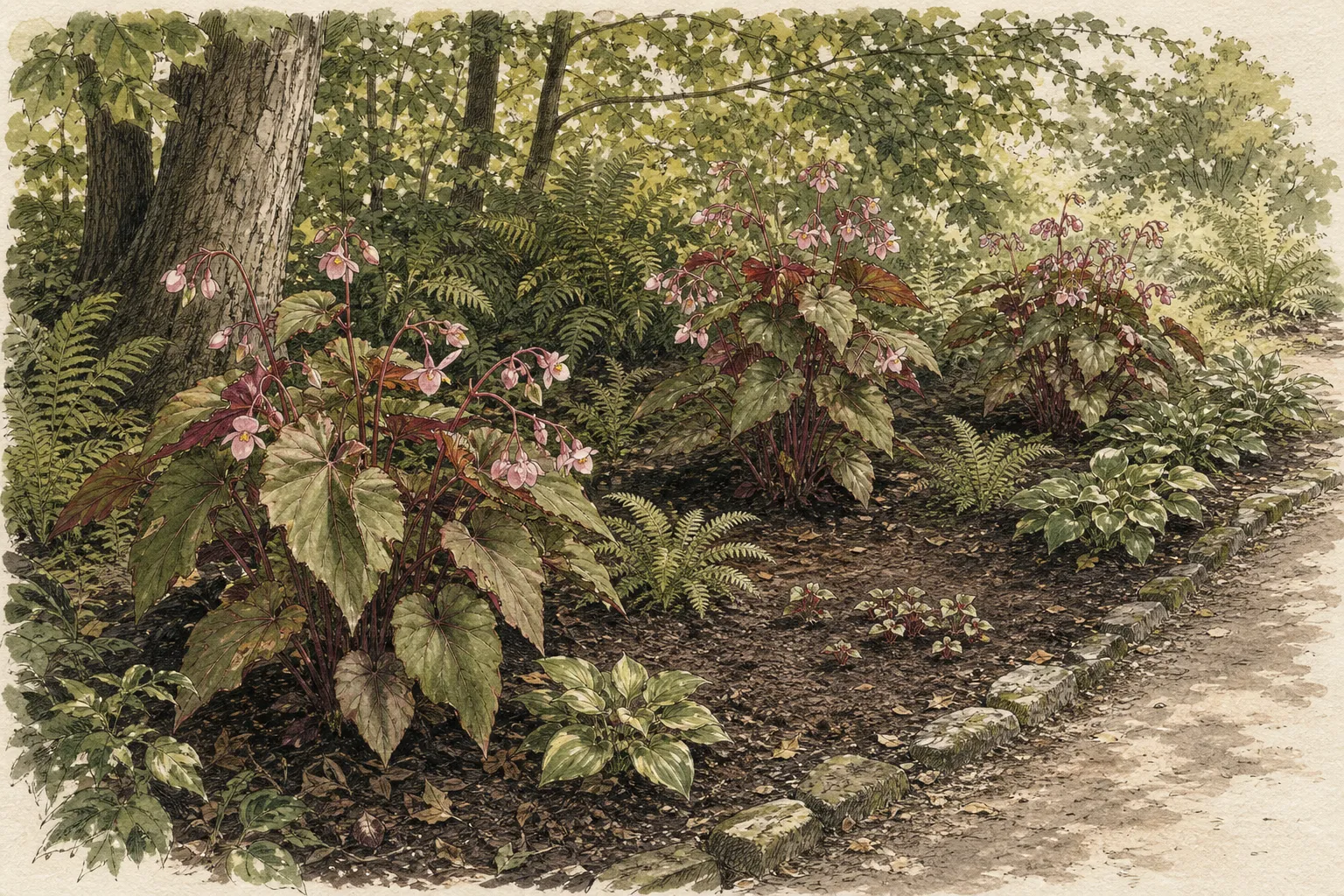
Hardy begonia clumps spaced beside a shaded path with ferns and hostas in a moist woodland-edge border
Sources
- Begonia grandis Dryand.. Plants of the World Online, Royal Botanic Gardens, Kew. Source record · Accessed 2026-08-31.
- Begonia grandis (Hardy Begonia). North Carolina Extension Gardener Plant Toolbox. Source record · Accessed 2026-08-31.
- Begonia grandis subsp. evansiana | hardy begonia. Royal Horticultural Society. Source record · Accessed 2026-08-31.
- Plant of the Week: Begonia. University of Arkansas System Division of Agriculture. Source record · Accessed 2026-08-31.
- Toxic and Non-toxic Plants: Begonia. American Society for the Prevention of Cruelty to Animals. Source record · Accessed 2026-08-31.