Goat’s Beard
Aruncus dioicus
Goat’s beard is a large, moisture-loving woodland perennial with fernlike foliage and cream plumes; this profile covers its dioecious flowers, seed safety, siting, and seasonal care.
Published Last updated
At a glance
- Light
- Full sun to partial shade; favor afternoon shade in hot regions
- Water
- Consistently moist; do not allow the root zone to dry out
- Soil
- Fertile, organically rich, well-drained but moisture-retentive soil
- Hardiness
- Zones 3–8
- Bloom
- Late spring to early summer
- Height
- 4–6 ft · 120–180 cm
In this guide
Overview
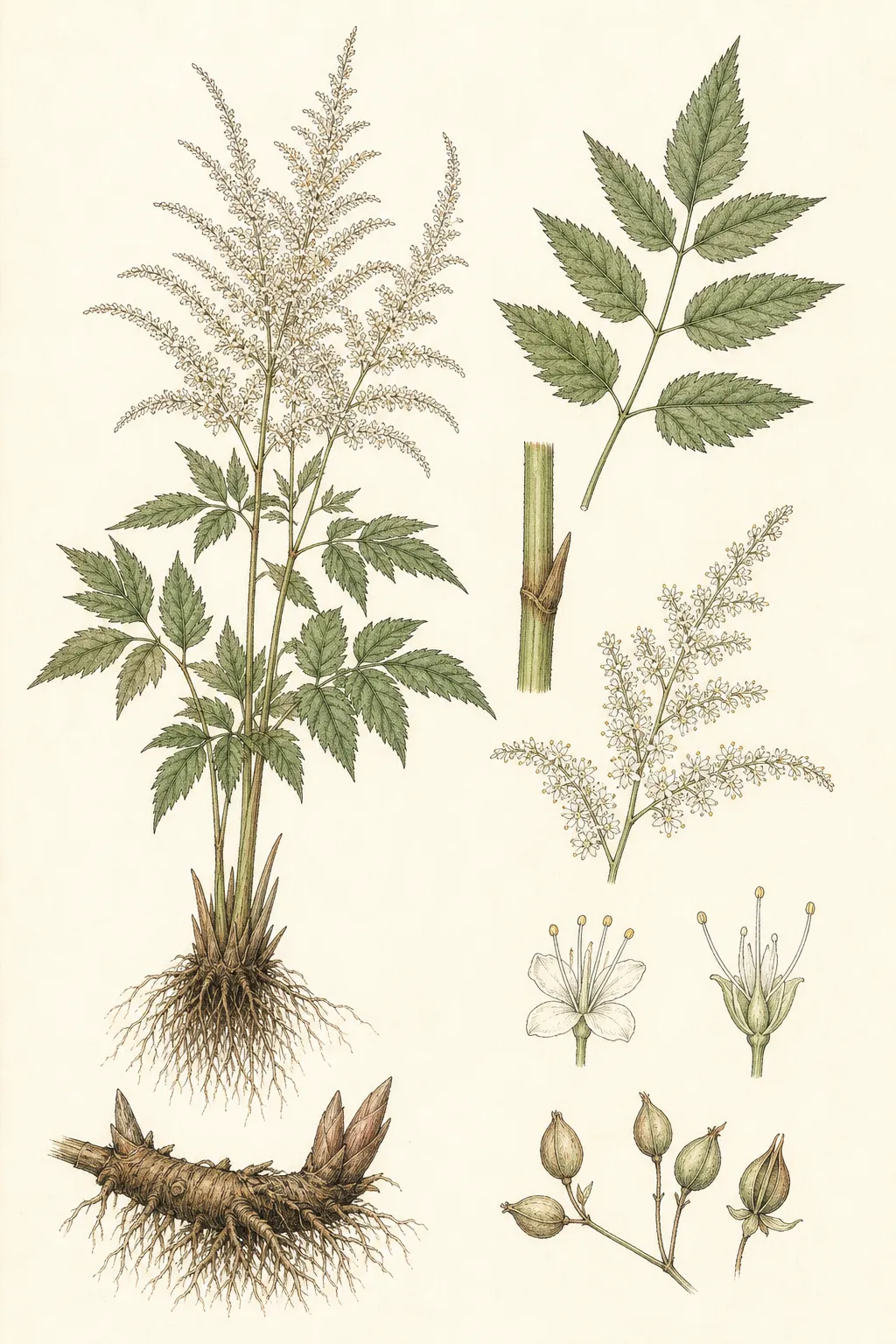
Aruncus dioicus is a rhizomatous herbaceous perennial, not a woody shrub. Its divided dark-green leaves form a broad clump and cream flower panicles rise above them in late spring or early summer. The species is dioecious: male and female flowers occur on separate plants, and male plumes are usually fuller.
A mature clump commonly reaches 4–6 ft high and 2–4 ft across. That scale suits the back of a moist border, a stream edge, or a woodland opening. The entire top dies back, so winter structure must come from neighboring plants rather than from goat’s beard stems.
Moist, fertile soil is the central requirement. In cool climates it can flower in full sun if water remains consistent; farther south or beside heat-reflecting surfaces, partial shade protects the foliage. Brown margins and premature collapse usually point to dry soil or excessive heat before they suggest a nutrient shortage.
The crown establishes slowly and becomes difficult to move. Plant it at the same grade at which it grew in the nursery, allow room for the 2–4 ft spread, and keep the whole root zone evenly moist through the first seasons. A light organic mulch can conserve water, but it should not cover the crown.
Divide a congested plant in early spring with at least one visible eye on each section. Otherwise, leave the heavy rootstock undisturbed. Faded plumes may be removed for appearance, but healthy leaves and stems should remain until they yellow and return stored energy to the crown.
Female flower stalks can develop small brown seed capsules. They may add late-season texture, but Wisconsin Extension identifies them as poisonous; remove them where children or other visitors might sample the garden.
- Family
- Rosaceae
- Range
- Temperate Northern Hemisphere, including parts of Europe, Asia, and North America
- Soil pH
- 5–8
- Spread
- 2–4 ft · 60–120 cm
Planting & careHow to grow goat’s beard
Full sun is most successful in cooler parts of the range when soil stays moist; in hot-summer regions, afternoon shade reduces foliage decline. Local forms and cultivars can differ in stature and hardiness.
- 1Allow a shrub-scale summer clump
Allow 4–6 ft of height and a 2–4 ft spread. Keep the crown back from narrow paths and leave room to reach it for an occasional spring division.
- 2Choose cool, moisture-holding ground
Use partial shade in hot-summer gardens. Full sun is suitable only where fertile soil stays consistently moist without becoming stagnant.
- 3Set the herbaceous crown at grade
Place the crown at its nursery depth rather than burying the emerging eyes. Backfill the hole, water thoroughly to settle the soil, and keep mulch just outside the crown.
- 4Keep the root zone evenly moist
Check moisture through the root-ball depth and water before the bed dries. Extend irrigation beyond the original pot so new roots enter equally moist soil.
- 5Give the crown time to establish
Expect slow growth for the first two or three seasons. Mark the dormant crown and avoid repeated lifting, heavy cultivation, or excess fertilizer intended to force faster growth.
- 6Plan for optional seed-head removal
If the plant proves female, decide whether its brown seed capsules can remain safely. Cut the fruiting stalks before capsules mature where accidental ingestion is plausible.
Pruning goat’s beard
Deadheading is optional and does not extend bloom. Retain green stems and leaves, then cut them close to the crown after they yellow in autumn or before new shoots emerge; divide only a congested crown in early spring.
Seasonal care
Spring
Mark the emerging eyes before working the bed. This is the preferred time to divide an old crown, keeping at least one eye on each section and replanting it immediately at the original grade.
Summer
Keep the soil consistently moist through flowering and hot weather. Inspect browned foliage for drought stress first, and check any skeletonized leaves for sawfly larvae before choosing a response.
Autumn
Remove poisonous seed capsules where access is a concern. After foliage yellows or frost collapses the stems, cut them at the base and leave a thin layer of fallen leaves around, not over, the crown.
Winter
The top is fully dormant. Keep the crown marked, prevent winter mulch from packing over it, and note any pooling water that must be redirected before spring growth.
Safety and garden spread
Common problems
Drying or scorched foliage
- Look for
- Leaf edges brown and the clump loses substance during hot or rainless weather.
- Action
- Check moisture below the mulch and compare afternoon exposure with cooler parts of the bed. Restore even moisture and, in hot regions, provide afternoon shade rather than fertilizer.
Sawfly feeding
- Look for
- Groups of larvae feed along leaf edges or rapidly skeletonize the divided foliage.
- Action
- Confirm the larvae on the plant and remove small colonies by hand where practical. For material outbreaks, use a locally recommended targeted method and follow the product label.
Leaf spot
- Look for
- Discrete brown or dark lesions persist and expand even when soil moisture is adequate.
- Action
- Remove badly affected fallen material, avoid wetting leaves late in the day, and seek local diagnosis before applying a fungicide because drought scorch can look similar.
A crown that remains sparse
- Look for
- Few shoots return, growth stays undersized, or sections fail to emerge after winter.
- Action
- Check that the crown is not buried and that the root zone neither dried out nor sat in stagnant water. Correct the site condition and allow for the species’ naturally slow establishment.
Plant details
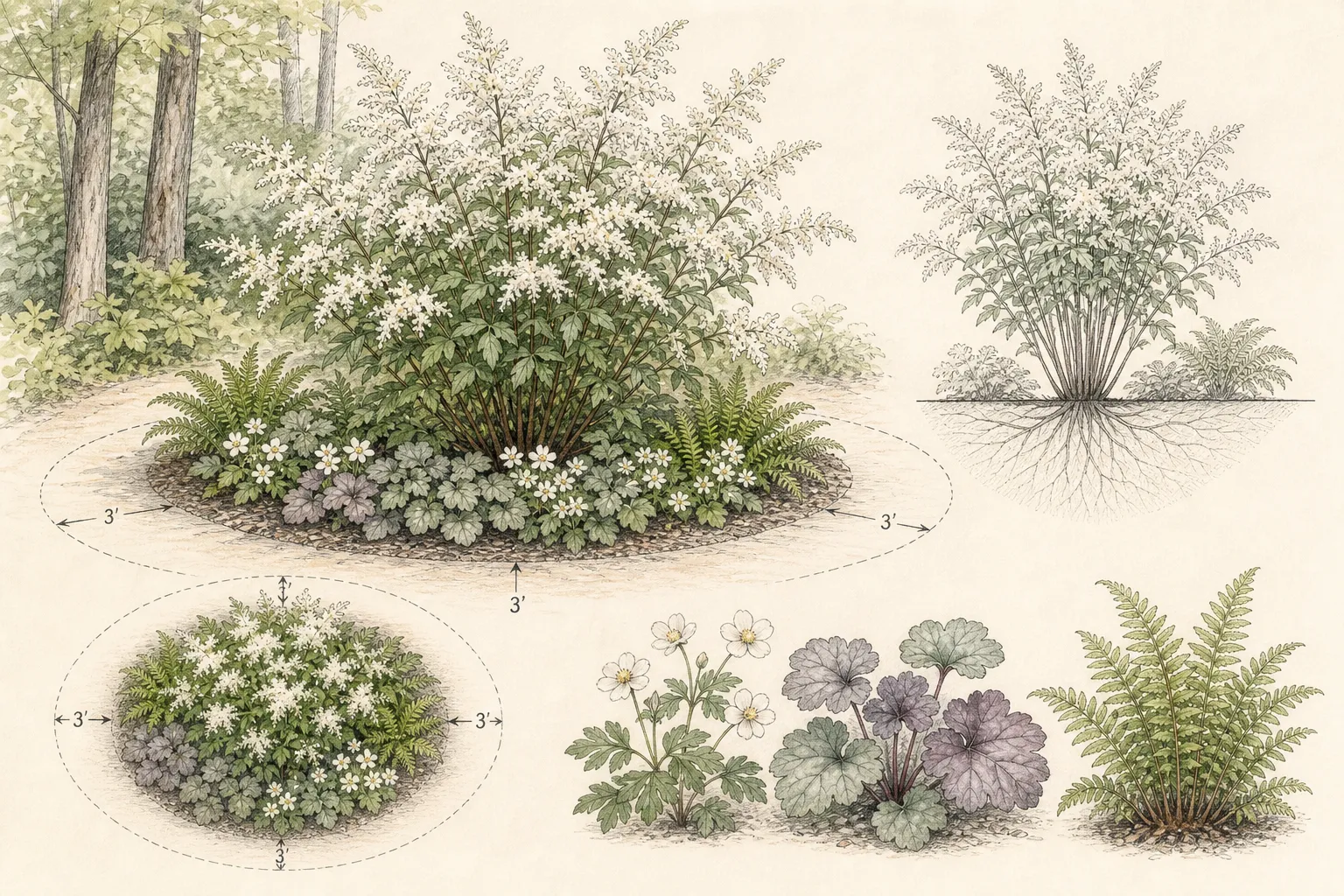
Garden study showing the placement and growth habit of Goat’s Beard
Sources
- Aruncus dioicus plant profile. NC State Extension. Source record · Accessed 2026-08-30.
- Aruncus dioicus Plant Finder record. Missouri Botanical Garden. Source record · Accessed 2026-08-30.
- Aruncus dioicus taxonomy and distribution. Royal Botanic Gardens, Kew. Source record · Accessed 2026-08-30.
- Goatsbeard, Aruncus dioicus. University of Wisconsin–Madison Division of Extension. Source record · Accessed 2026-08-30.