Fragrant Solomon’s Seal
Polygonatum odoratum
Fragrant Solomon’s seal sends angled, arching stems from slender rhizomes, with fragrant spring bells and blue-black fruit; this profile covers shade culture, spread, dieback, pests, and ingestion risk.
Published Last updated
At a glance
- Light
- Partial to full shade
- Water
- Evenly moist but well drained
- Soil
- Fertile, humus-rich, moist but well-drained soil
- Hardiness
- Zones 3–8
- Bloom
- Late spring to early summer
- Height
- 1.5–3 ft · 45–90 cm
In this guide
Overview
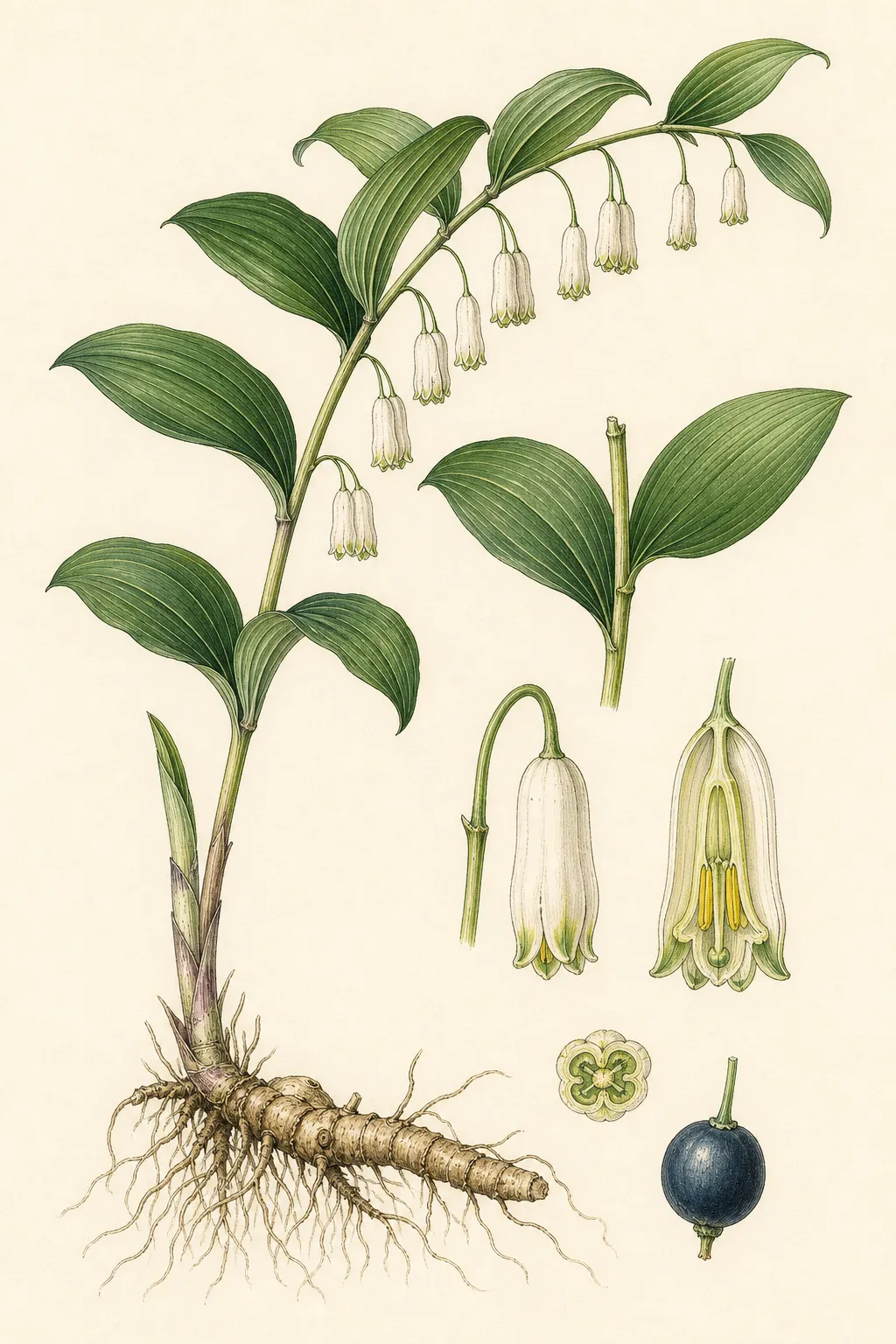
Polygonatum odoratum is a deciduous, rhizomatous herbaceous perennial. Its unbranched stems are distinctly angled and arch outward, carrying alternate elliptic leaves. One or two fragrant, creamy-white tubular flowers tipped green hang from the leaf axils in late spring, and blue-black berries may follow.
The arching stems are most legible where they can lean over a low groundcover or the open edge of a shaded path. Individual stems rise about 1.5–3 ft, while slender rhizomes slowly repeat them into a colony rather than a single dense crown.
Cool, humus-rich, moist but well-drained soil produces the cleanest foliage. Partial to full shade is dependable; hot summer conditions and dry root competition cause early yellowing. Waterlogged soil is also unsuitable even though the plant accepts regular moisture.
For a bare-root division, place the rhizome horizontally a few inches deep and keep it evenly moist, following Wisconsin Extension’s genus guidance. Mark the position because spring shoots are brittle and a broken shoot will not replace its display that season.
The colony needs little pruning. Leave green leaves on the stems, allow them to turn yellow in autumn, and then cut the stems to the base. Lift a complete outer rhizome section only when the drift reaches a path or a delicate companion.
All parts are harmful if eaten, including the attractive berries; this is not an edible woodland plant. Wear gloves when handling it as advised by the RHS, and place fruiting stems where children and dogs cannot sample them.
- Family
- Asparagaceae
- Range
- Europe to Japan
- Soil pH
- 5–7.5
- Spread
- 0.75–1.5 ft and slowly expanding · 23–45 cm and slowly expanding
Planting & careHow to grow fragrant solomon’s seal
The species is hardy across a broad temperate range but performs best in cool shade. Hot summers can shorten the foliage display, and emerging shoots are brittle enough to be lost to foot traffic or cultivation.
- 1Leave room for arching stems
Give 1.5–3 ft arching stems open air above a low companion and keep the slowly widening rhizomes back from high-traffic edges.
- 2Choose cool, sheltered shade
Use partial to full shade with fertile, humus-rich soil. Confirm that the bed stays evenly moist through a dry spell yet drains after heavy rain.
- 3Orient the rhizome and buds
Lay a bare-root division horizontally a few inches deep, with sound buds facing upward. Backfill gently, water to settle the soil, and mark the dormant line of rhizome.
- 4Keep rhizomes evenly moist
Keep the soil evenly moist during establishment and through spring growth, then water during dry summer intervals. Do not leave the rhizomes in standing water.
- 5Protect the brittle spring shoots
Keep feet, hoes, and rakes out of the marked patch as stems emerge. Use a light leaf-mold mulch between stems without covering their bases.
- 6Keep the fruit out of reach
If blue-black berries develop, treat them as harmful ornament rather than food. Remove fruiting stems when their position creates a realistic ingestion risk.
Pruning fragrant solomon’s seal
Leave every green stem until the foliage yellows, then cut it to the base in late autumn. Divide or lift an outer rhizome section in spring, taking care not to break the emerging shoots.
Seasonal care
Spring
Watch for the pointed shoots before cultivating. Divide an encroaching rhizome now, then protect the brittle new stems and inspect them for early slug or sawfly feeding.
Summer
Keep the root zone cool and evenly moist after flowering. Examine rapidly stripped foliage for Solomon’s seal sawfly larvae and distinguish that feeding from scattered slug holes.
Autumn
Do not cut green stems. Once the leaves turn yellow, remove stems at the base and dispose of fruit where it cannot be eaten by children or dogs.
Winter
The colony is fully below ground. Keep its markers in place, prevent winter mulch from becoming a deep cap, and plan any division for spring rather than digging through dormant rhizomes now.
Safety and garden spread
Common problems
Early yellowing or scorch
- Look for
- Leaves yellow or brown well before autumn during hot, dry weather.
- Action
- Check moisture through the rhizome zone and assess reflected heat or unexpected sun. Restore even moisture and shade; do not feed a heat-stressed plant.
Solomon’s seal sawfly
- Look for
- Grayish larvae consume large areas of leaf tissue and can strip stems quickly.
- Action
- Confirm the pale gray larvae on leaf undersides. Healthy plants usually recover after defoliation; tolerate them where possible or remove larvae by hand when practical, as the RHS advises.
Slug and snail feeding
- Look for
- Fresh spring leaves carry irregular holes or rasped surfaces close to the soil.
- Action
- Check after dark, remove hiding places that touch the shoots, and protect new growth with a locally appropriate method only after identifying the feeder.
Rhizome decline in wet ground
- Look for
- A section fails to emerge and the corresponding rhizome is soft or discolored in persistently saturated soil.
- Action
- Stop adding water, inspect drainage, and remove irrecoverable tissue. Replant sound sections only in moist but well-drained soil at their previous depth.
Plant details
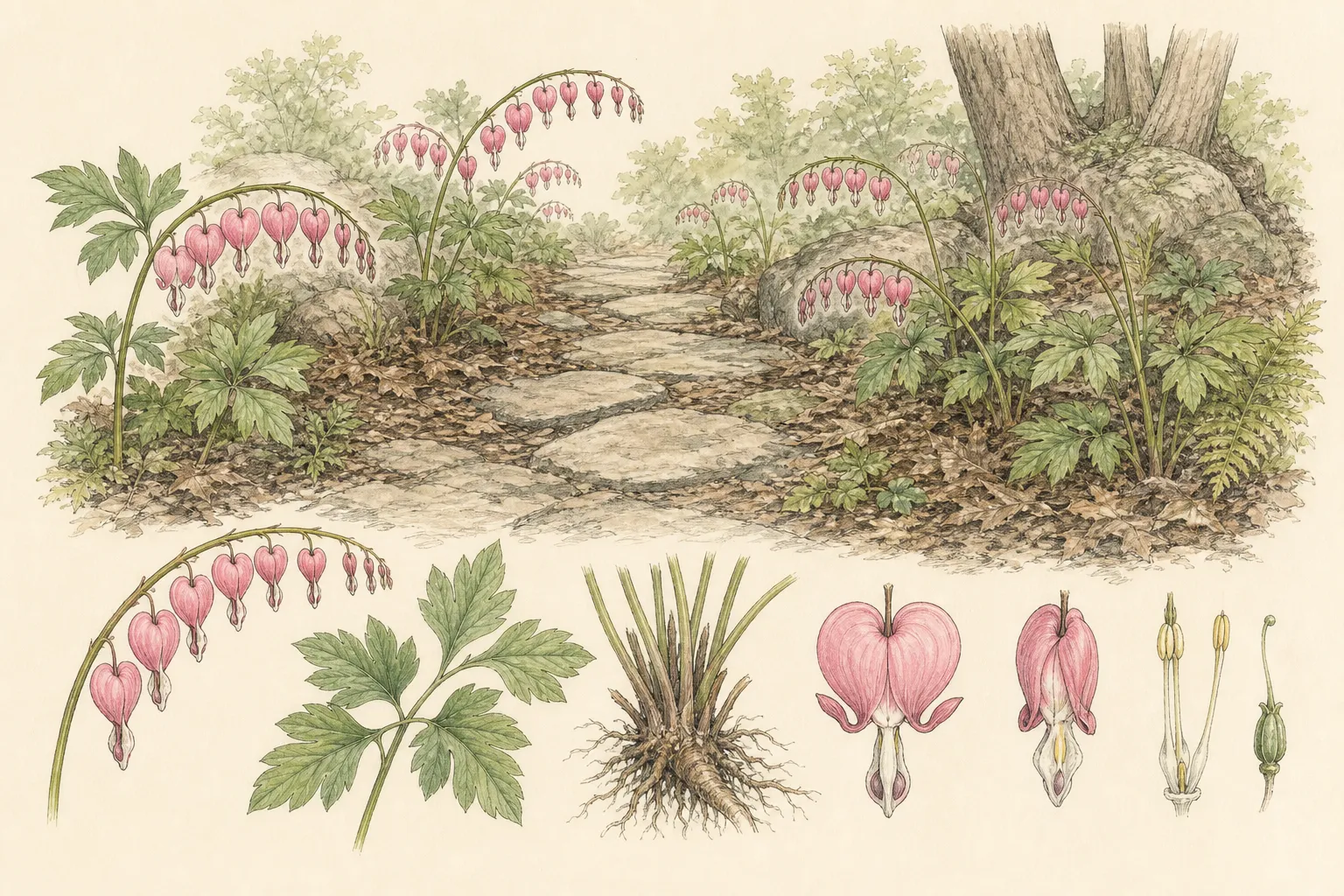
Garden study showing the placement and growth habit of Fragrant Solomon’s Seal
Sources
- Polygonatum odoratum plant profile. Royal Horticultural Society. Source record · Accessed 2026-08-30.
- Polygonatum odoratum Plant Finder record. Missouri Botanical Garden. Source record · Accessed 2026-08-30.
- Polygonatum odoratum taxonomy and distribution. Royal Botanic Gardens, Kew. Source record · Accessed 2026-08-30.
- Solomon’s Seal, Polygonatum spp.. University of Wisconsin–Madison Division of Extension. Source record · Accessed 2026-08-30.
- Solomon’s seal sawfly. Royal Horticultural Society. Source record · Accessed 2026-08-30.