Culver’s Root
Veronicastrum virginicum
A tall native perennial with whorled leaves, candelabra-like flower spikes, and a taproot-rhizome system suited to sunny, moist meadows and borders.
Published Last updated
At a glance
- Light
- Full sun to partial shade
- Water
- Moderate; consistent moisture supports upright growth
- Soil
- Moist, fertile, well-drained soil
- Hardiness
- Zones 3–8
- Bloom
- Early summer to early autumn
- Height
- 4–7 ft · 1.2–2.1 m
In this guide
Overview
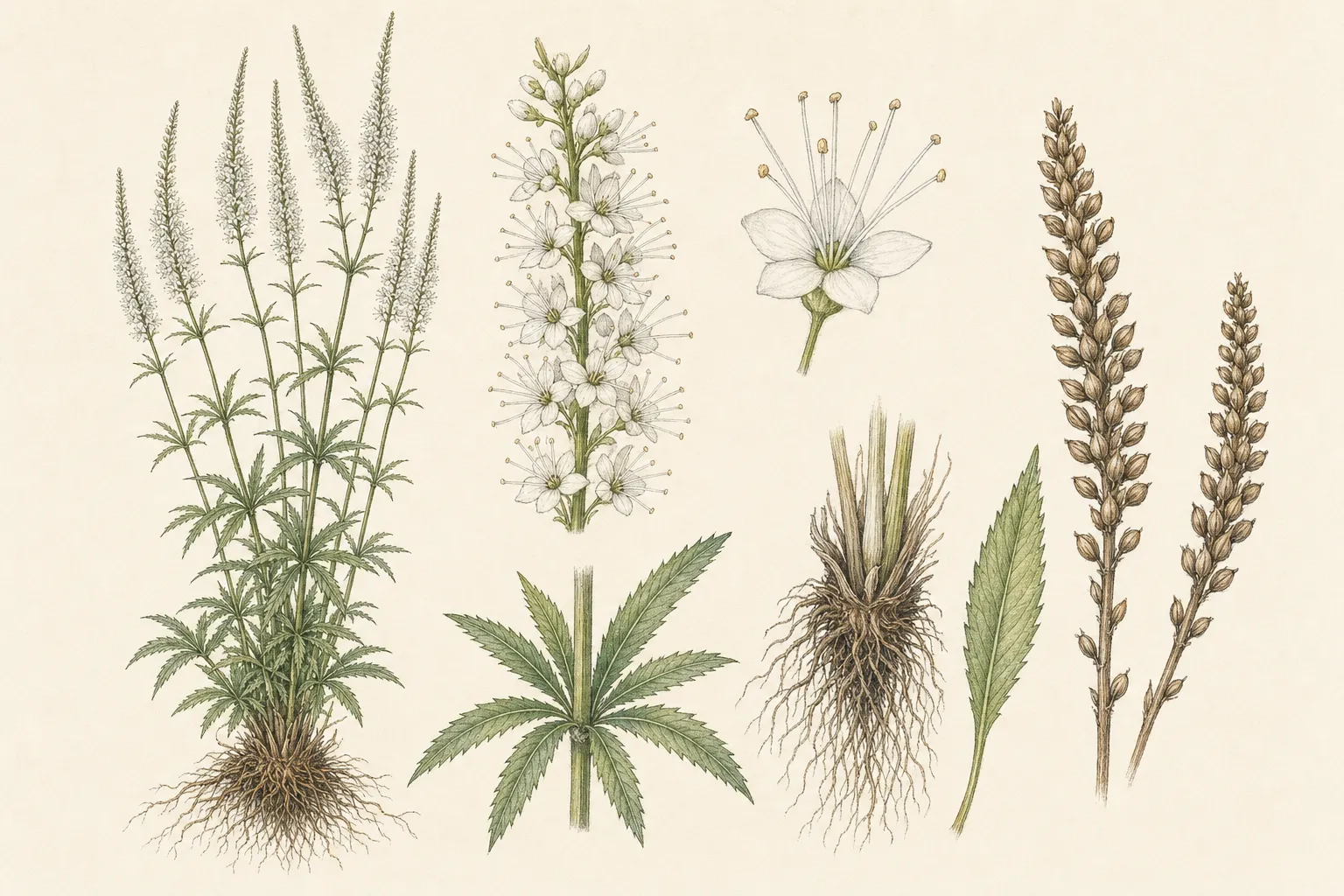
Veronicastrum virginicum is an upright, clump-forming herbaceous perennial. Three to seven finely toothed leaves form a whorl around each smooth stem, and several slender white to pale pink or blue spikes create a candelabra outline. The small flowers open from the top downward, a useful distinction from many bottom-opening spikes.
Garden plants commonly reach 4–7 ft high and 2–4 ft wide. Repeat them through a sunny moist border, meadow, rain garden, or wetland edge where lower companions can cover the stem bases. Leave access for staking and dormant cleanup, and keep the tall clump back from narrow paths.
Full sun and average to wet soil match the retained North Carolina and USDA guidance. The species is adaptable to several soil textures and moisture levels, yet new plants establish slowly. Keep the first-year root zone moist without saturating the small root system; visible top growth may remain modest until the second season.
The root system combines a central taproot with underground rhizomes. Set the crown at surrounding soil level and avoid breaking the rootstock into unbudded pieces. If propagation is needed, divide in late autumn or early spring and keep at least one visible bud on every segment.
Tall stems sometimes need staking, especially in an exposed site. Pinching them sacrifices the strong architectural leaf and flower arrangement, so support is usually the better response. After the main display, cutting spent spikes down to the basal rosette may produce some later bloom.
The roots have a documented history as emetic and cathartic medicine, but the retained sources do not establish safe home preparation or dose. Treat the plant as ornamental, do not ingest it, and obtain nursery-propagated material because conservation status varies by state.
- Family
- Plantaginaceae
- Range
- Eastern and central North America
- Soil pH
- 5.5–7.5
- Spread
- 2–4 ft · 60–120 cm
Planting & careHow to grow culver’s root
Veronicastrum virginicum is native across central and eastern North America, but state conservation status and wetland context differ. Check the current state natural-resources record, use nursery-propagated stock, and never remove roots or seed from a protected wild population.
- 1Reserve a tall 4–7 ft column
Allow 4–7 ft of height and 2–4 ft of width, with a route for staking and late-season stem removal. Place the clump behind lower plants but far enough forward that its basal rosette remains visible.
- 2Choose sun and moist ground
Use full sun for the strongest vertical habit. Select average-moist to occasionally wet soil, and observe the site through both rain and a dry interval so a transient puddle is not mistaken for dependable moisture.
- 3Set the budded crown at grade
Keep the herbaceous crown level with the surrounding bed. Ease the container root system into a hole wider than the pot, preserve visible buds, backfill with site soil, and water once to settle it.
- 4Support slow first-year establishment
Check the young root ball below the surface and water before it dries through, while allowing air back into the soil after irrigation. Expect the first year to be smaller than the mature profile.
- 5Keep the rosette and crown visible
Apply a light mulch beyond the crown to moderate moisture, leaving buds and basal leaves uncovered. Mark the young plant so cultivation does not damage its slowly establishing shoots.
- 6Install support before elongation
If the site is windy, set a discreet ring or stakes while stems are short. Avoid pinching away the whorled architecture; record whether support was actually needed before repeating it next year.
Pruning culver’s root
Do not shear the emerging clump or pinch stems when the candelabra form is the design goal. After the main spikes fade, cut individual flower stems back to the basal rosette if a possible later bloom is wanted. Otherwise retain sound seed capsules temporarily, then cut the dead herbaceous stems near ground level in late autumn or before new spring growth.
Seasonal care
Spring
Remove old stems before new shoots lengthen. Divide only a mature clump that needs propagation, giving every rootstock section a bud, and keep the slowly establishing crown moist. Set supports now if the site is exposed.
Summer
Maintain moist soil as the 4–7 ft stems rise and watch whether they need the prepared support. Let the distinctive whorls and top-opening spikes develop without pinching; water young plants before their small root systems dry.
Autumn
Cut spent spikes to the basal rosette for a possible late display, or retain selected capsules until seed is mature. Late autumn is an appropriate division window when propagation is needed and each section retains a bud.
Winter
The crown and rhizomes are dormant below ground. Remove collapsed stems or leave sound ones briefly for structure, then complete cleanup before spring shoots emerge and keep winter mulch off the crown.
Safety and garden spread
Common problems
Slow first-year growth
- Look for
- A newly planted crown remains small but has firm green leaves and no soft or discolored base.
- Action
- Treat this as normal establishment when the crown is sound. Maintain even moisture, keep weeds away, and assess vigor in the second growing season before moving or feeding it.
Young roots fail in saturated soil
- Look for
- A new plant wilts while the small root zone stays waterlogged, or the crown becomes soft before it has established.
- Action
- Stop automatic irrigation, restore drainage and air to the root zone, and confirm crown depth. Replace irrecoverable material only after the site can remain moist without staying saturated.
Tall stems need support
- Look for
- Flowering stems bend after wind or rain even though leaves remain healthy and the crown is firm.
- Action
- Tie stems loosely to support installed around the clump. Next spring set the support earlier; avoid pinching unless losing the plant’s architectural form is acceptable.
Few flowers in a shaded position
- Look for
- The plant makes elongated stems and sparse spikes while a brighter part of the clump performs better.
- Action
- Reduce overhead shade if that can be done safely, or move a young plant during dormancy to a sunnier moist site. Support current stems while waiting for the appropriate move window.
Plant details
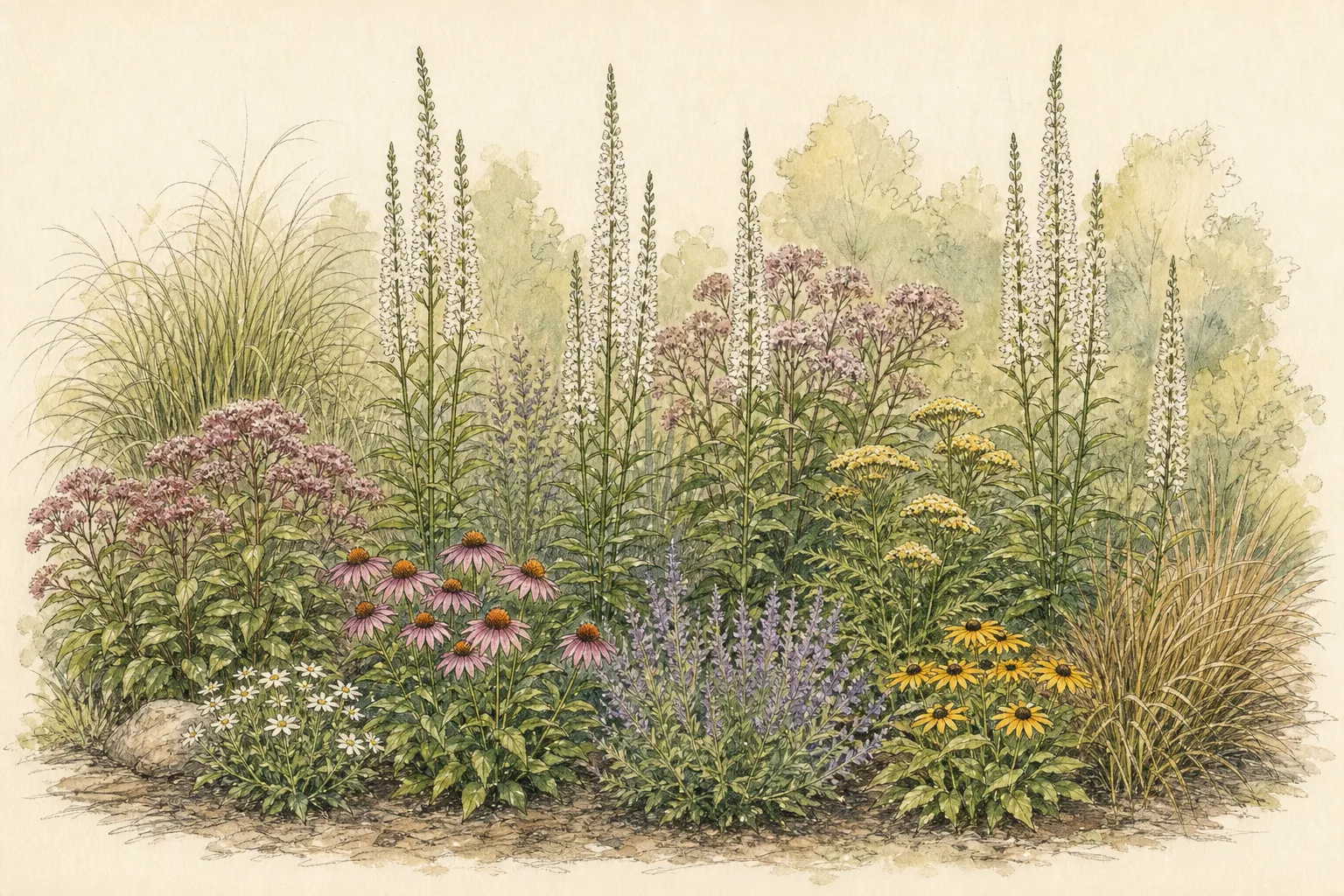
Garden placement study showing mature Culver’s Root in an ornamental planting
Sources
- Veronicastrum virginicum. North Carolina Extension Gardener Plant Toolbox. Source record · Accessed 2026-08-30.
- Culver's Root, Veronicastrum virginicum Plant Fact Sheet. USDA PLANTS Database. Source record · Accessed 2026-08-30.
- Veronicastrum virginicum (L.) Farw.. Royal Botanic Gardens, Kew. Source record · Accessed 2026-08-30.