Common Ninebark
Physocarpus opulifolius
A species-focused guide to common ninebark's exfoliating bark, arching habit, adaptable soil, old-wood flowers and selective renewal.
Published Last updated
At a glance
- Light
- Full sun to partial shade
- Water
- Moderate; adaptable once established
- Soil
- Average, well-drained soil; tolerates clay
- Hardiness
- Zones 2–8
- Bloom
- Late spring to early summer
- Height
- 5–10 ft · 1.5–3 m
In this guide
Overview
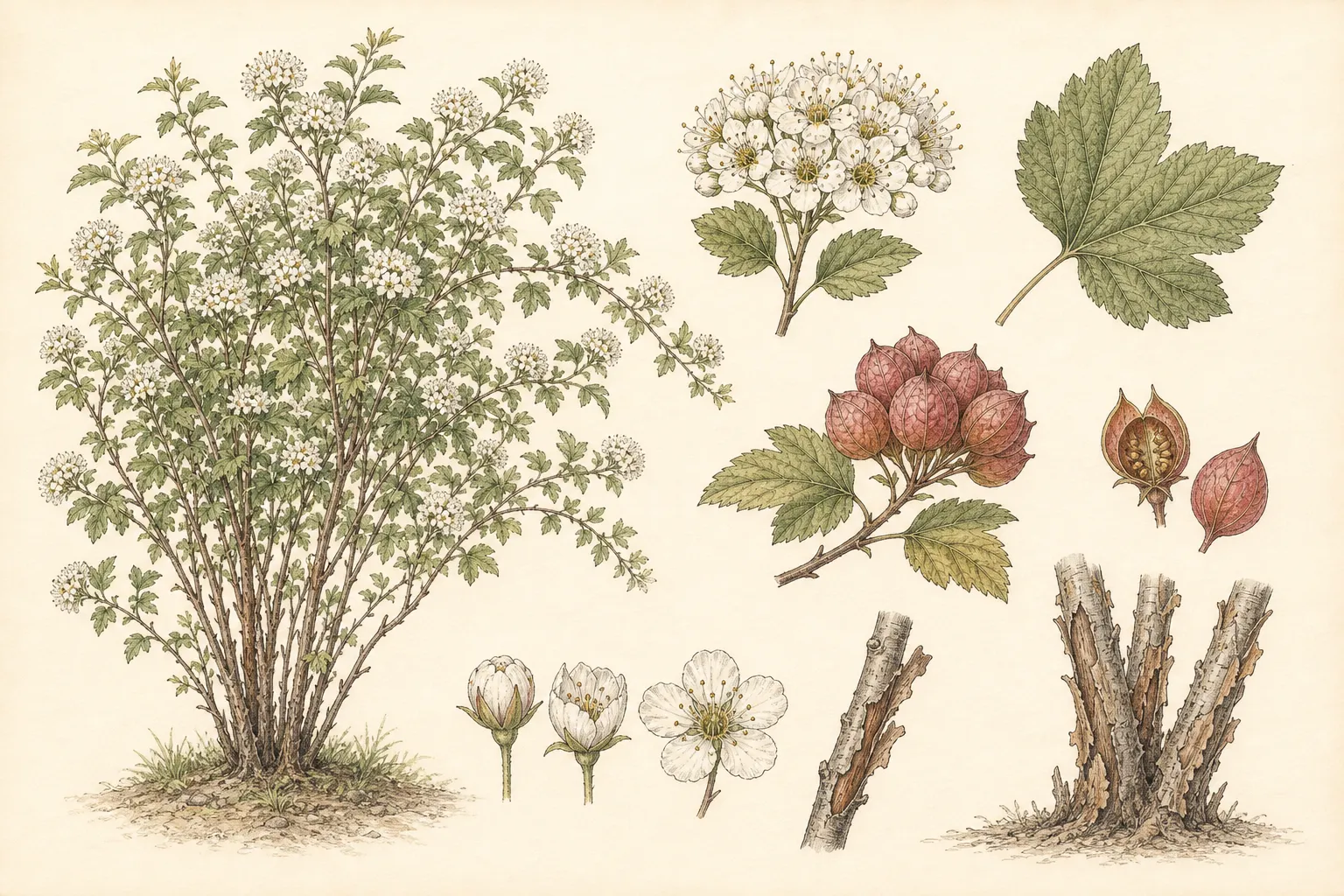
Common ninebark is a fast-growing, multi-stemmed deciduous shrub. Rounded clusters of white to pinkish flowers appear from late spring into summer, followed by red seed capsules. Three- to five-lobed leaves and the papery strips of reddish-brown bark on older stems separate it from similarly sized hedge shrubs.
A species plant makes a broad screen, informal hedge, bank planting, or rain-garden shrub. North Carolina Extension gives the species a typical height of 5–8 feet and width of 4–6 feet, while USDA records plants up to about 10 feet tall. Leave enough width to see the arching stems instead of forcing them into a narrow clipped outline.
Full sun to partial shade suits the species. Plants in the northern part of the range can take full sun, while some afternoon shade is useful near the southern limit. Deep shade usually reduces bloom and makes colored-leaf cultivars less distinctive.
Ninebark grows in clay, loam, or sand and tolerates a wider pH range than many flowering shrubs. A slightly acidic, dry-to-medium soil with reliable drainage is a dependable garden baseline, although wild populations also occur beside streams and in moist thickets. Site adaptation does not make a chronically saturated planting hole harmless.
Flowers are carried on older growth. If size correction is needed, prune just after bloom and finish by mid-August so the next flower crop is not removed. An overgrown plant can be rejuvenated much harder during winter, but cutting all stems to the ground trades the following display for new framework.
North Carolina Extension identifies powdery mildew and fire blight as the principal problems. Keep the natural spacing open enough to inspect leaves and shoot tips, then confirm the symptom pattern before choosing sanitation or a locally recommended treatment.
- Family
- Rosaceae
- Range
- Eastern and central North America
- Soil pH
- 5–7.5
- Spread
- 4–6 ft · 1.2–1.8 m
Planting & careHow to grow common ninebark
Common ninebark is native across much of central and eastern North America, with regional varieties and outlying populations. It is introduced beyond that range. Species plants and compact or colored-leaf cultivars differ markedly in finished size, so confirm the label and local status before using it in a native planting or a small border.
- 1Allow for an arching shrub
Allow about 5–8 feet of height and 4–6 feet of width for a typical species plant, checking the label for cultivars or regional plants that mature outside that range.
- 2Match light to the region
Choose full sun to partial shade, giving southern gardens some protection from the hottest afternoon exposure while retaining enough direct light for flowering.
- 3Set the root ball at grade
Place the top of the container root ball level with the surrounding soil, loosen circling roots where possible, and keep soil and mulch off the bases of the multiple stems.
- 4Establish the whole root ball
Water the root ball and adjacent soil thoroughly after planting. During the first season, check both zones before watering again so the original potting mix does not dry while surrounding clay remains wet.
- 5Keep the base visible
Spread a shallow mulch beyond the root ball to moderate moisture and weeds, leaving a clear ring around every stem so basal bark and new shoots remain visible.
- 6Record the selection
Keep the cultivar label and compare its stated size and leaf color with the plant after several seasons; purple foliage can respond differently to sun exposure among selections.
Pruning common ninebark
Ninebark usually needs selective thinning rather than shearing. After flowering, remove damaged stems and take a few of the oldest stems to the base when renewal is needed; complete this work by mid-August because the next flowers form on old growth. Reserve a winter cut to the ground for deliberate rejuvenation, knowing that it sacrifices the next bloom cycle.
Seasonal care
Spring
Watch the lobed leaves and flower clusters develop on retained stems. Remove only clearly dead wood before bloom, refresh a shallow mulch away from the stem bases, and avoid nitrogen feeding that produces soft growth.
Summer
Prune for size immediately after the white-pink flower clusters fade and finish by mid-August. During dry spells, check newly planted root balls and inspect crowded foliage for powdery mildew.
Autumn
Let red capsules and maturing bark provide seasonal interest, clear diseased fallen leaves where a diagnosis calls for sanitation, and continue establishment watering until the deciduous shrub enters dormancy.
Winter
Use the leafless season to view the exfoliating bark and decide whether an old, congested shrub truly needs rejuvenation. A ground-level winter cut is an occasional reset, not annual maintenance.
Safety and garden spread
The North Carolina Extension and USDA profiles do not flag common ninebark as poisonous, but they do not establish edibility. Keep plant material out of the mouth and use ordinary garden hygiene after handling.
Common problems
Powdery mildew
- Look for
- White powdery growth on leaves, often heaviest inside dense growth or on susceptible cultivars.
- Action
- Thin only enough to improve light and air movement, avoid repeatedly wetting foliage late in the day, and confirm a local treatment only if damage is more than cosmetic.
Fire blight-like shoot dieback
- Look for
- Rapidly blackened shoot tips, wilted flower clusters, or hooked young stems rather than uniform winter injury.
- Action
- Seek an Extension diagnosis before cutting because several injuries resemble fire blight; if confirmed, follow current sanitation and tool-disinfection guidance for the region.
Few flowers
- Look for
- Vigorous leaves with sparse clusters, bloom only on the bright side, or no buds after late-summer pruning.
- Action
- Compare the site with the full-sun to partial-shade range and review pruning dates. Move size-control pruning to just after bloom before adding fertilizer.
An overgrown framework
- Look for
- Old stems crowd the center, arch across access routes, or require repeated topping to stay inside the allotted bed.
- Action
- Remove a limited number of the oldest stems at ground level after bloom. Where the footprint itself is wrong, replace the shrub with a smaller cultivar instead of shearing it every year.
Plant details
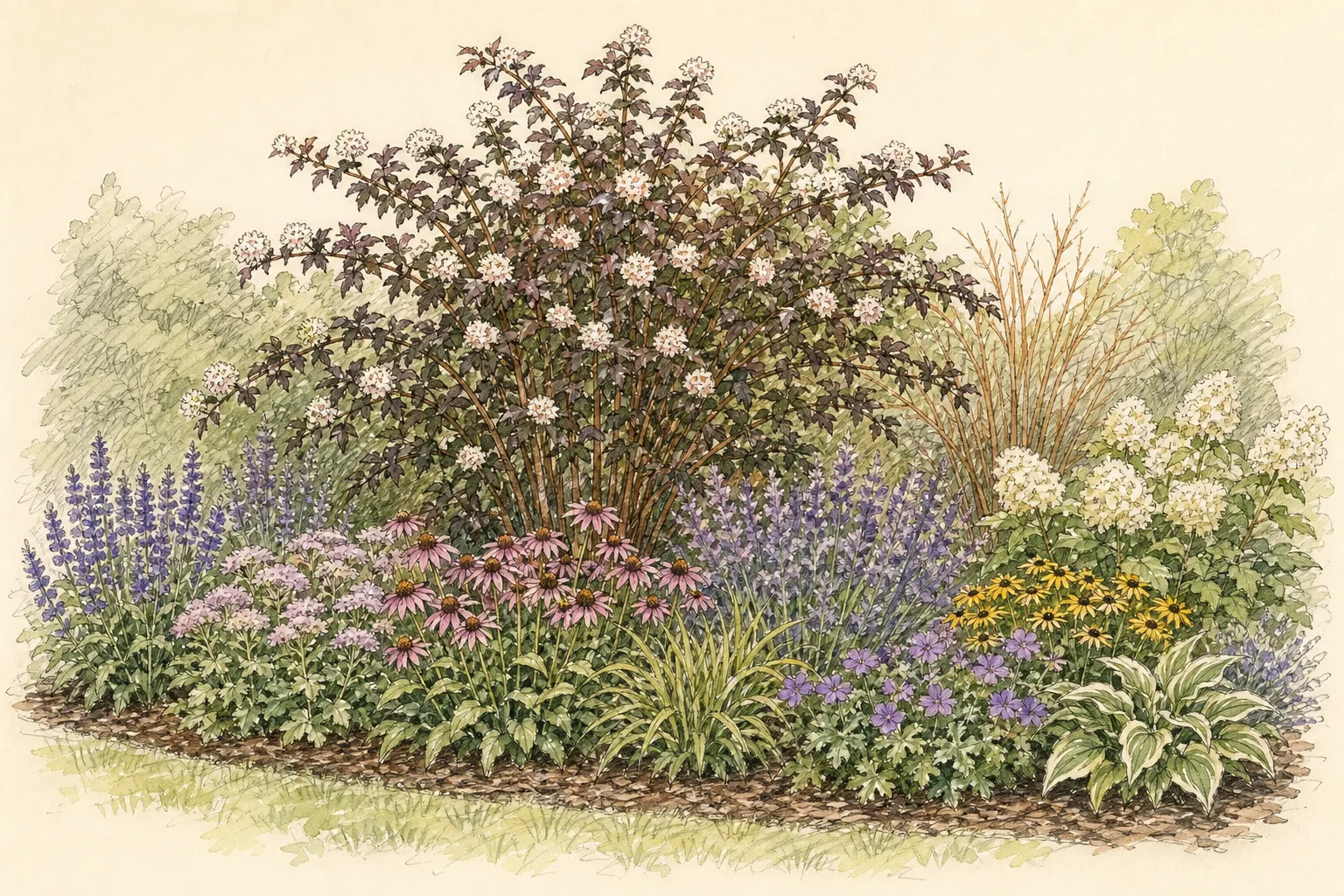
Garden placement study showing mature Common Ninebark in an ornamental planting
Sources
- Physocarpus opulifolius. North Carolina Extension Gardener Plant Toolbox. Source record · Accessed 2026-08-20.
- Physocarpus opulifolius (L.) Maxim.. Royal Botanic Gardens, Kew. Source record · Accessed 2026-08-20.
- Atlantic Ninebark. USDA Natural Resources Conservation Service. Source record · Accessed 2026-08-20.