Chestnut-Leaved Rodgersia
Rodgersia aesculifolia
Chestnut-leaved rodgersia is a bold rhizomatous perennial for reliably moist ground, valued for horse-chestnut-like leaves, summer panicles, and an expanding architectural clump.
Published Last updated
At a glance
- Light
- Partial shade; full sun only in cool sites with consistently moist soil
- Water
- Medium to wet; keep consistently moist
- Soil
- Rich, humusy, consistently moist soil
- Hardiness
- Zones 5–7
- Bloom
- Early to midsummer
- Height
- 3–5 ft · 90–150 cm
In this guide
Overview
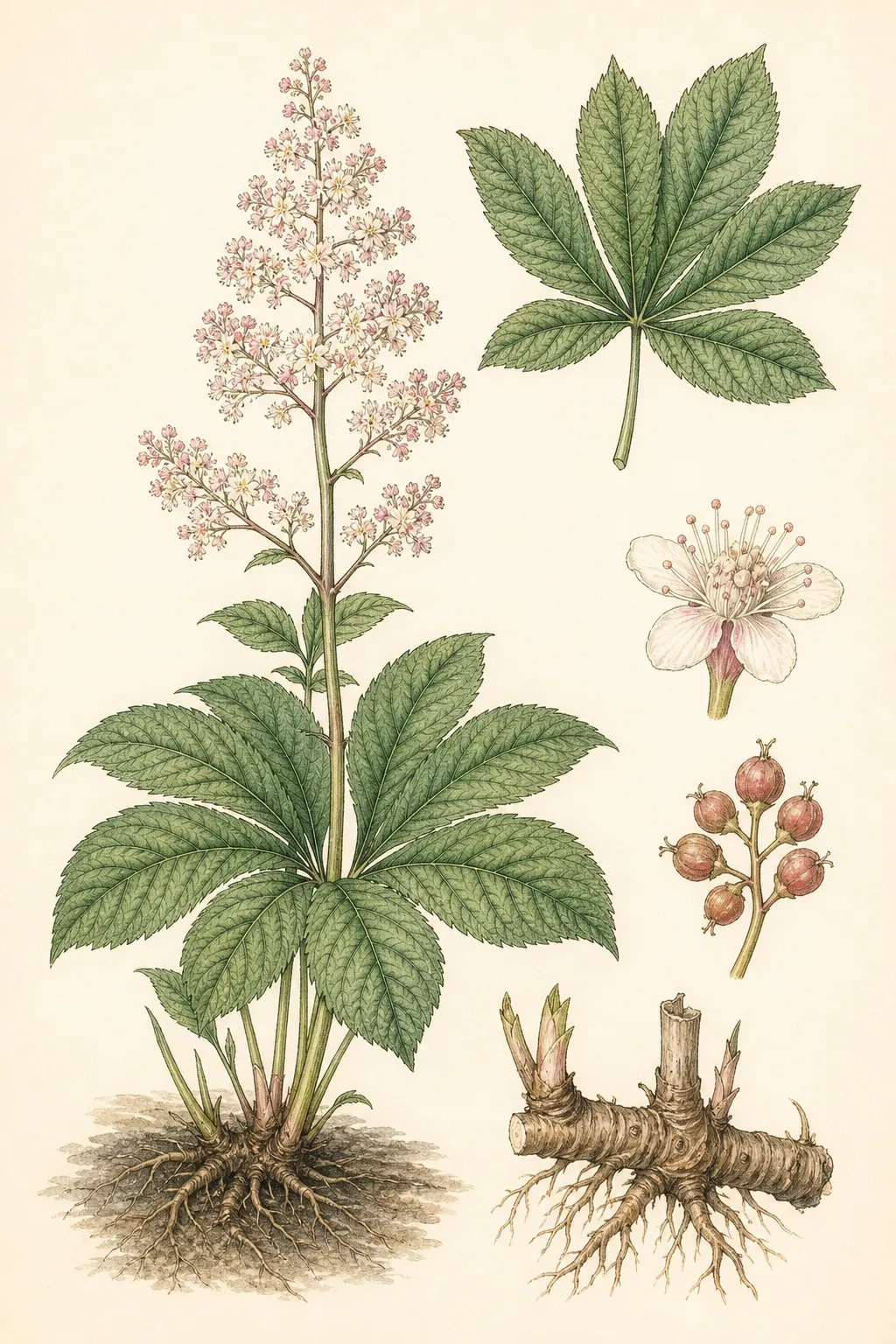
Rodgersia aesculifolia is a deciduous, rhizomatous herbaceous perennial in the saxifrage family. Large basal leaves are palmately divided into five to nine strongly veined leaflets, resembling a horse-chestnut leaf. Creamy-white or pale-pink flowers open in large terminal panicles in summer.
The foliage, more than the flowers, gives the plant its architectural role. A settled clump reaches about 3–5 ft in height and spread, so it works beside a pond, in a moist woodland opening, or at the rear of a deep border rather than beside a narrow path.
Rich soil that remains consistently moist is essential. Part shade is the dependable position; full sun can work in cool climates if the root zone never dries. The broad leaves show site stress quickly as brown margins, scorching, or wind tears.
Set a container-grown plant at the same depth it occupied in its pot and water the full root ball. Keep organic mulch between the emerging shoots instead of over them. The bed may be moisture-retentive or even poorly drained, but newly added organic matter should be distributed across the planting area rather than packed into one small hole.
Thick rhizomes slowly enlarge the clump and can naturalize in favorable ground. Divide in spring only when the plant crosses its boundary or a section is needed elsewhere; divisions may take time to regain mature scale.
Spent flower stalks can be cut after bloom, while healthy leaves should remain until frost. Once the foliage collapses, remove it so a wet mat does not cover the dormant buds.
- Family
- Saxifragaceae
- Range
- Assam through China to northern Myanmar
- Soil pH
- 5–7
- Spread
- 3–5 ft · 90–150 cm
Planting & careHow to grow chestnut-leaved rodgersia
US sources place the species mainly in zones 5–7. Full sun is realistic only in cool climates with dependable moisture; hot afternoon exposure and drying wind can damage the broad leaves.
- 1Make room for the five-foot clump
Reserve a 3–5 ft-wide patch and keep the center reachable without stepping on the rhizomes. This is a substantial foliage plant, not a narrow edging perennial.
- 2Test the bed for reliable moisture
Choose rich ground that stays moist through a dry spell. Prefer partial shade and shelter from drying wind; reserve full sun for cool sites where irrigation or natural moisture is dependable.
- 3Keep the rhizomatous crown at nursery depth
Set the top of the root ball level with the surrounding bed. Water thoroughly after backfilling and keep leaf mold or compost away from visible buds and new shoots.
- 4Water beneath the leaf canopy
Check below the large leaves, where rain may not wet the root ball evenly. Water whenever the soil begins to lose its even moisture, especially during establishment and flower-stem extension.
- 5Shield emerging foliage
Mark the dormant crown and avoid spring cultivation through it. Keep newly opened leaves out of foot traffic and protect the planting from the cold, drying wind noted in the RHS guidance.
- 6Define the future rhizome edge
Choose a boundary that can be inspected each spring. Lift a complete outer rhizome section if the clump reaches a path; do not repeatedly chop through the center.
Pruning chestnut-leaved rodgersia
Cut spent flower stalks after bloom if they are untidy, but retain healthy foliage until frost. Remove collapsed leaves at the base in autumn, and divide an encroaching clump only in spring.
Seasonal care
Spring
Clear last year’s collapsed material before the leaves unfurl. Divide only now, keeping sound buds and roots on each piece, and avoid damaging the newly opened foliage.
Summer
Do not let the bed dry while the panicles rise. Remove spent flower stalks if desired, inspect low leaves for slugs, and use browning margins as an early signal to check moisture and exposure.
Autumn
Let sound leaves continue feeding the rhizomes. After frost collapses them, cut the foliage at the base and remove the wet mass from the crown.
Winter
Keep the dormant position marked and the buds free of piled mulch. Review whether drying wind or summer drought, rather than winter cold, caused the previous season’s leaf damage.
Safety and garden spread
The retained institutional plant profiles do not flag this species as harmful. That is not evidence of edibility; keep it as an ornamental and use routine garden hygiene.
Common problems
Brown leaf margins
- Look for
- Crisp brown tissue begins at the edges of the large leaflets, especially after heat or a dry interval.
- Action
- Probe the whole root zone and restore consistent moisture. If the soil is already moist, assess hot afternoon sun and drying wind rather than adding fertilizer.
Slug-damaged new leaves
- Look for
- Irregular holes and scraped patches appear while the foliage is still close to damp soil.
- Action
- Inspect at night, reduce dense hiding places immediately against the crown, and use a locally appropriate targeted control only after confirming slugs.
Wind-torn foliage
- Look for
- Large leaflets split along veins even though color and soil moisture remain normal.
- Action
- Move temporary objects that funnel wind and add a permeable windbreak if exposure is persistent. Do not cut sound torn leaves solely for appearance.
Rhizomes beyond the intended patch
- Look for
- New leaf stalks appear in a path or inside the crown of a smaller companion.
- Action
- Wait until spring, trace the outer rhizome, and lift a complete section with buds and roots. Re-establish a visible boundary rather than shearing the leaves.
Plant details
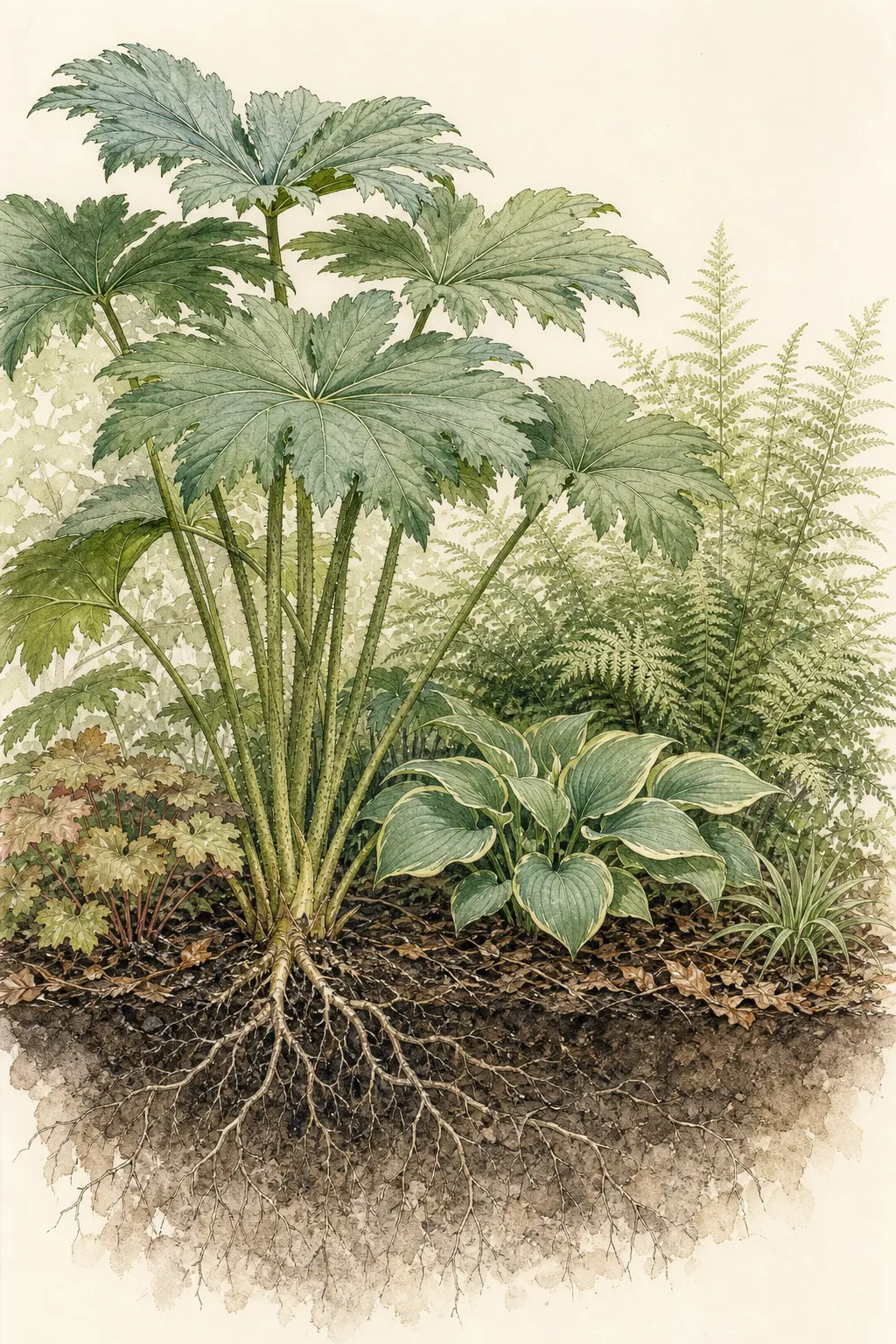
Garden study showing the placement and growth habit of Chestnut-Leaved Rodgersia
Sources
- Rodgersia aesculifolia plant profile. Royal Horticultural Society. Source record · Accessed 2026-08-30.
- Rodgersia aesculifolia Plant Finder record. Missouri Botanical Garden. Source record · Accessed 2026-08-30.
- Rodgersia aesculifolia taxonomy and distribution. Royal Botanic Gardens, Kew. Source record · Accessed 2026-08-30.