Buttonbush
Cephalanthus occidentalis
A large native wetland shrub with spherical white flower heads, whorled or opposite leaves, persistent fruit, and a strict need for reliable moisture.
Published Last updated
At a glance
- Light
- Full sun to partial shade
- Water
- Consistently moist to wet; tolerates flooding
- Soil
- Moist to wet clay, loam, sand, or organic soil; drought intolerant
- Hardiness
- Zones 4–11
- Bloom
- Early summer to early autumn
- Height
- 6–12 ft · 1.8–3.6 m
In this guide
Overview
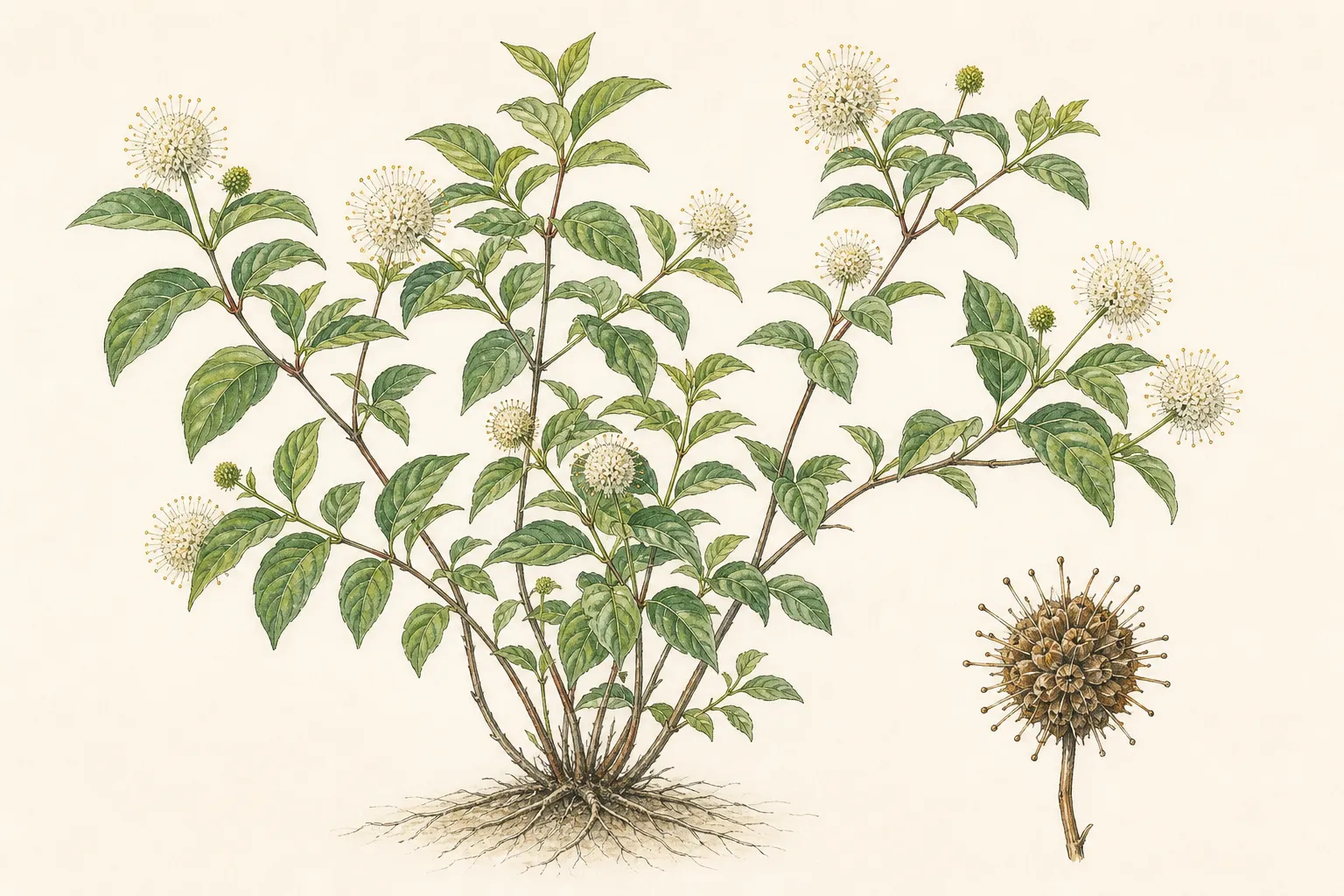
Cephalanthus occidentalis is a deciduous, usually multistemmed wetland shrub in the coffee family. Creamy white tubular flowers are packed into round heads, and the long projecting styles create the familiar pincushion effect. Glossy leaves occur opposite one another or in whorls of three and have smooth margins; the flower heads mature into reddish-brown clusters of small nutlets that often persist into winter.
A full-size landscape plant commonly reaches 6–12 ft high and 6–10 ft wide, with older wild plants sometimes becoming small trees. Reserve that broad irregular crown for a pond margin, wet swale, streambank, or the low shelf of a large rain garden. Dwarf cultivars need their own label dimensions and should not be used to infer the species size.
Buttonbush requires consistently moist to wet soil and tolerates periodic or standing water; it is poorly suited to a dry foundation bed. Full sun to partial shade is acceptable, but flowering becomes sparse in deep shade or dry soil. Clay, loam, sand, and organic soils can work when water remains available and salt exposure is low.
Install the shrub at the same depth it grew in the container, with the root flare and basal stems unburied. Settle soil around the root ball and keep it continuously moist while roots extend into the surrounding wet zone. A rain garden that only receives brief runoff but dries hard for weeks is not equivalent to buttonbush habitat.
The natural outline is rounded to irregular and needs little pruning. Where access or renewal is necessary, remove dead wood and selected old stems during dormancy rather than shearing the crown. Leave sound fruiting heads for winter structure and wildlife unless a specific maintenance need calls for removal.
The bark is not safe to ingest: institutional sources identify cephalathin and warn of vomiting, convulsions, and paralysis. Historical medicinal use is not a garden-care recommendation. Wear normal work gloves, collect pruned bark and stems, and keep them away from children, pets, and livestock.
- Family
- Rubiaceae
- Range
- Eastern Canada through the United States to Central America and Cuba
- Soil pH
- 5–7.5
- Spread
- 6–10 ft · 1.8–3 m
Planting & careHow to grow buttonbush
UF/IFAS lists landscape use from USDA zones 4–11, while cold-region references often give a narrower range. Full-size plants and dwarf cultivars differ greatly, and dependable soil moisture is essential everywhere; confirm local hardiness and high-water behavior before planting beside engineered drainage or natural waterways.
- 1Allow for the full-size crown
Reserve roughly 6–12 ft in height and 6–10 ft in spread for the species, keeping it clear of narrow walks, small basin centers, utilities, and structures. Use label dimensions for a dwarf cultivar.
- 2Verify persistent moisture
Observe the site after rain and through a dry interval. Choose soil that remains consistently moist to wet or floods periodically; reject a basin that becomes drought-dry between storms.
- 3Use enough light for bloom
Place the shrub in full sun to partial shade. Account for future tree-canopy expansion because deepening shade reduces flowering and creates a looser framework.
- 4Keep the woody base unburied
Set the root flare at the container’s original grade even in saturated soil, correct circling roots, and backfill without burying basal stems. Protect the young shrub from mower and string-trimmer injury.
- 5Keep the root ball wet
Water thoroughly after planting and maintain moisture through establishment, including droughts when a pond or swale recedes. Probe inside the original root ball rather than assuming nearby surface water has wetted it.
- 6Plan safe debris handling
Choose a location where toxic bark and pruned stems can be collected without entering play or grazing areas. Do not leave cut material where children, pets, or livestock can chew it.
Pruning buttonbush
Buttonbush normally needs little pruning. During late winter or early spring dormancy, remove dead or damaged wood and, if renewal is needed, take selected old stems at ground level while retaining a broad multistem framework. Avoid routine shearing. Treat every cut stem and piece of bark as potentially toxic if ingested and collect the debris promptly.
Seasonal care
Spring
Before leaf-out, remove only necessary dead or interfering wood and confirm that winter water movement has not buried the root flare or eroded the root ball. Restore consistent moisture as growth begins.
Summer
Keep the root zone moist to wet while fragrant spherical flowers open. During drought or a receding pond, inspect new plants closely and irrigate before leaves wilt or branch tips die back.
Autumn
Allow reddish-brown fruit heads to mature for wildlife and winter form. Clear only debris that blocks drainage infrastructure, and continue watering a recent planting if autumn is dry.
Winter
Inspect the dormant multistem structure after ice or high water and schedule limited renewal before spring growth. Collect all bark and pruning debris rather than leaving it in browse or play areas.
Safety and garden spread
Common problems
Drought stress and dieback
- Look for
- Leaves wilt or brown and young branch tips die during an extended dry interval, especially after water recedes from the site.
- Action
- Check moisture inside the occupied root zone and restore deep, sustained watering. If the site repeatedly dries hard, move the shrub to a genuinely moist-to-wet position.
Few flower heads
- Look for
- A leafy shrub produces few spherical blooms, with most flowers confined to the brightest or wettest side.
- Action
- Compare seasonal sun and soil moisture across the root zone. Relieve remediable shade or drought; fertilizer cannot compensate for a dry or deeply shaded site.
Buried or eroded base
- Look for
- Sediment covers the flare after flooding, or runoff exposes and undercuts roots on one side of the shrub.
- Action
- Restore the original grade without piling soil against stems, stabilize the surrounding flow path, and seek site-specific stormwater guidance where engineered drainage is involved.
Potential ingestion
- Look for
- Chewed bark or missing prunings where a child, pet, horse, or other livestock may have had access.
- Action
- Remove access to the plant material and contact the appropriate poison-control center or veterinarian promptly; do not wait for vomiting, convulsions, or paralysis to appear.
Plant details
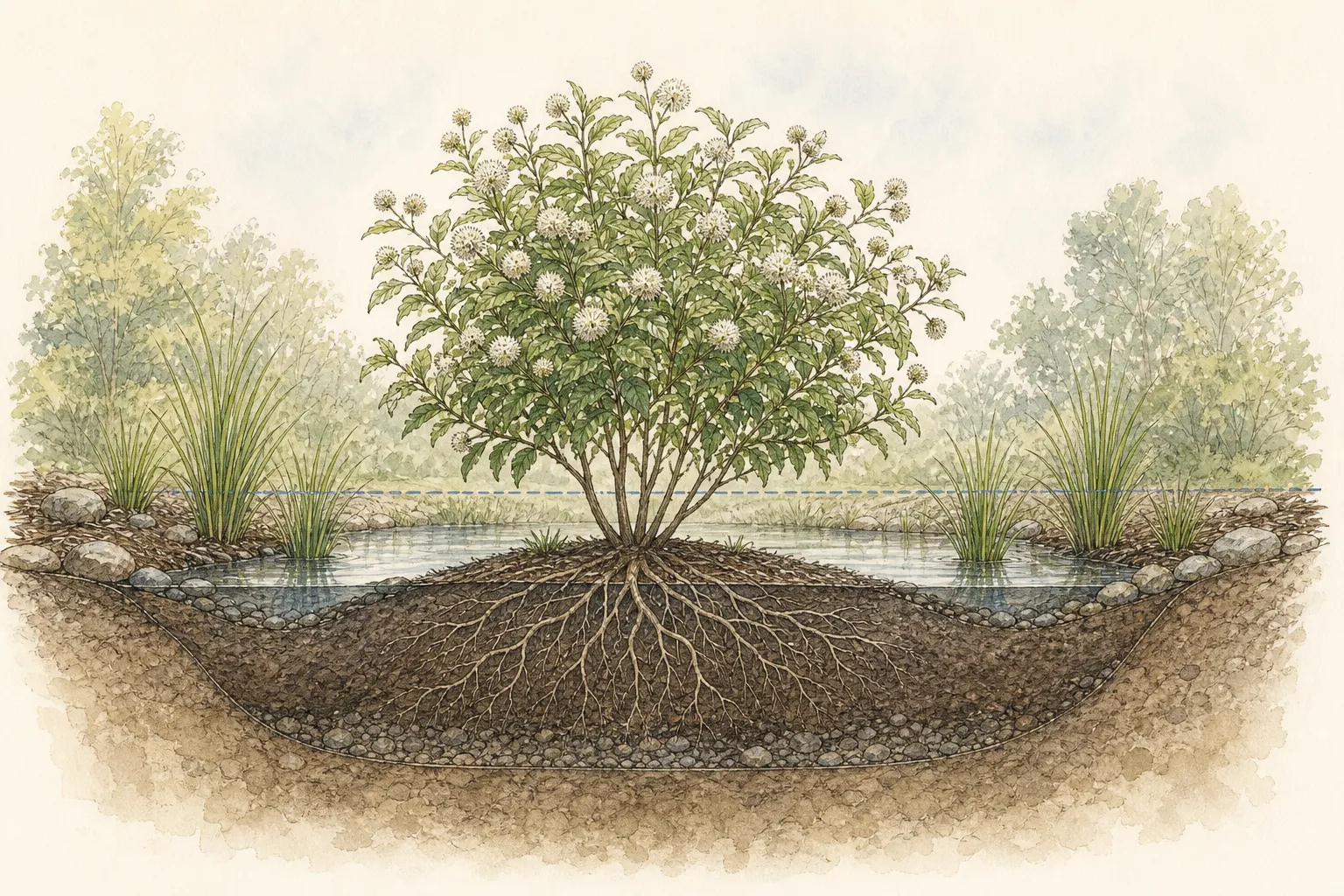
Rain-garden section with a multistem buttonbush on saturated soil between shallow pools and wetland companions
Sources
- Cephalanthus occidentalis. North Carolina State Extension. Source record · Accessed 2026-08-30.
- Cephalanthus occidentalis: Buttonbush. University of Florida IFAS Extension. Source record · Accessed 2026-08-30.
- Common Buttonbush Plant Guide. USDA Natural Resources Conservation Service. Source record · Accessed 2026-08-30.
- Cephalanthus occidentalis L.. Royal Botanic Gardens, Kew. Source record · Accessed 2026-08-30.