Bodnant Viburnum
Viburnum × bodnantense
An upright deciduous shrub with fragrant pink-to-pale flower clusters on bare wood, deeply veined leaves and a winter display shaped by the local climate.
Published Last updated
At a glance
- Light
- Full sun to partial shade; shelter helps preserve winter flowers
- Water
- Moist, freely draining soil; check the nursery root ball through the first one or two years and water during dry spells
- Soil
- Moderately fertile, humus-rich, moist but well-drained soil; suitable loam, sand or clay with working drainage
- Hardiness
- Zones 5–8
- Bloom
- Late autumn to spring in mild winters; chiefly late winter to spring in colder climates
- Height
- Typically 8–10 ft; older specimens can be taller · Typically 2.4–3 m; older specimens can be taller
In this guide
Overview
Bodnant viburnum brings fragrance to the garden when many deciduous shrubs are bare. Viburnum × bodnantense carries clusters of small tubular flowers on its woody framework, often opening pink and fading paler. In a mild winter, flowering can begin in late autumn and continue in spells into spring. Colder gardens usually see the main display later. Choose a site for the mature shrub and its winter flowers, then reserve any routine thinning until the bloom has finished.
This is a garden hybrid between V. farreri and V. grandiflorum, raised at Bodnant in North Wales in the 1930s. It is distinct from the spring-flowering Koreanspice viburnum and from evergreen winter-flowering viburnums such as V. tinus. Check the full label, including the cultivar. A bare plant in a nursery pot can look unremarkable until its small flower clusters open; the name and eventual dimensions are more useful buying information than its current height.
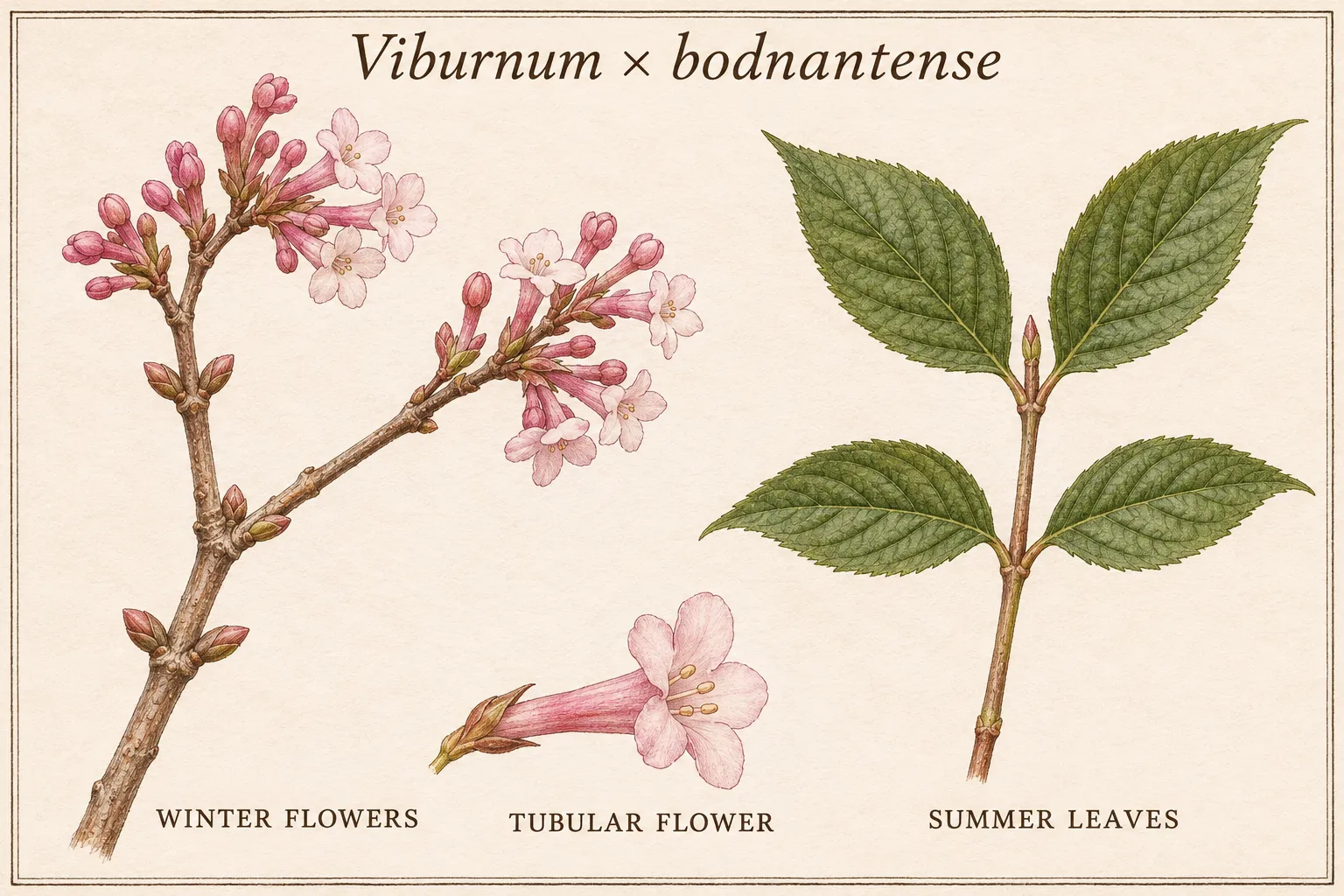
The leaves are opposite, simple and toothed, with conspicuous impressed veins. Oregon State describes the leaves of Dawn at about 5–10 cm long, bronze when young and deep green later. NC State records orange, red and purple autumn colour. The leaf study in the identification plate represents the growing season; the flowering branch represents the largely leafless winter display. Their combination shows the plant across seasons.
On Dawn, rich rose-coloured buds open into pink flowers that age toward white with a pink flush, as Cambridge University Botanic Garden describes. Clusters occur at shoot tips and along the bare stems. Oregon State gives flower heads around 2.5–5 cm across. The small tubular blooms invite close viewing; they form neither the large white snowballs of some other viburnums nor a dense evergreen screen.
Dawn is a widely available selection. Charles Lamont is another named form with dark pink flowers, while Deben offers a paler flowering option. Nursery names deserve care: Oregon State notes that Pink Dawn and Dawn have sometimes been sold interchangeably. Buy a clearly labelled plant from a supplier able to identify the selection. Keep that label through establishment, especially if you are comparing flowering time or colour with another garden.
Allow for an upright shrub that broadens with age. NC State gives the hybrid about 8–10 ft high and 4–6 ft wide, approximately 2.4–3 m by 1.2–1.8 m. Clemson notes that it can exceed 10 ft. RHS lists smaller ultimate dimensions for Dawn, while its descriptive text also calls it a large vigorous shrub around 2–3 m. The displayed size is therefore a planning range, with cultivar and local growth checked before placing it in a narrow bed.
A useful position is in a mixed border beside a path used through winter, with its eventual canopy extending over the bed and clear of the walking line. A plain fence or restrained evergreen background can make the pale flowers easier to see; leave enough separation that neither crowds the viburnum. This is a seasonal focal shrub with an open winter framework. Its summer foliage supplies a different, fuller presence in the same view.
Give it sun or partial shade and moderately fertile, humus-rich soil that retains moisture while releasing excess water. RHS specifically includes V. × bodnantense among viburnums that accept shadier positions. NC State recommends a site protected from late spring frosts, and Oregon State notes that wet weather and frost can limit the flowers. Shelter is useful for preserving the display even where the woody plant is hardy.
The pH range of 5.5–6.5 shown here is Clemson’s general cultivation range for many viburnums, not a measured limit for this hybrid. RHS explicitly accepts acid, neutral and alkaline soil for Dawn. Test the soil before attempting to change its chemistry. A well-drained existing bed that already supports healthy shrubs may need little preparation; acidifying it simply to reach the displayed range could be unnecessary.
Flowers can brown after prolonged wet weather or harsh frost. The RHS notes that the plant usually opens further blooms, so a damaged cluster is different from a dead shrub. Pick off affected flowers if appearance matters and leave sound flowering wood in place. A local freeze may interrupt the display even when the overall winter has been mild. Plant hardiness ratings describe survival conditions, not protection for every open flower.
Fruit is an occasional secondary feature. Oregon State describes ellipsoid fruits that may appear in late summer, changing from red to black. Choose the plant primarily for winter flowers, fragrance and form. RHS treats the fruit as ornamental. Winter-flowering time, local conditions and the exact plant influence what follows; adding another shrub solely to promise a crop would be an unreliable reason to use limited space.
Container-grown nursery stock gives a straightforward planting route. Ask to inspect the root ball before purchase, and select a plant with sound roots and a stable framework. A severely congested ball, buried stem base or shrub loose in its pot needs closer assessment. Smaller sound stock is often easier to establish than an oversized flowering specimen. Keep its roots moist while awaiting a suitable planting day.
Propagation can preserve a named selection through cuttings. RHS lists softwood cuttings from late spring to midsummer for this hybrid, and hardwood cuttings after leaf fall in late autumn or winter. Its hardwood guidance uses pencil-thick pieces about 10–15 cm long. Take material deliberately from a healthy established plant and follow a complete rooting method; harvesting cuttings is separate from the main post-flowering pruning routine.
- Family
- Viburnaceae
- Range
- Garden hybrid of the Asian species Viburnum farreri and V. grandiflorum; raised at Bodnant, North Wales
- Soil pH
- 5.5–6.5
- Spread
- Commonly 4–6 ft; check the mature width of the selection · Commonly 1.2–1.8 m; check the mature width of the selection
Planting & careHow to grow bodnant viburnum
The displayed USDA zones 5–8 follow NC State for the hybrid. Oregon State gives zone 4 for Dawn, while RHS assigns that cultivar H6 in the UK system. Use local experience with the exact selection near the cold edge. Winter survival and an undamaged winter flower display are separate outcomes. In colder districts, bloom may wait until late winter or spring; November flowers are a possibility in a mild garden, not a promise. Plant container-grown stock in workable soil from autumn to early spring, postponing the job when the ground is frozen or saturated.
- 1Reserve mature room and check the soil
Confirm the hybrid and cultivar, then place the future canopy within the bed, clear of the path or doorway. Observe drainage after rain. Use the autumn-to-early-spring planting window for this deciduous shrub while soil is workable. Delay digging in frozen or saturated ground and keep waiting nursery stock watered as needed.
- 2Prepare the container-grown root ball
Water a dry ball before planting and slide off the pot while supporting its weight. Locate the upper structural roots where they meet the stem bases, gently clearing excess loose compost above them. Loosen accessible circling roots; obtain nursery help for a badly matted or girdled ball. Use the exposed root collar to judge the planting level if the pot was overfilled.
- 3Dig broad and set the upper roots at grade
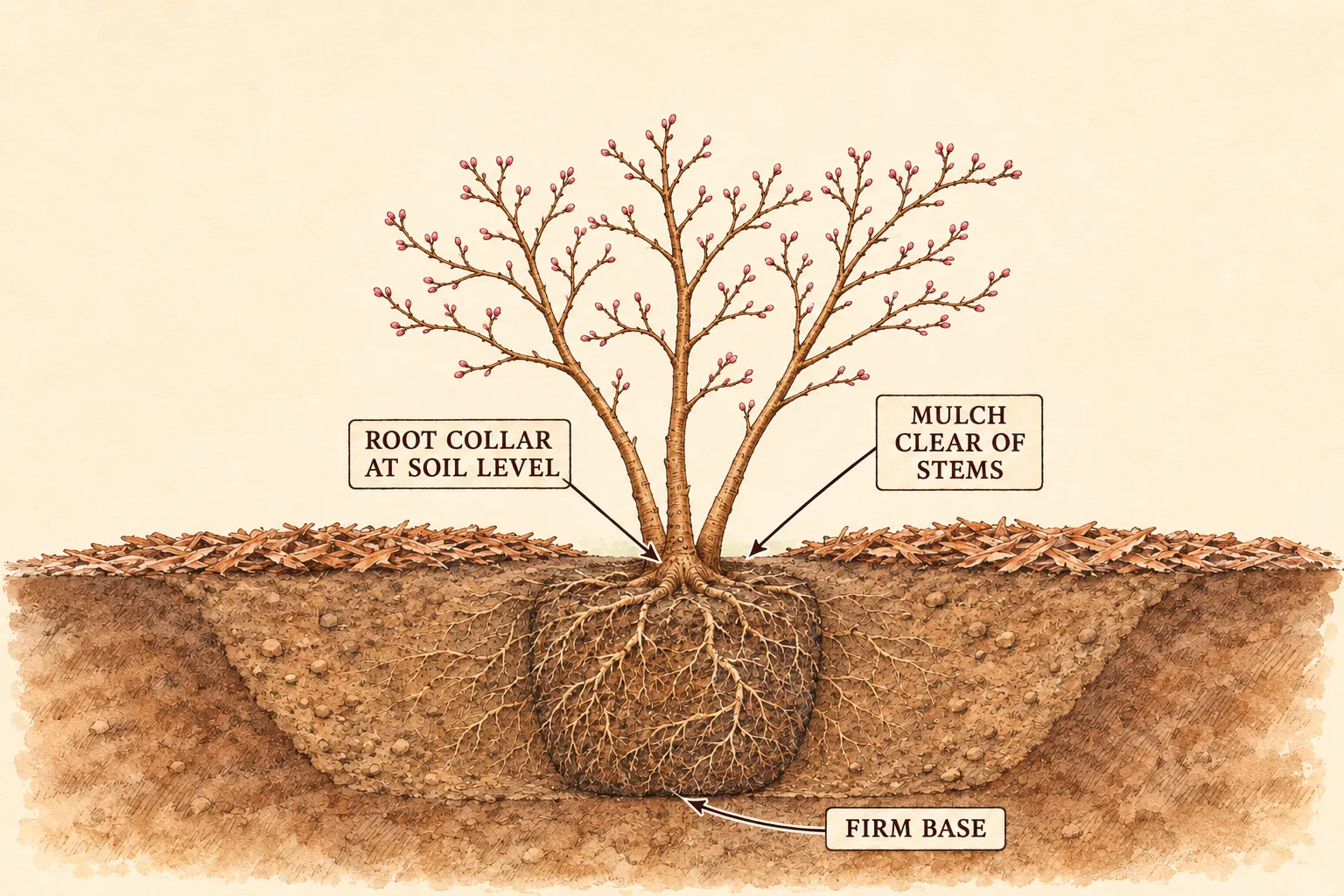
Following Maryland’s shrub-planting guidance, make the hole at least twice the root-ball width and no deeper than the ball measured from its true collar. Leave firm soil beneath it. Set the shrub with the collar at finished soil level and the upper roots just beneath that level, then check the arrangement from more than one side before filling.
- 4Backfill, water and mulch clear of the stems
Return the excavated soil, settling it gently with water and hand pressure around the ball. Preserve the collar level and an open route for excess water. Spread an organic mulch around the root area, following the RHS 5 cm layer recommendation, and leave an uncovered circle at the stem bases. Keep the young shrub’s lower framework visible.
- 5Maintain moisture through establishment
Check the original nursery ball as well as surrounding soil during the first one or two years. Water when the root zone is drying, especially through the first summer, and allow surplus to drain. RHS advises little or no routine feeding in ordinary garden soil; annual mulch is often enough. Retain sound shoots during planting and remove only necessary damaged growth.
Pruning bodnant viburnum
Time routine pruning for the end of flowering, usually spring, so winter buds remain on the shrub through their display. RHS’s specific viburnum guide describes removing up to a third of the oldest wood at the base after bloom for V. × bodnantense. Treat that as selective renewal of an established framework: retain vigorous younger stems and reduce congestion where it exists. A small newly planted shrub needs establishment and only necessary corrective cuts. The RHS Dawn profile also places it in minimal-pruning group 1, so a well-placed, open young plant has little reason for repeated heavy cutting. Shortening every branch in autumn sacrifices flowering wood and turns a naturally upright shrub into a routine clipping job. For an overgrown specimen, plan renovation separately and expect a temporary loss of display; tolerance of hard pruning is not a promise of uninterrupted flowers. Check for active bird nests before spring work and postpone affected cuts. Softwood or dormant hardwood cuttings are propagation options when suitable healthy material is available.
Seasonal care
Spring
Enjoy the remaining flowers, then inspect the framework for any selective renewal needed after bloom. Retain healthy young stems and check for active nests before cutting. Refresh the organic mulch to about 5 cm, keeping the stem bases clear. Water recently planted shrubs during drying weather. Softwood cuttings become an option from late spring if propagation is intended.
Summer
Check moisture in the nursery ball and the wider root zone, particularly in the first two growing seasons. Deep watering during a prolonged dry spell may also help an established plant in otherwise suitable soil. Watch the leaf undersides and shoot tips if damage appears. Keep any softwood propagation separate from routine shaping, and allow the main framework to develop.
Autumn
Look for orange, red or purple autumn leaf colour, followed by the exposed branch framework. Plant sound nursery stock when the soil is workable and moisture can be maintained. Keep the developing flower-bearing shoots intact. In a mild garden, buds and early flowers may appear toward winter; in a colder site, their main display can be months later.
Winter
Inspect flower clusters after frost or extended rain. Remove spoiled blooms if desired while preserving sound buds and stems. Check the root zone of newly planted shrubs when the soil is unfrozen, and keep waiting pots from drying out or sitting in water. Hardwood cuttings can be taken after leaf fall under a suitable propagation method; general size reduction waits until flowering finishes.
Safety and garden spread
Common problems
Brown flowers after frost or wet weather
- Look for
- Open clusters brown or collapse following a freeze or a prolonged wet spell, while other buds remain sound.
- Action
- Match the timing to the weather before assuming a plant-wide disease. RHS reports that further flowers usually develop. Pick off spoiled clusters if needed and retain the living framework. A sheltered position can reduce exposure, but no hardiness rating guarantees an unblemished winter display.
Little bloom after autumn trimming
- Look for
- The shrub has been shortened across its crown before winter and has few remaining flowering tips or clusters.
- Action
- Keep the remaining shoots and shift routine pruning to immediately after flowering. Use selective old-stem renewal in an established plant, following its structure. Check light and plant condition as well; pruning history is a useful explanation to investigate, not the only possible cause of poor bloom.
Weak growth with persistently wet roots
- Look for
- Yellowing, poor extension or dieback occurs where water collects around the nursery ball or buried stem bases.
- Action
- Inspect drainage, planting level and accumulated mulch before adding more water or fertilizer. NC State and RHS list root diseases among possible problems, but leaf colour alone cannot identify one. Correct obvious water accumulation and seek a root assessment if decline continues.
Damaged leaves or declining shoots
- Look for
- Leaf spots, unusual deposits, visible pests, chewing or progressive shoot dieback appear during the growing season.
- Action
- Inspect both leaf surfaces and the woody stems, photograph the pattern and obtain identification before treatment. NC State and RHS list aphids, mites and several diseases as possibilities. Keep moisture and growing conditions appropriate; a single marked leaf is insufficient evidence for a pesticide application.
A narrow site needs repeated hard clipping
- Look for
- The maturing shrub increasingly blocks the route and must be cut back repeatedly to keep access open.
- Action
- Compare the available width with the exact selection’s mature size. Preserve an open framework with selective pruning where feasible, but reconsider the planting arrangement when space is permanently inadequate. This upright shrub can broaden with age even if its young nursery form looked narrow.
Sources
- Viburnum x bodnantense. NC State Extension Gardener Plant Toolbox. Source record · Accessed 2026-11-09.
- Viburnum × bodnantense 'Dawn'. Oregon State University. Source record · Accessed 2026-11-09.
- Viburnum × bodnantense 'Dawn'. Royal Horticultural Society. Source record · Accessed 2026-11-09.
- How to grow viburnum. Royal Horticultural Society. Source record · Accessed 2026-11-09.
- Viburnum x bodnantense ‘Dawn’. Cambridge University Botanic Garden. Source record · Accessed 2026-11-09.
- Planting a Tree or Shrub. University of Maryland Extension. Source record · Accessed 2026-11-09.
- Viburnum. Clemson Cooperative Extension. Source record · Accessed 2026-11-09.