Bluebeard
Caryopteris clandonensis
A Caryopteris × clandonensis profile for late-summer blue flowers, with identification, full-sun placement, sharp drainage, spring pruning and hardiness limits.
Published Last updated
At a glance
- Light
- Full sun; bright exposure supports compact growth and flowering
- Water
- Medium at establishment; drought tolerant after roots are established
- Soil
- Loose, moderately fertile, sharply well-drained loam or gravelly soil
- Hardiness
- Zones 5–9
- Bloom
- Late summer into early autumn; commonly July through September, with timing varying by cultivar and climate
- Height
- 2–3 ft · 60–90 cm
In this guide
Overview
Bluebeard is the small shrub to choose when a sunny border needs a late-summer veil of real blue. Caryopteris × clandonensis forms a low rounded mound of gray-green, aromatic foliage, then carries small blue to blue-purple flowers in clusters around the upper stems. It earns its place at the front or middle of a shrub border, along a gravel path, in a dry garden or beside grasses that have started to turn. The direct answer is conditional: plant it when you can provide full sun, soil that drains freely and enough space for a two- to three-foot mound.
The name can hide a useful distinction. Bluebeard, blue mist shrub and blue spirea are common names used for the cultivated Caryopteris group, while the plant in this profile is the artificial hybrid Caryopteris × clandonensis. Kew records the hybrid as a cross of C. incana and C. mongholica, and the Royal Horticultural Society notes that many widely sold cultivars come from this hybrid. Read the botanical name on the label when comparing 'Dark Knight', 'Arthur Simmonds', 'Longwood Blue' or other selections; flower color, mature size and winter performance can differ.
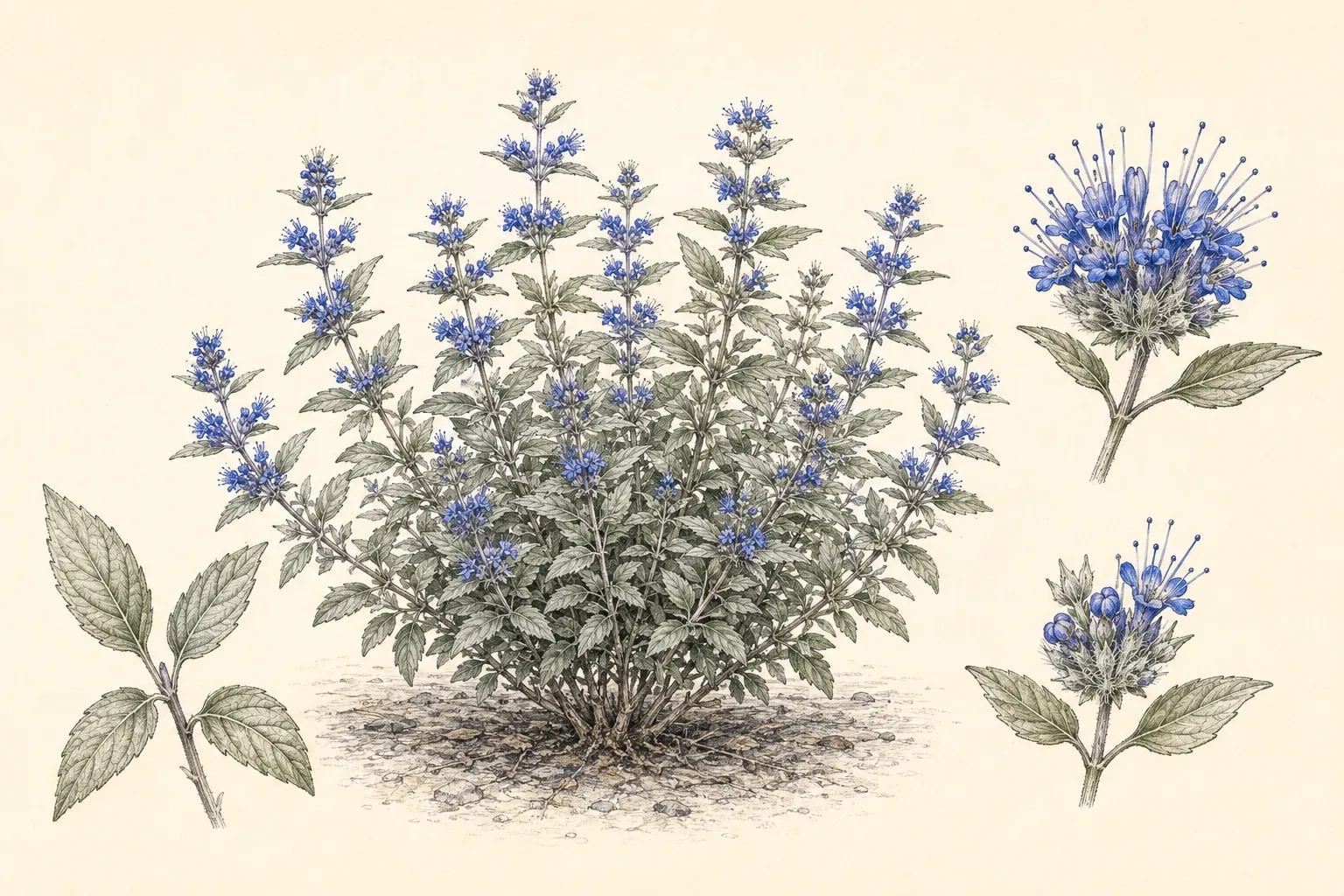
Use the leaves and the flower placement to confirm an identification. The leaves occur in opposite pairs on gray-green stems and release a scent when brushed. Small flower clusters sit in the leaf axils and toward the tips, so the plant looks covered in blue points instead of carrying one terminal spike. The individual flowers have a beard-like base, the feature behind the common name. The identification plate shows the whole mounded habit beside the close traits because a blue flower alone could point to several unrelated late-season plants.
Expect roughly 2–3 feet of height and a similar spread for the common garden form. The mound is fine-textured and open enough to let stone, low sedum or a short grass show through, but it becomes untidy when crowded by taller neighbors. Repeat it in a loose drift along a sunny edge, use one plant as a cool blue counterpoint to ochre grasses, or make a low informal hedge where the branches can be cut back each spring. Place taller shrubs behind it and keep the front edge low enough that the flower clusters stay visible.
Drainage decides whether bluebeard is durable. Missouri Botanical Garden and the RHS both describe a plant for full sun and well-drained soil, while the RHS warns that winter waterlogging can be fatal. Average moisture helps a new transplant establish, but an established plant handles dry spells better than a shrub planted into compacted or saturated ground. Test the site after rain, open a broad root zone if the soil is tight and move the plant to a raised or gravelly position when water lingers. Frequent shallow irrigation does not compensate for a wet crown.
The flowering season fills a gap between the main summer flush and the first autumn leaf color. North Carolina Extension describes bright blue fragrant flowers in late summer and early fall, while the Missouri profile gives July through September for one cultivar. The timing changes with latitude, cultivar and pruning, but flowers are produced on new growth, so a hard late-winter or early-spring cutback can be part of the plant's normal care. Do not mistake winter dieback for failure in a cold garden: the root system can survive while the top returns from the base.
Bluebeard also has a useful pollinator role without requiring a lush, high-input bed. North Carolina Extension records flowers that attract butterflies, bees and other pollinators, and the RHS includes caryopteris among plants that provide nectar and pollen. Pair it with ornamental grasses, sedum, catmint or other plants whose drainage and sun needs agree. The goal is a dry, open composition: a sunny border with air around each mound, not a dense planting that traps moisture at the crown.
- Family
- Lamiaceae
- Range
- Artificial garden hybrid of East Asian parents, Caryopteris incana and Caryopteris mongholica
- Soil pH
- 6–8
- Spread
- 2–3 ft · 60–90 cm
Planting & careHow to grow bluebeard
Caryopteris × clandonensis is a cultivated hybrid, not a wild species with a single native range. North Carolina Extension places the commonly grown plant in USDA zones 6a–9b, while Missouri Botanical Garden and University of Illinois Extension describe cultivars or plantings reaching zones 5–9 and note that stems may die to the ground in colder winters. Treat zone 5 as a root-survival edge, not a promise of woody stems; cultivar, shelter and winter drainage matter. In every region, give bluebeard full sun and a bed that drains after rain.
- 1Buy the named hybrid
Check the label for Caryopteris × clandonensis and record the cultivar when one is given. Bluebeard, blue mist shrub and blue spirea can be used loosely, while named selections differ in flower color, stature and winter performance.
- 2Measure the sun
Choose a position with full sun for the growing season. Bright exposure keeps the mound compact and supports the late-summer flower clusters; a shaded border is likely to produce weaker, less useful growth.
- 3Test the drainage
Inspect the bed after rain and reject any place where water remains around the crown. Bluebeard tolerates dry conditions after establishment but dislikes wet, poorly drained soil, especially through winter.
- 4Reserve the mound
Allow about 2–3 feet of height and spread for the common garden form, then add clearance for the open branch tips. Set it where the blue flowers can be seen above low companions and in front of taller shrubs.
- 5Prepare the whole root zone
Loosen compacted ground across the planting area and keep the soil moderately fertile, loose and freely draining. A broad improvement is more reliable than a small pocket of contrasting mix around one root ball.
- 6Set the plant at grade
Place the top of the root ball level with the surrounding soil, backfill without burying the stem bases and water slowly to settle the roots. Keep mulch thin around the crown so it can dry between rains.
- 7Establish before judging drought tolerance
Water the full occupied root zone during the first growing season and during extended dry periods. Once roots reach the surrounding bed, let the soil dry moderately between deep waterings while keeping the plant out of standing water.
- 8Plan the spring cutback
Mark the plant before winter and wait until late winter or early spring to remove dead top growth. Cut back before vigorous new shoots begin, since bluebeard flowers on new growth and often returns from the base after cold winters.
Pruning bluebeard
Bluebeard flowers on new growth, so cut the shrub back hard in late winter or early spring before new shoots lengthen. In zones where winter kills the stems, remove the dead top to the base when the condition is clear; in milder climates, the same cutback keeps the mound compact and encourages fresh flowering stems. Avoid a late-summer shear that removes the season's flower-bearing growth. During bloom, remove only damaged or awkward stems, and leave the crown open to air through winter.
Seasonal care
Spring
Cut back dead or winter-damaged stems before new growth accelerates, then clear wet debris from the crown. Check that winter runoff leaves the bed and keep early watering measured while the new shoots build the flowering framework.
Summer
Give a new planting deep water during dry spells, but let an established bed drain and dry moderately between soakings. Keep taller companions from shading the mound and avoid excess fertilizer that promotes lanky growth.
Autumn
Enjoy the blue flower clusters as other shrubs quiet down and let sound stems hold their shape until frost or dormancy. Remove diseased material, check for crown wetness after rain and note which cultivar and stem growth survived in your garden.
Winter
Treat the dormant plant as a low woody framework or a returning perennial, depending on climate. Keep the crown free of saturated mulch and do not prune early just because the top looks bare; the spring cutback is easier once winter damage is visible.
Safety and garden spread
ASPCA Poison Control guidance lists Caryopteris clandonensis as nontoxic to pets. Bluebeard is an ornamental, not an edible plant; keep ordinary garden hygiene around any plant material and seek veterinary advice after a concerning ingestion.
Common problems
Winter dieback mistaken for death
- Look for
- The stems turn brown or disappear after a cold winter, while the crown remains firm and the plant has not yet resumed spring growth.
- Action
- Wait until late winter or early spring, scrape-test questionable stems and cut dead wood back to the base. In zones 4–6, expect some or all top growth to die back while flowering can still occur on new shoots from surviving roots.
Crown or root rot
- Look for
- Weak growth, collapse or loss after rainy weather in soil that stays saturated, especially where mulch presses against the stem bases.
- Action
- Stop automatic irrigation, trace where water collects and improve the bed before replanting. Move the shrub to a raised, gravelly or otherwise free-draining position; surface mulch cannot correct a waterlogged root zone.
Lanky or leaning growth
- Look for
- Long weak stems, an open center or branches reaching away from the border instead of forming a compact mound.
- Action
- Check light first and reduce fertilizer if growth is soft. Cut the plant back in late winter, give it full sun and restore the mature footprint so neighboring plants do not crowd the new stems.
Few flowers
- Look for
- Healthy foliage with few blue clusters, delayed flowering or a plant shaded by a shrub or grass that has grown taller than expected.
- Action
- Compare the site with the plant's full-sun requirement, confirm that spring pruning was not followed by repeated summer shearing and check that the cultivar's expected bloom window has arrived. Correct light and timing before adding fertilizer.
Plant details
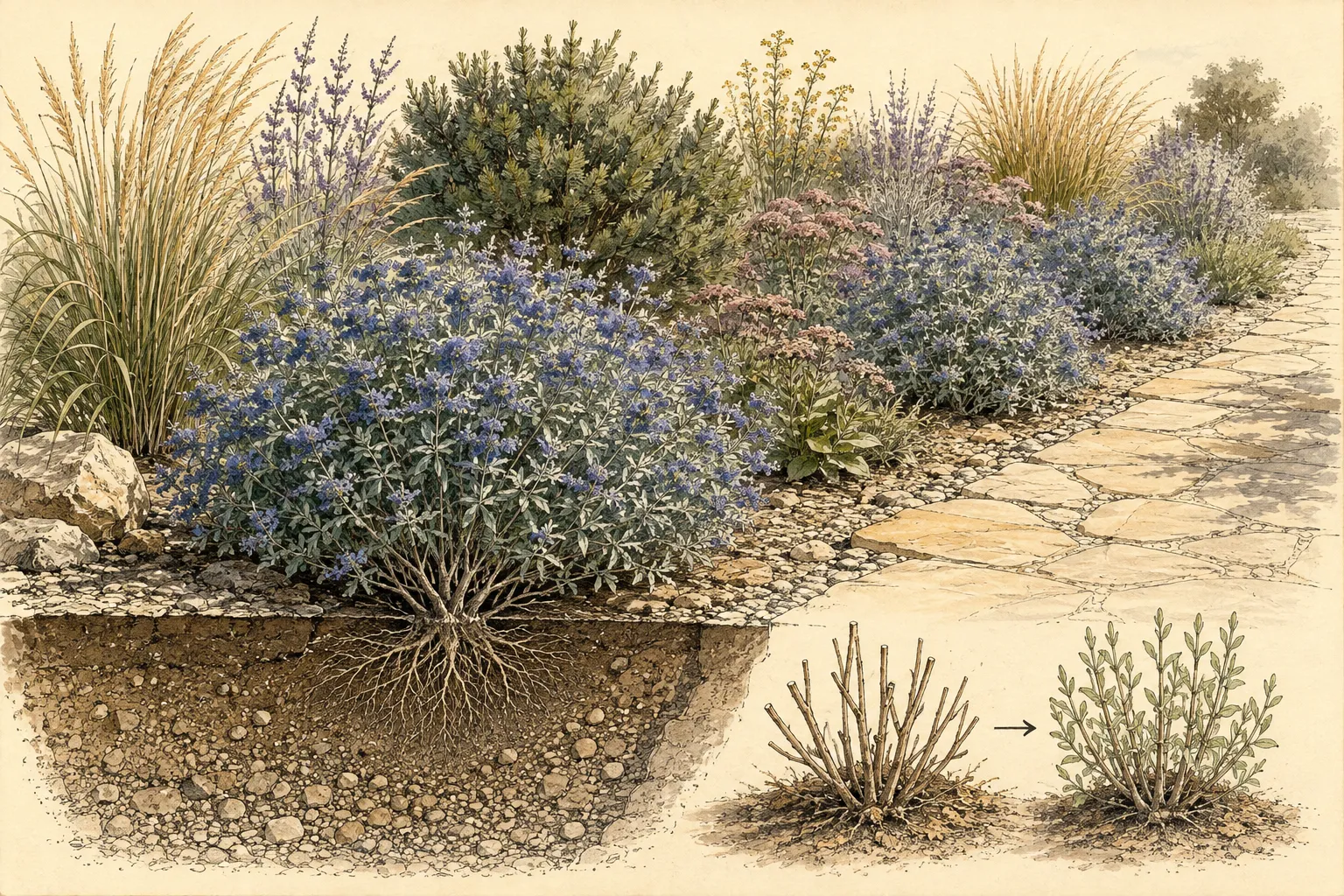
Garden placement study showing bluebeard in a sunny gravelly border with ornamental grasses, sedum, a path and a well-drained root zone
Sources
- Caryopteris x clandonensis (Bluebeard, Blue Mist Shrub, Blue Spirea). North Carolina Extension Gardener Plant Toolbox. Source record · Accessed 2026-09-07.
- Caryopteris × clandonensis 'Arthur Simmonds' - Plant Finder. Missouri Botanical Garden. Source record · Accessed 2026-09-07.
- Caryopteris / RHS Plant Guide. Royal Horticultural Society. Source record · Accessed 2026-09-07.
- Caryopteris × clandonensis A.Simmonds. Plants of the World Online, Royal Botanic Gardens, Kew. Source record · Accessed 2026-09-07.
- Bluebeard (Caryopteris x clandonensis) - Selecting Shrubs for Your Home. University of Illinois Extension. Source record · Accessed 2026-09-07.
- Hazardous or Harmless? Discover Which Fall Plants Are Toxic to Pets. ASPCApro. Source record · Accessed 2026-09-07.