Bleeding Heart
Lamprocapnos spectabilis
An old-fashioned woodland perennial with arching stems of pendent heart-shaped flowers and a natural summer dormancy that should shape its companions and care.
Published Last updated
At a glance
- Light
- Partial shade to shade; sun only with reliable moisture
- Water
- Even moisture during active growth; avoid both summer drought and wet dormant roots
- Soil
- Fertile, humus-rich, neutral to alkaline soil with reliable drainage
- Hardiness
- Zones 3–9
- Bloom
- Late spring to early summer, shifting with climate
- Height
- 2–3 ft · 60–90 cm
In this guide
Overview
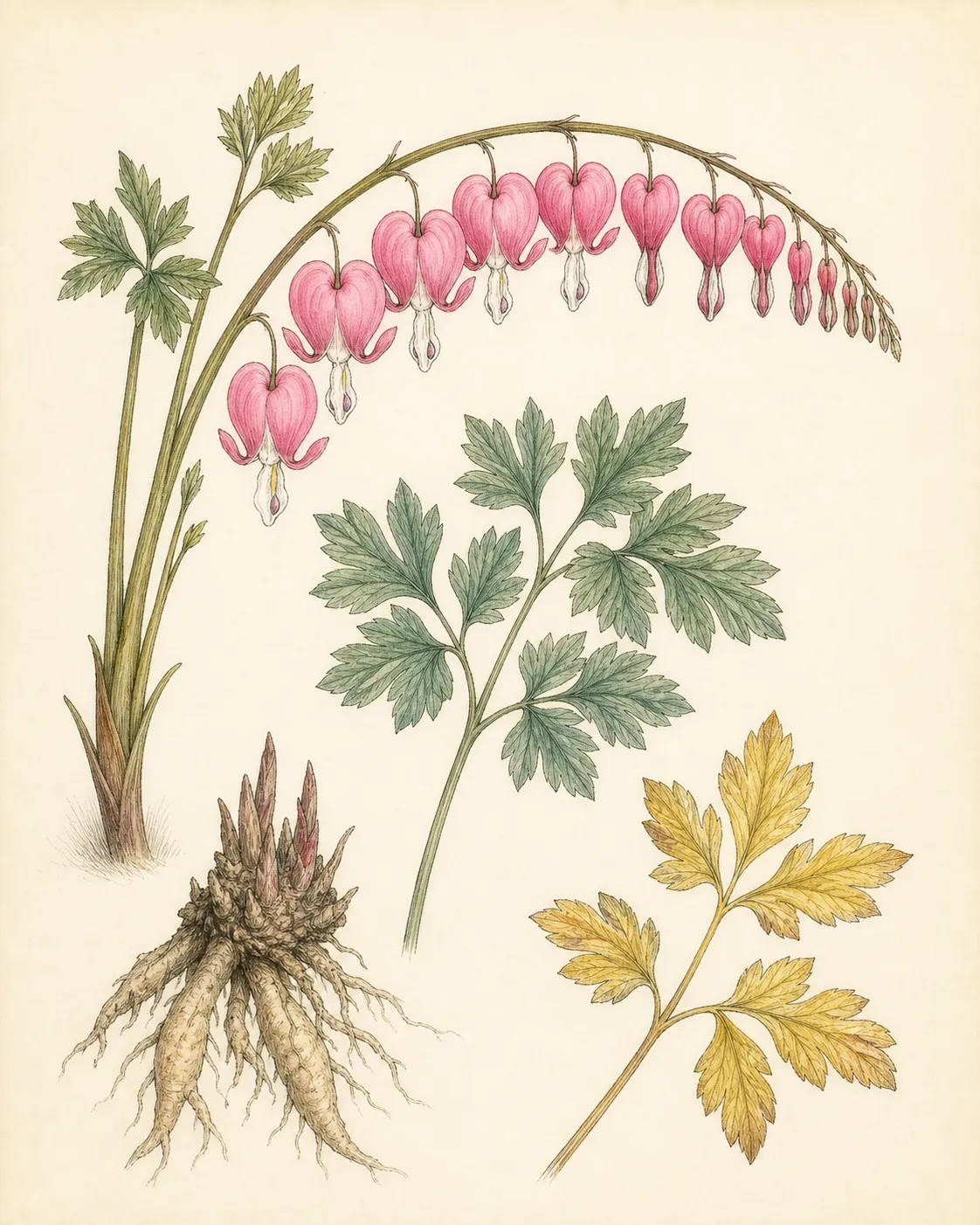
Old-fashioned bleeding heart is an upright spring perennial with thick, succulent stems, divided blue-green leaves and one-sided arching racemes of pendent heart-shaped flowers. The usual species form carries rose-pink outer petals and projecting white inner petals; white-flowered forms are selections of the same species. A mature clump is commonly 2–3 feet high and wide, much larger than the compact North American Dicentra species that share the common name bleeding heart.
The shoots rise from brittle, fleshy rhizomes and roots, then often disappear after flowering. In warm or dry summers the foliage yellows and dies to the ground by midsummer; in a cool, evenly moist site it can remain attractive much longer. Uniform yellowing after bloom is therefore not automatically drought, disease or death. Mark the dormant footprint so later planting, digging and hoeing do not damage the invisible root system.
Give the plant partial shade, ideally morning light with protection from hot afternoon sun. Full sun is reasonable only in a cool climate where the root zone remains reliably moist. Fertile, humus-rich soil should hold useful moisture while draining freely, especially in winter. The retained North Carolina and RHS profiles place it in neutral to alkaline soil; use a soil test before changing pH, and never turn a dense wet site into a small compost-filled basin.
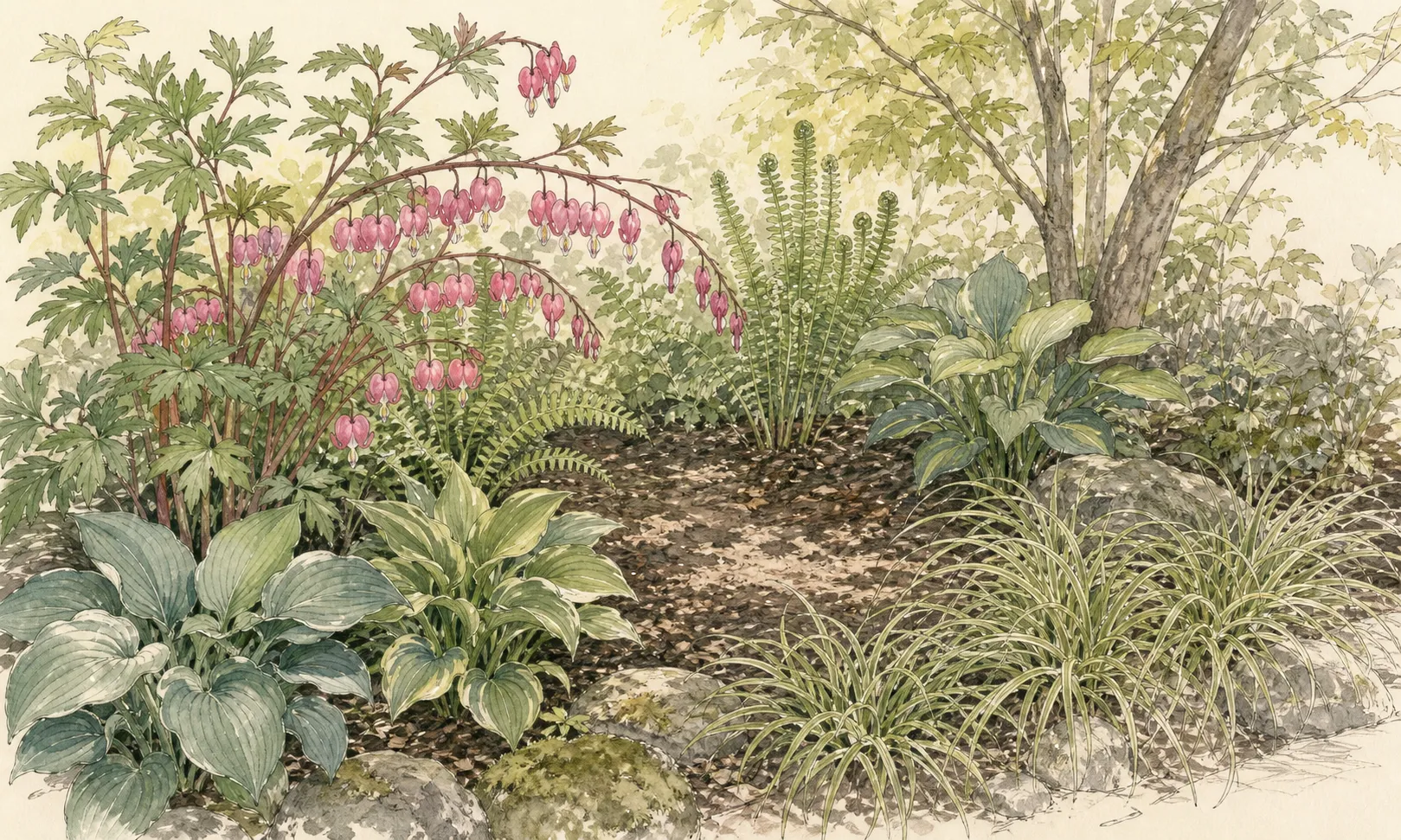
Bleeding heart works best as the spring layer of a woodland border rather than as a permanent summer groundcover. Place ferns, hostas or later-emerging perennials nearby to mask the seasonal opening, but allow for their mature roots and crowns instead of planting directly over the rhizomes. Keep the tender arching stems away from path corners, hose routes and repeated foot traffic.
Division is an occasional propagation task, not annual maintenance. RHS guidance supports division in early spring or after the leaves have died down, while Wisconsin Extension also describes very early spring or late-fall division. Keep several buds with sound fleshy roots, replant promptly at the established grade and wear gloves: both North Carolina Extension and the RHS identify ingestion risk, and they warn that foliage can aggravate skin sensitivity.
- Family
- Papaveraceae
- Range
- Northeastern China to northern Korea
- Soil pH
- 6–8
- Spread
- 2–3 ft · 60–90 cm
Planting & careHow to grow bleeding heart
Kew's current accepted taxon record places the native range in northeastern China and northern Korea. The retained North Carolina and RHS horticultural profiles use older, broader range descriptions that include Japan or Siberia; this profile follows Kew for native status while recognizing the plant's long cultivation elsewhere. Summer dormancy is also regional: heat or dry soil can bring early yellowing, whereas foliage may persist much longer in a cool, evenly moist garden. Zones 3–9 describe broad hardiness, not an assurance that the fleshy dormant root system will tolerate winter saturation or that foliage will remain visible all summer.
- 1Confirm old-fashioned bleeding heart
Keep the name Lamprocapnos spectabilis with the plant. Expect a loose 2–3 ft clump, coarse divided leaflets and arching racemes of large pendent hearts. Dicentra eximia and D. formosa are smaller North American plants with finer foliage and a longer leafy season, so their size and dormancy should not be transferred to this profile.
- 2Choose cool partial shade
Select morning sun, dappled light or open shade with relief from hot afternoon exposure. Full sun is suitable only where summers are cool and soil moisture is dependable. Avoid dry root competition beneath dense shallow-rooted trees and positions where succulent shoots will be brushed or stepped on.
- 3Check drainage in the dormant season
Inspect the site after substantial autumn or winter rain. Reject a low pocket that remains saturated around the fleshy rhizomes. Improve soil structure across the bed only as local soil guidance supports; a soft amended hole inside compacted ground can collect water around the root system.
- 4Reserve the full seasonal footprint
Allow roughly 2–3 ft for the species clump and mark where it will disappear in summer. Position later companions beyond the occupied root zone so their leaves can overlap visually without sending crowns, spades or aggressive roots through the dormant bleeding heart.
- 5Set the plant at its previous grade
Handle the root ball or division gently because the fleshy roots and shoots break easily. Replant at the depth shown by the nursery root ball or the established soil mark, with buds oriented upward and roots spread naturally. Do not bury the crown beneath extra soil or a deep layer of mulch.
- 6Water through active establishment
Settle soil around the roots, then keep the occupied root zone evenly moist while spring shoots and leaves are active. Probe below the surface before watering. Reduce irrigation after natural dieback, but do not let a newly planted root system become completely dry or leave it saturated.
- 7Mulch lightly and label the dormant place
Use a modest organic surface layer around, not over, the emerging crown. Keep a durable label outside the clump and record its outline before foliage collapses. The marker is part of the care plan because no stems remain above ground to warn against summer or winter digging.
Pruning bleeding heart
RHS lists no pruning requirement for Lamprocapnos spectabilis. Remove a broken stem cleanly and deadhead only when seed is unwanted; neither task requires shaping the clump. Leave healthy green foliage after bloom so the plant can complete its active season, then cut or lift away stems only after they have yellowed and died naturally. Wisconsin Extension notes that cutting hard after flowering can delay senescence and sometimes prompt another flush, but that is an optional response rather than necessary annual care; the conservative routine is to retain functional leaves. Mark the dormant crown before cleanup. Divide only when propagation, relocation or genuine congestion justifies disturbance, in early spring or after foliage dies down. Wear gloves, wash after handling and keep every cutting and division away from ingestion.
Seasonal care
Spring
Locate emerging buds before raking, protect brittle shoots from traffic and maintain even moisture as leaves expand. Confirm identity from the divided foliage and arching heart-shaped flowers, record the clump outline, and remove only stems that are broken. Do not cultivate or plant companions through the active crown.
Summer
Distinguish uniform post-bloom yellowing from sudden localized collapse. Let ordinary senescence finish, then clear fully dead foliage with gloves and leave the marker visible. During an unusually cool season, retain green leaves instead of cutting to a calendar date. Check root-zone moisture before irrigating an apparently empty space.
Autumn
Divide or relocate only a sound established clump when regional conditions allow roots to settle before hard winter. Keep the previous planting grade visible, refresh a light crown-clear mulch and prevent fallen leaves from forming a wet mat over the dormant root system.
Winter
Protect the marked footprint from storage, compaction and accidental digging. Observe whether rain, snowmelt or roof runoff stands over the site and correct broad drainage before spring growth. Do not compensate for exposed-looking ground by adding soil or a deep mulch mound.
Safety and garden spread
Common problems
Normal summer dormancy
- Look for
- Foliage yellowing broadly after flowering and then disappearing cleanly, especially during warm or dry weather, without a soft base or an expanding patch of collapsed shoots.
- Action
- Allow the leaves to finish, remove them only when dead and keep the crown marked. Expect emergence in the normal spring window; investigate only when a previously established clump fails to return or decline began while cool active growth should have continued.
Wet-soil collapse
- Look for
- Sudden wilt during active growth, dark soft tissue at the base, loose shoots or a dormant site that remains saturated after surrounding soil has drained.
- Action
- Stop routine irrigation, keep suspect material out of other planting holes and obtain a local diagnosis when decline is progressive. Correct grade or drainage across the site before replacing the plant; winter-wet soil is a documented intolerance.
Heat or drought stress
- Look for
- Crisp margins, pale foliage or early decline concentrated on the sunny side while soil is dry at root depth, rather than the even post-bloom yellowing of dormancy.
- Action
- Restore even moisture without saturating the roots and add afternoon protection where feasible. Move the clump during an appropriate division window if the normal exposure remains hotter or drier than the species can support.
Slug or aphid feeding
- Look for
- Irregular holes or rasped patches on leaves from slugs, or colonies of soft-bodied insects clustered on tender flower stems; the rest of the crown remains firm.
- Action
- Confirm the pest before acting, reduce hiding places that do not require burying the crown and use current local Extension guidance for proportionate control. Do not treat normal summer decline as insect damage.
Ingestion or skin exposure
- Look for
- A person or animal has chewed plant material, or repeated foliage contact is followed by skin irritation.
- Action
- Prevent further access, wash exposed skin and retain the exact plant name. Contact an appropriate poison-control service, medical professional or veterinarian for case-specific advice rather than using this horticultural profile as treatment guidance.
Sources
- Lamprocapnos spectabilis (L.) Fukuhara. Royal Botanic Gardens, Kew. Source record · Accessed 2026-08-30.
- Lamprocapnos spectabilis. North Carolina State Extension. Source record · Accessed 2026-08-30.
- Lamprocapnos spectabilis. Royal Horticultural Society. Source record · Accessed 2026-08-30.
- Bleeding Heart, Lamprocapnos (Dicentra) spectabilis. University of Wisconsin-Madison Extension. Source record · Accessed 2026-08-30.