Black Gum
Nyssa sylvatica
Identify black gum and choose a lasting garden site for its autumn foliage, with acidic soil, mature crown space and spring planting for sensitive roots.
Published Last updated
At a glance
- Light
- Full sun for strong fall color; tolerates partial shade
- Water
- Moist soil preferred; regular establishment watering, with occasional flooding tolerated
- Soil
- Acidic, moisture-retentive soil with drainage; clay, loam or sand
- Hardiness
- Zones 4–9
- Bloom
- Small greenish flowers in spring; foliage is the autumn attraction
- Height
- Commonly 30–50 ft in gardens; regional accounts reach 60–80 ft · Commonly 9–15 m in gardens; regional accounts reach 18–24 m
In this guide
Overview
Black gum earns its place through autumn foliage, but the first buying decision is the site: give Nyssa sylvatica acidic soil, dependable establishment water and space for a substantial tree. A sunny position favors its fall display. Mid-October is useful for observing local trees and choosing a nursery selection; it is not a universal planting deadline. The Morton Arboretum recommends spring planting, and Kentucky likewise places transplanting in spring because the roots are sensitive.
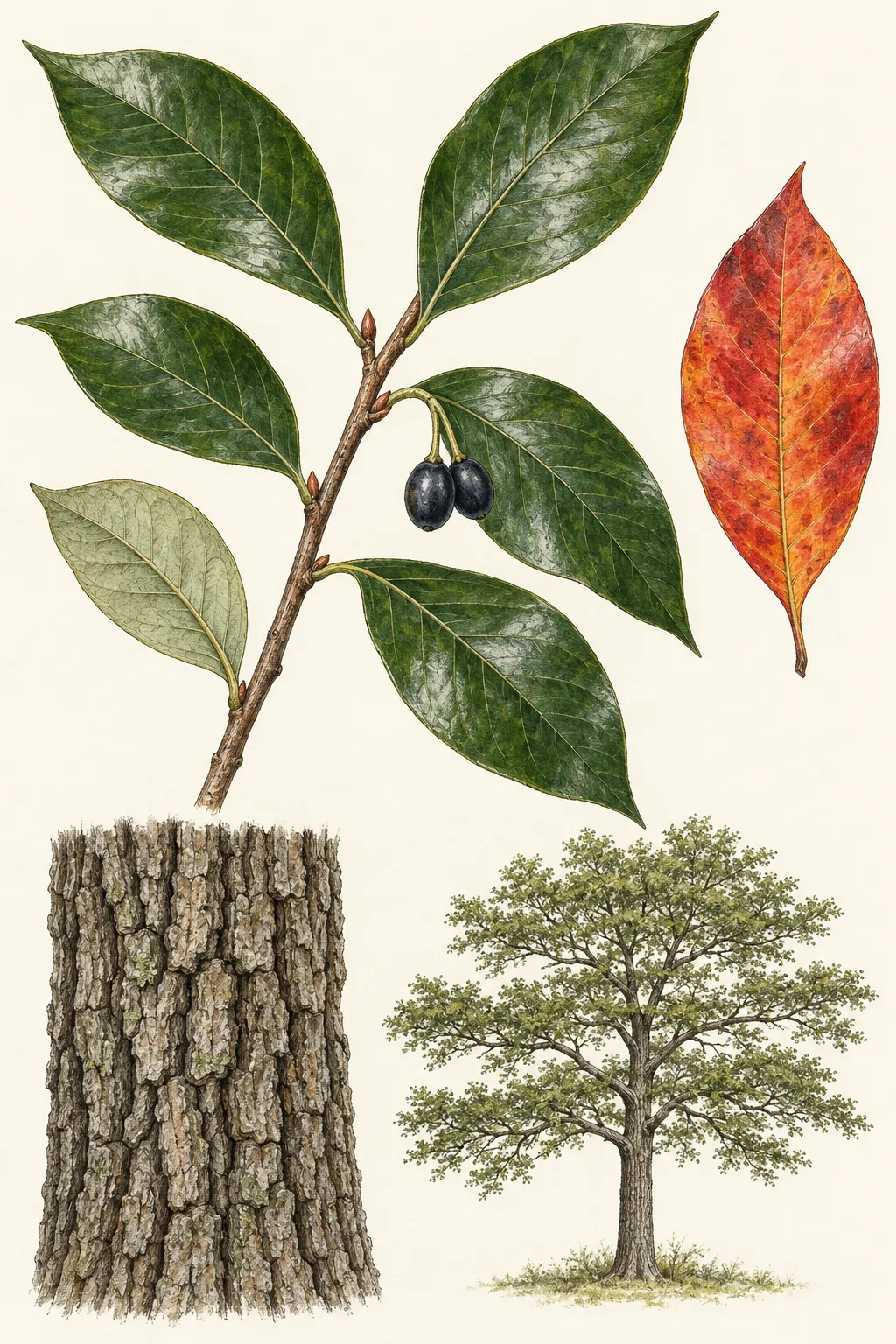
Identify it by a combination of features. The leaves are simple and alternate along the twig, with an elliptical outline and usually smooth edges. They are dark green above and paler below. Small oval blue-black drupes appear on fruiting trees toward late summer and autumn. Mature bark forms thick, blocky ridges. The illustration separates these details so the fruit can be compared with the much larger leaf; it does not imply every tree carries fruit.
Flowering is more complicated than a single male-or-female label suggests. NC State describes predominantly male and predominantly female trees, sometimes carrying a few flowers with both reproductive parts. A compatible pollen source matters when fruit production is a priority. Ask the nursery about the actual selection and nearby pollination opportunities. A tree grown chiefly for leaf color can still be useful when its crop is sparse. Spring flowers provide nectar, and the later drupes support birds.
Plan with regional mature dimensions, not the height of the nursery pot. Morton lists 30–50 feet tall and 20–30 feet wide; the North Carolina Forest Service gives 60–80 feet tall and 25–35 feet wide. The larger figures are a useful warning against treating this as a small courtyard tree. Its youthful pyramid becomes less regular with age. Photograph an older local specimen from a distance to judge the crown you may eventually be accommodating.
The Forest Service's large-tree siting advice calls for at least 40 feet of open space, at least 15 feet from sidewalks and hardscape, and a position clear of overhead utilities. Use those values as an initial screen, then follow local utility and property constraints. Arbor Day's separate large-tree guideline gives at least 20 feet from a wall. Neither number substitutes for a site plan: mark the projected crown, buildings, access routes and underground services before ordering.
A design option for a roomy eastern North American garden is one black gum beyond the main terrace, where its crown can be seen across open ground. Keep a broad mulched area around the young tree and let the seasonal color be read against distant green planting. Draw the future crown on the plan before placing another large tree beside it. This is a suggested composition, not a tested companion prescription; the viewing distance and mature space matter more than a fixed plant combination.
Acid soil is a real selection constraint. The North Carolina Forest Service gives pH 5.5–6.5, which is the working range shown here. Test the proposed root area before purchase. On a strongly alkaline site, choose a better-suited tree instead of budgeting for indefinite corrective treatments. Arbor Day notes how difficult lasting pH changes can be. Adding a little acidic compost to the planting hole cannot establish that the entire future root zone will suit this tree.
Moisture tolerance also needs context. Florida describes substantial drought tolerance and use on wet urban soils; Morton calls it moderately drought-sensitive and favors moist, drained ground. These descriptions cover different growing settings. For a new garden tree, use their shared preference for moisture and the need for establishment care. A wild tree's survival on a dry slope is poor evidence that a newly planted root ball can be left unwatered. Permanent standing water warrants a separate species-and-site assessment.
For a named selection, compare more than a red autumn photograph. Morton describes 'Wildfire' as opening with red new foliage before it turns green, with a later autumn display. Ask for a label giving the botanical name, cultivar, expected dimensions and locally demonstrated hardiness. A seedling may differ in crown shape and color. Record when nearby trees begin coloring and drop their leaves; no profile can promise peak scarlet foliage on October 19 at every location.
- Family
- Nyssaceae
- Range
- Eastern and central North America, from southern Ontario through the eastern United States, with populations in Mexico
- Soil pH
- 5.5–6.5
- Spread
- About 20–35 ft; selection and site affect crown size · About 6–11 m; selection and site affect crown size
Planting & careHow to grow black gum
This profile uses northern-temperate seasons and North American species guidance. USDA zones 4–9 follow NC State and the North Carolina Forest Service; UF/IFAS specifies 4b–9b. A zone number does not predict a particular autumn display or remove transplant risk. Regional height estimates differ substantially, so reserve full tree space. The pH range is a Forest Service planting target, not a claim that growth abruptly stops outside it. Check the full Nyssa name: a plant sold for a swamp site may represent a different taxon.
- 1Select in autumn; arrange spring planting
Use the autumn display to compare labelled local stock, then arrange nursery holding or spring delivery. Kentucky recommends a generous soil ball for transplanting; UF/IFAS specifically restricts field transplanting to spring. Its observation that container stock is common does not establish a universal autumn planting recommendation. Let the nursery and local extension service resolve an unusual planting window before purchase.
- 2Inspect the roots and permanent position
Have underground services located before digging. Ask to inspect container stock for tight circling roots and a buried trunk base. Choose a sound root ball and a site that meets the mature-space plan. A large, poorly rooted bargain is a weak starting point for a species that is difficult to move later.
- 3Set the root flare at surrounding grade
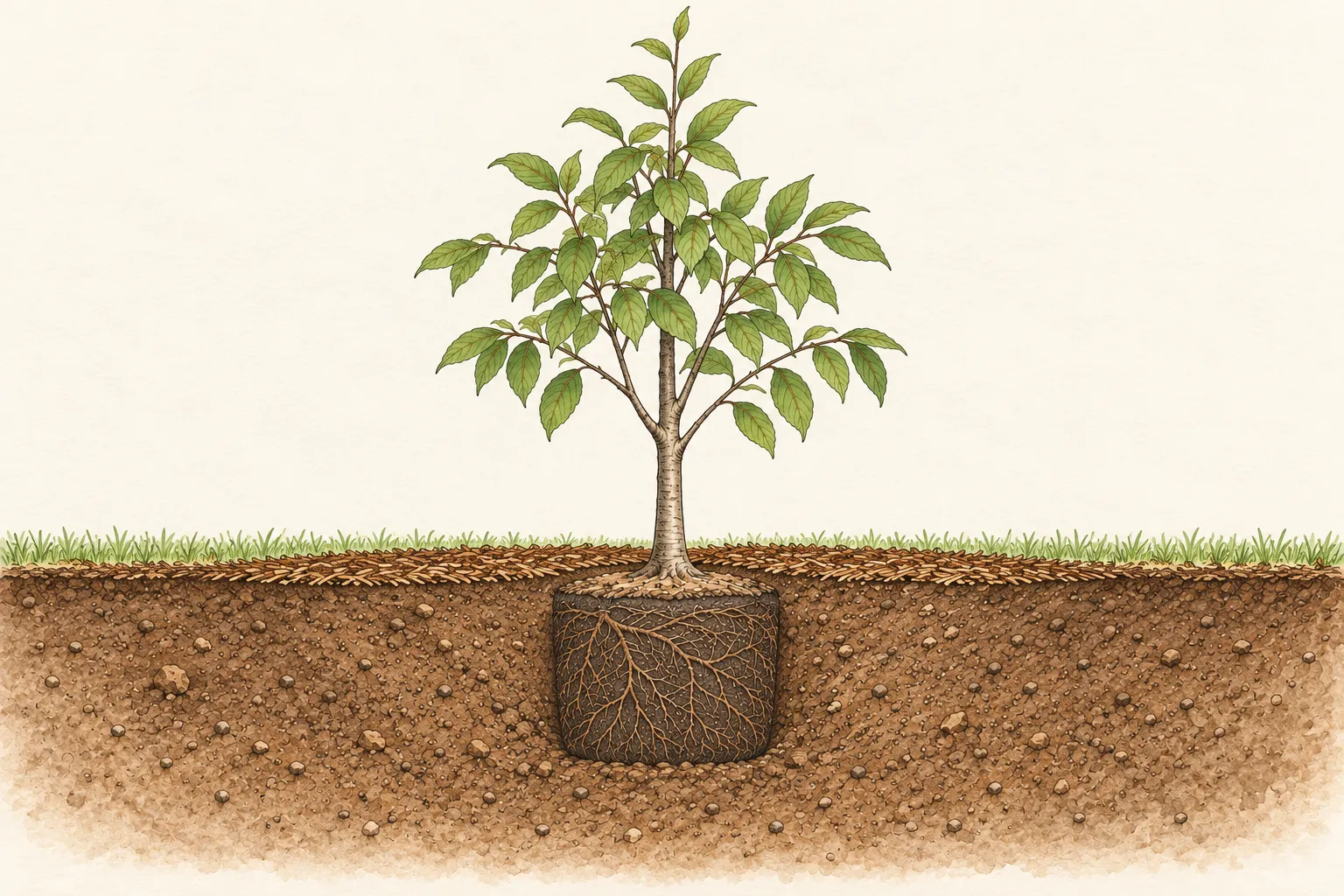
Follow Maryland’s geometry: a hole at least twice the root-ball width, with depth measured from the exposed root flare to the ball base. Keep the base firm. Set the flare level with the surrounding soil, using a straightedge across the hole to check it. Backfill with the excavated soil; a rich isolated pocket is unnecessary.
- 4Water the ball and surrounding backfill
Apply water slowly so it reaches the root ball and the soil around it. Minnesota gives 1–1.5 gallons per inch of trunk caliper per watering as a starting guide; a 2-inch tree therefore begins around 2–3 gallons. Actual moisture, rainfall and drainage must govern repeat watering. Check the original ball as well as adjacent soil.
- 5Keep mulch flat and the trunk clear
Minnesota recommends a layer up to 3 inches deep, leaving the root flare bare. Spread the mulch outward over the rooting area, with a clear gap against the bark. Make the mulched footprint easy to maintain so lawn equipment stays away from the young trunk.
Pruning black gum
Black gum usually develops useful structure with little intervention, according to UF/IFAS. Keep its natural branching form; assess damaged, rubbing or poorly placed branches individually. Morton places pruning in late fall or dormancy. At planting, Maryland advises against cutting back the crown to compensate for root loss. For branches beyond safe ground-level work, obtain an arborist’s assessment. Mature size should be accommodated through siting, not a plan to repeatedly shorten the crown.
Seasonal care
Spring
Carry out planned planting while local conditions suit it, then begin regular root-zone checks. Small flowers accompany the new season. Red young leaves on a labelled Wildfire selection can be normal; compare them with its later green foliage before assuming a deficiency.
Summer
Pay particular attention to a newly planted tree during hot, dry spells. Minnesota’s establishment guidance starts with frequent watering and reduces frequency over time; continue checking moisture as roots expand. Keep the original root ball and expanding watered area connected, especially where lawn irrigation only dampens the surface.
Autumn
Observe the sequence of yellow, orange, scarlet or purple leaves in your garden and note any fruit crop. Compare potential nursery selections while their identity is visible. Separate normal seasonal color from patches of dead foliage or branch dieback. Use this season to complete the soil and space assessment for a spring purchase.
Winter
Study the exposed branching outline and review any future pruning needs. Check that mulch still leaves the flare visible. Inspect an establishing tree after storms and record damaged branches for assessment. A nursery reservation can stay a spring project; frozen or saturated ground offers no reason to rush installation.
Safety and garden spread
No specific toxicity warning is recorded in the retained species profiles. This is an ornamental-care profile, not an edible-plant identification guide or a guarantee of safety after ingestion.
Common problems
Yellow foliage during the growing season
- Look for
- Leaves are unusually pale before the expected autumn transition, especially on a high-pH site.
- Action
- Morton flags chlorosis in alkaline soil. Test soil and have the pattern assessed before adding nutrients. Yellow leaves alone cannot establish a particular deficiency, and extra fertilizer cannot make an unsuitable site suitable.
A sparse or absent fruit crop
- Look for
- A healthy tree colors in autumn but carries few blue-black drupes.
- Action
- Check the selection’s flowering behavior and pollen availability. Predominantly male trees and limited pollination can explain poor fruiting; fruit absence is not by itself evidence of failing roots.
Leaf blotches with branch decline
- Look for
- Purplish spots, persistent dead leaves or discrete dying branches occur outside normal leaf fall.
- Action
- UF/IFAS lists leaf spots and cankers among possible problems. Record the timing and photograph leaves, affected stems and the whole crown for a local diagnostic service. Those signs do not identify one pathogen, so choose treatment only after diagnosis.
A dry root ball in otherwise damp ground
- Look for
- The newly planted ball feels dry beneath the surface while nearby backfill is moist.
- Action
- Direct a slow application onto the original ball and recheck moisture. Extend irrigation outward as roots establish. A wet lawn or a passing shower does not confirm that the confined nursery root system received water.
Sources
- Nyssa sylvatica. NC State Extension. Source record · Accessed 2026-10-05.
- Nyssa sylvatica (Blackgum). University of Kentucky Cooperative Extension. Source record · Accessed 2026-10-05.
- Tupelo. The Morton Arboretum. Source record · Accessed 2026-10-05.
- Nyssa sylvatica: Black Tupelo. University of Florida IFAS Extension. Source record · Accessed 2026-10-05.
- N.C. Forest Service - Blackgum. North Carolina Forest Service. Source record · Accessed 2026-10-05.
- Planting a Tree or Shrub. University of Maryland Extension. Source record · Accessed 2026-10-05.
- Watering newly planted trees and shrubs. University of Minnesota Extension. Source record · Accessed 2026-10-05.
- Planting the Right Tree in the Right Place. Arbor Day Foundation. Source record · Accessed 2026-10-05.