American Beautyberry
Callicarpa americana
A species-led guide to the open native shrub whose opposite leaves, small axillary flowers and vivid stem-hugging fruit clusters reward a generous garden footprint.
Published Last updated
At a glance
- Light
- Full sun to part shade; deep shade reduces density and fruit display
- Water
- Even moisture during establishment; moderate drought tolerance once established
- Soil
- Well-drained sand, loam or clay with room for a broad root zone
- Hardiness
- Zones 6–10
- Bloom
- Small axillary flowers in late spring and summer; fruit colors from August into autumn
- Height
- 3–8 ft · 90 cm–2.4 m
In this guide
Overview
American beautyberry is a loose, many-stemmed shrub built around long upright-to-arching shoots. Its summer flowers are small; the unmistakable display arrives when violet to magenta fruit clusters form dense rings directly around the stems at the leaf axils. The fruit can remain after the leaves fall, turning a lightly textured green shrub into a strong autumn and early-winter structure.
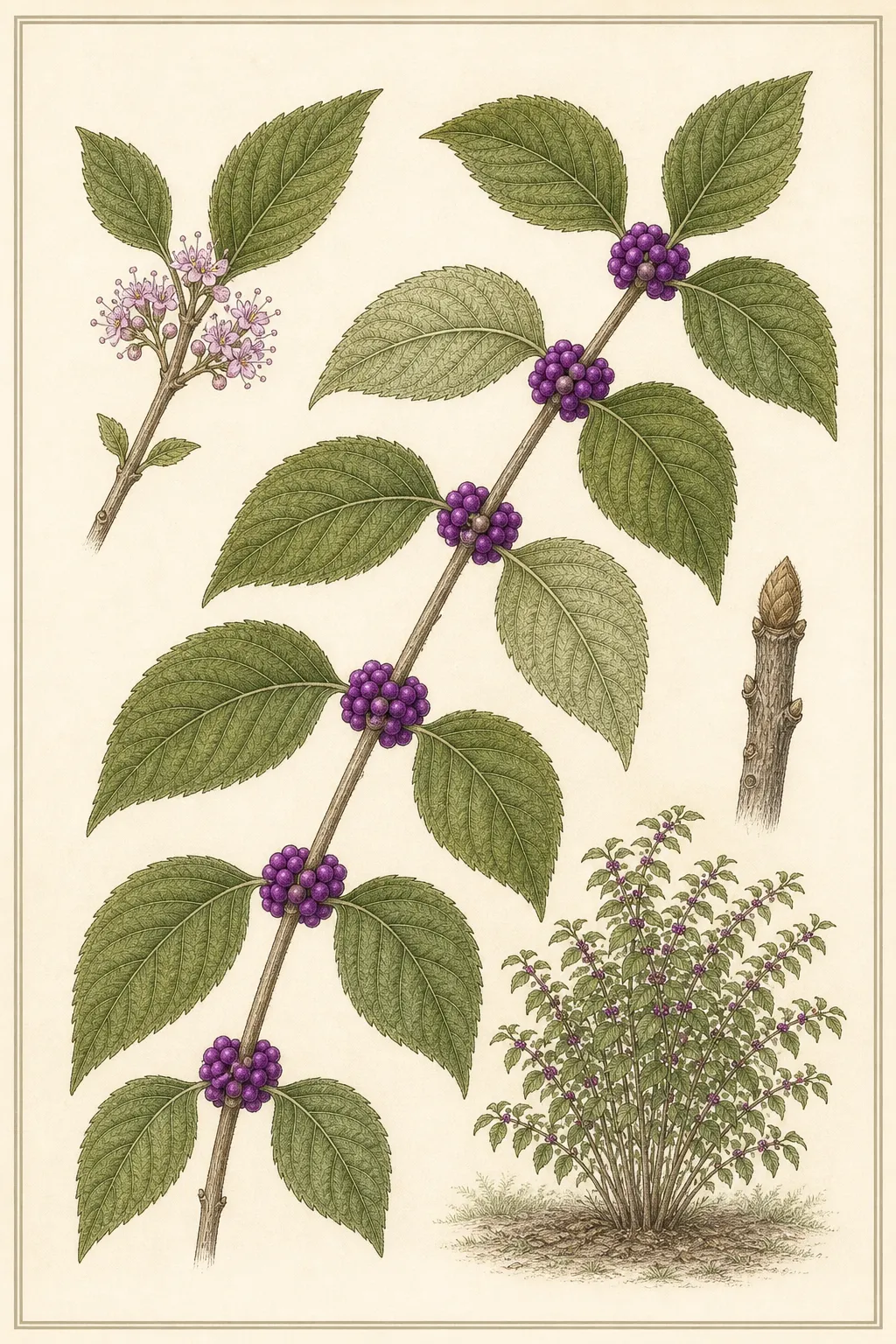
Identification starts with arrangement. The simple ovate to elliptic leaves occur in opposite or nearly opposite pairs, carry serrated margins and often show a paler, softly hairy underside. Small pink flowers also arise in axillary clusters. On a fruiting stem, the short-stalked clusters hug the twig instead of hanging as grape-like bunches. Read leaf arrangement, axillary flowers, stem-hugging fruit and the open fountain habit together before assigning the species name.
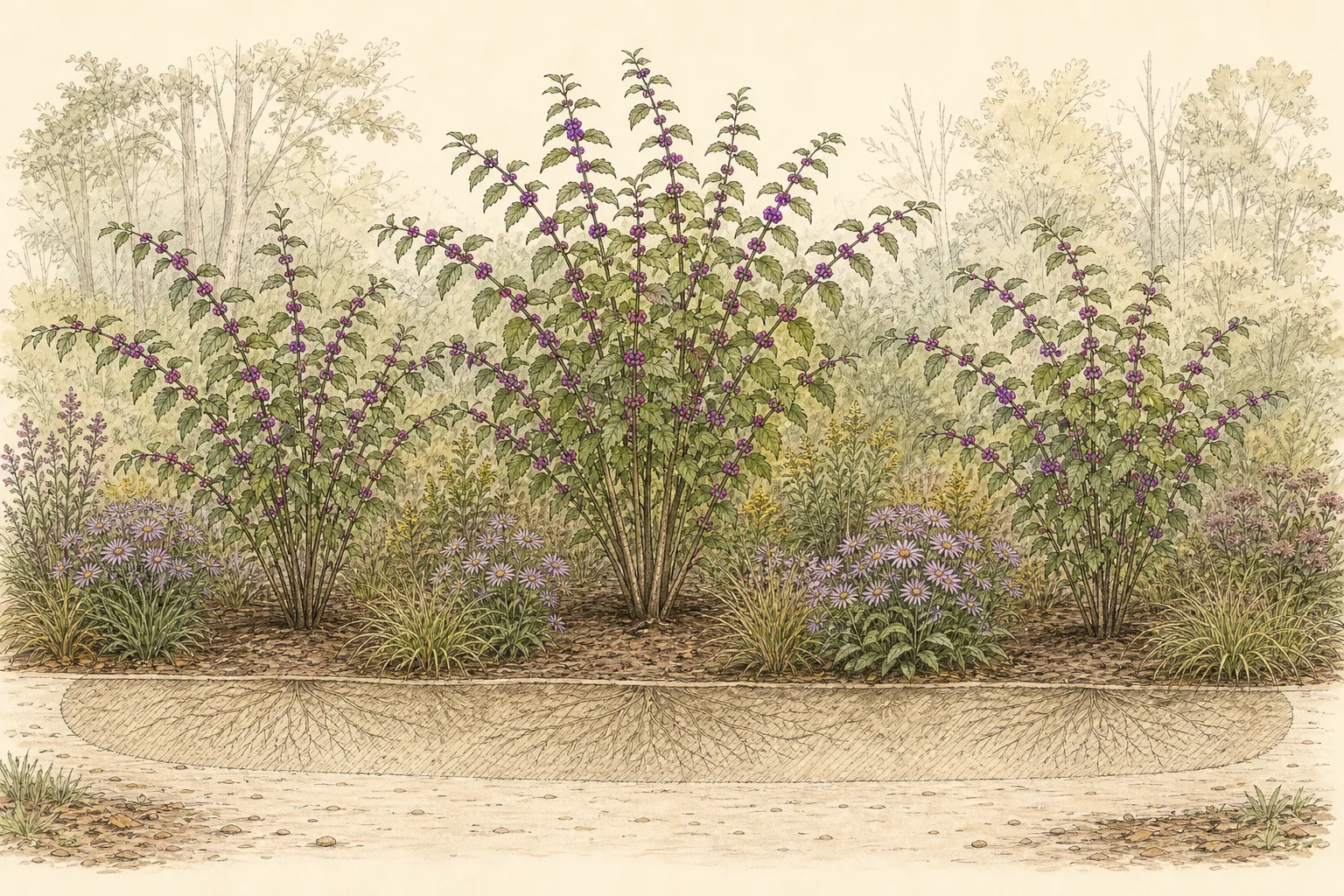
A mature plant is broader and less formal than a clipped foundation shrub. Regional references describe roughly three to eight feet of height with a similar potential spread, and individual plants can fall outside that envelope. Long outer shoots need room to bow without narrowing a walk or burying lower companions. Use a single plant where its complete outline can show, or repeat several at the back of a broad naturalistic border.
Full sun to light or dappled shade supports the species, while deep shade produces a thinner plant and weaker display. Soil texture is flexible if water can leave the root zone. Established plants tolerate some dry weather, yet prolonged summer drought can reduce leaf quality and fruiting. The practical site combines useful light, establishment water, a visible crown and a bed wide enough to hold the arching stems.
Flowers and fruit are produced on current-season shoots. That trait gives the gardener choices: an established shrub can be cut back before spring growth when winter dieback or renewal calls for it, while a well-placed plant can retain more of its natural framework and receive only thinning. The timing is more important than imposing one height everywhere. Cuts made after new shoots are carrying flowers or young fruit remove that season's display.
Wildlife use is part of the species' garden value. NC State and the USDA Forest Service describe the fruit as food for birds and small mammals, with leaves also browsed by deer. The fruit may disappear quickly where wildlife pressure is high, so persistence is not a measure of plant health. Place the shrub where dropping fruit, visiting birds and occasional self-sown seedlings are acceptable parts of the design.
Pair the coarse fruiting stems with finer foreground plants and a quiet structural background. Sedges, asters and other locally appropriate lower plants can cover the front of the bed while keeping the beautyberry crowns visible. Evergreen shrubs or a woodland edge can hold the winter composition after fruit is eaten, but maintain enough separation for light, air and inspection of the root zone.
- Family
- Lamiaceae
- Range
- Central and southeastern United States, Bermuda and the Caribbean through Cuba
- Soil pH
- 5.2–7
- Spread
- 4–8 ft · 1.2–2.4 m
Planting & careHow to grow american beautyberry
Kew records the native range from the central and southeastern United States through Bermuda to Cuba. The displayed Zone 6–10 envelope follows NC State and is broader than Virginia Cooperative Extension's Zone 7 (perhaps 6b)–9 guidance and UF/IFAS's Zone 7A–11B Florida guidance; winter dieback, heat and provenance make local performance narrower than any single map. The 5.2–7.0 pH field comes from UF/IFAS's sustainable-landscape plant matrix; Virginia Cooperative Extension gives 3.7–6.4, so local soil-test recommendations take priority. White- and pink-fruited forms exist, and related Asian beautyberries may differ in habit and fruit placement. Retain the full botanical and cultivar name.
- 1Keep the complete plant name
Confirm Callicarpa americana and retain any variety or cultivar name. White- or pink-fruited selections and related beautyberry species can differ from the violet-fruited species picture and from its mature dimensions.
- 2Draw the arching footprint
Mark a four- to eight-foot planning circle where the regional label supports it, then keep stems clear of paths, drives, windows and small permanent crowns. A narrow bed will turn the natural fountain habit into repeated pruning work.
- 3Match light to summer moisture
Choose full sun to part shade and inspect how quickly the soil dries in summer. Deep shade weakens the display, while a hot exposed site needs a root zone that can be watered evenly through establishment.
- 4Check drainage and pH
Observe the site after substantial rain and test the actual planting soil before amending it. Use the regional laboratory recommendation when it narrows or differs from the broad pH range shown in this profile.
- 5Set the root crown at grade
Dig no deeper than the measured root ball and open a wider planting area. Locate the upper roots, correct manageable circling roots, set the crown at finished grade and backfill with soil compatible with the surrounding bed.
- 6Water both soil zones
Settle the planting slowly, then check moisture inside the original root ball and in adjacent soil because the two textures may dry at different rates. Keep the site evenly moist during establishment without maintaining saturation.
- 7Mulch and preserve access
Apply a modest organic layer across the occupied root zone, taper it away from every stem and leave a route for inspection. Position foreground companions outside the crown so they do not hide the base or force the arching shoots over a path.
Pruning american beautyberry
American beautyberry flowers and fruits on current-season shoots, so dormant pruning does not sacrifice buds carried through winter. That flexibility does not make annual hard cutting compulsory. Where the open natural form fits, remove dead or crowded stems and shorten only shoots that have a clear conflict. For an established plant needing renewal, NC State recommends cutting to about one foot before spring growth; Virginia Cooperative Extension gives a more severe four- to six-inch regional regimen. Choose a locally proven approach, keep cuts above sound basal structure and expect vigorous regrowth to need later thinning if too many stems emerge. In colder gardens, wait until the worst winter weather has passed but finish before active shoots lengthen. Once flowers or fruit are present, postpone size control until dormancy so the current display remains intact.
Seasonal care
Spring
Before new shoots lengthen, remove confirmed dead wood and complete any locally appropriate renewal cut. Clear heavy debris from the crown, restore a thin mulch layer and begin moisture checks. Watch the pattern of new stems and thin excess growth early enough to keep an open framework.
Summer
Let current-season shoots carry their small axillary flowers. Maintain even establishment moisture and check exposed plants during prolonged drought. Stop pruning once flowering and fruit formation begin, and observe whether crowding or deep shade is reducing the number of productive stems.
Autumn
Read fruit placement, color and persistence as identification evidence. Water during extended dry weather while leaves remain, keep paths clear of arching stems and allow birds to use the crop. Pull unwanted seedlings while small rather than disturbing the mature crown.
Winter
After leaf fall, enjoy remaining fruit and inspect the open stem structure. Record winter dieback before removing it, especially near the cold edge. Schedule renewal or thinning for late winter before new growth, leaving the crown visible and protected from wet mulch.
Safety and garden spread
The retained horticultural sources do not identify a specific ornamental-garden toxicity for Callicarpa americana. This profile does not establish food, medicinal or pet safety and gives no preparation or dose guidance. Keep unidentified plant material out of mouths and seek appropriate medical or veterinary advice when an exposure causes concern.
Common problems
Sparse fruit
- Look for
- Few axillary fruit clusters on otherwise leafy shoots, paired with deep shade, prolonged summer drought or pruning after active growth began.
- Action
- Confirm the species and fruiting season, review light and pruning timing, and restore even moisture where the occupied root zone is dry. Observe one complete season before adding fertilizer.
Winter-killed stems
- Look for
- Dry upper shoots with no spring growth while vigorous new stems arise from the base, most often near the cold edge or in an exposed position.
- Action
- Wait for growth to separate live and dead wood, then remove the dead portion before the new framework becomes crowded. Improve shelter if the same exposure causes repeated top loss.
Leggy or congested framework
- Look for
- Long bare lower stems in shade, many weak shoots from repeated hard cuts or branches crossing through the center and over adjacent plants.
- Action
- Increase useful light where possible and thin selected stems at the base during dormancy. Use one renewal strategy consistently instead of alternating severe cutting with summer shearing.
Leaf spots
- Look for
- Discrete tan, brown or dark lesions that expand or merge, especially where foliage stays wet or neighboring plants restrict air movement.
- Action
- Remove heavily affected fallen material, direct irrigation to the soil and open crowded neighboring growth. Seek local diagnosis when spotting advances or causes early defoliation.
Weak establishment
- Look for
- Wilting, little shoot extension or early leaf drop while the original root ball is much drier or wetter than the surrounding bed.
- Action
- Check moisture in both soil zones, verify that the crown is at grade and correct irrigation distribution. Investigate persistent saturation or root defects before applying fertilizer.
Self-sown seedlings
- Look for
- Young opposite-leaved plants appearing beneath perches or around the fruiting shrub after berries have matured and dispersed.
- Action
- Confirm identity, remove unwanted seedlings while roots are small and monitor naturalized edges. Keep volunteers only where the species is regionally appropriate and the mature footprint is available.
Fruit pattern does not match
- Look for
- A plant labeled beautyberry whose fruit clusters stand away from the leaf axils, whose leaf arrangement differs or whose mature habit conflicts with the species profile.
- Action
- Retain the nursery label and compare several characters with regional references. Treat the plant as an unidentified Callicarpa until the full botanical name is confirmed.
Sources
- Callicarpa americana. NC State Extension Gardener Plant Toolbox. Source record · Accessed 2026-08-30.
- Callicarpa americana L.. Royal Botanic Gardens, Kew. Source record · Accessed 2026-08-30.
- Callicarpa americana: American Beautyberry. UF/IFAS Extension. Source record · Accessed 2026-08-30.
- Concepts for Sustainable Landscape Mosaics. UF/IFAS Extension. Source record · Accessed 2026-08-30.
- American Beautyberry (Callicarpa americana). Virginia Cooperative Extension. Source record · Accessed 2026-08-30.
- Callicarpa americana, American beautyberry. USDA Forest Service Research and Development. Source record · Accessed 2026-08-30.