Grow · renovate overgrown forsythia after bloom
Renovate an Overgrown Forsythia After Flowering
Remove the oldest canes at ground level over several seasons so an overgrown forsythia regains open structure without losing every spring bloom.
Published Last updated
In this guide
- Use the biological cue for overgrown forsythia
- Read the site and the whole plant together
- Set a visible finish line before beginning
- Prepare the work while every part is still identifiable
- Carry out the central operation in a controlled sequence
- Protect roots, crowns, and new growth after the work
- Diagnose a weak response before adding another treatment
- Leave a record for the next seasonal decision
- Steps
Use the biological cue for overgrown forsythia
Begin staged renovation as the yellow flowers fade. North Carolina State identifies the oldest stems as the pruning targets and places the work immediately after spring flowering; cuts made after mid-July are likely to remove buds for the following spring. The post-bloom window preserves this year’s display and leaves a long season for replacement shoots to mature.
Forsythia flowers on old growth, including one- and two-year-old wood, so every live cane is not interchangeable. Smooth vigorous stems rising from the base are the next flowering framework; heavily branched, coarse canes usually occupy more crown space for less renewal value. Follow each candidate from its flowers to its origin before assigning it to the saw.
Staged renewal and a total rejuvenation cut are different projects. This article keeps a portion of the established crown flowering while old stems leave over several seasons. A shrub reduced wholesale during dormancy may regrow, but it gives up the first spring display and requires a separate recovery plan.
Check whether the apparent failure is really pruning-related. The same Extension profile notes that temperatures below −5°F and late freezes can retard flower development, especially on unopened buds. A leafy shrub with few flowers after a harsh winter may still have sound younger canes; inspect bud injury before removing another age class.
Read the site and the whole plant together
Crouch at the edge of the crown and map each cane by age, health, and direction. Dead wood, crossing arches, coarse branched stems, smooth replacement shoots, and suckers that arise beyond the main base need separate marks. Then stand back at flower height to see which younger arches carried the best bloom and which old stems merely support a twiggy outer shell.
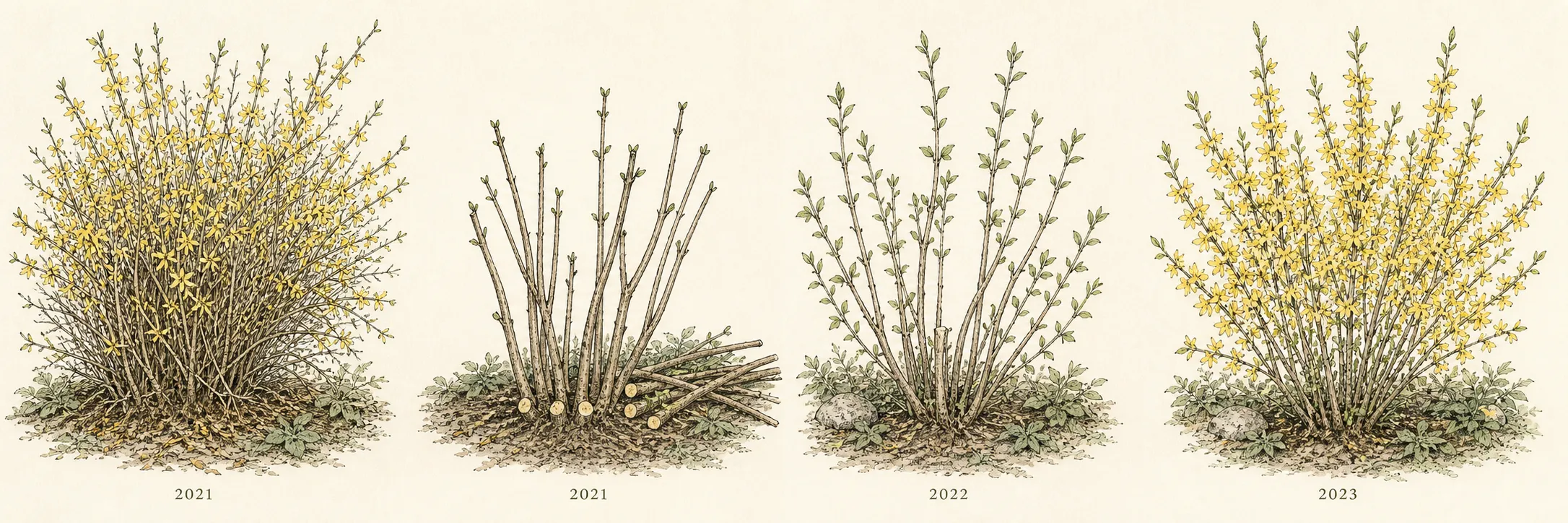
Allow for the plant’s actual scale. The published profile gives border forsythia a mature range of about 8 to 10 feet high and 10 to 12 feet wide, with an arching, spreading habit. A narrow foundation gap cannot accommodate that structure indefinitely; staged renewal improves cane age but cannot rewrite mature dimensions.
Map exposure before comparing flower coverage from one side of the shrub to another. Full sun produces more and earlier bloom than partial shade in the North Carolina State profile, so a shaded sector may carry sound wood yet flower less densely. Preserve a representative younger cane there and compare its leaf and bud performance after the crown opens.
Plan entry from firm ground and locate spring bulbs, low perennials, irrigation lines, and the landing space for long canes. The safest extraction route often lies opposite the path being cleared. Protect young basal shoots along that route because they are the wood expected to rebuild flowering coverage over the next seasons.
Set a visible finish line before beginning
Set the annual removal fraction from the retained source ranges. RHS routine guidance takes up to 20 percent of ageing stems near the base, while Missouri Extension describes roughly one-quarter to one-third of the oldest canes for established spring-flowering shrubs. Use the smaller share when bloom retention, weak vigor, or a sparse young cohort makes every live cane valuable.
Mark the younger framework that must survive before selecting old canes. The completed crown should contain open lanes at the base, vigorous arches of several lengths, and enough one- and two-year-old growth for the next display. Its outline will remain fountain-shaped and may look uneven immediately after an old cane leaves.
End the session when the marked fraction is complete or when another removal would create a large unsupported gap in younger wood. Widespread dieback, crown swellings, loose root anchorage, or a lack of replacement shoots changes the project from renovation to diagnosis. Repeated path conflict after sound renewal points toward relocation or a smaller cultivar.
Convert the percentage range into actual canes before tools enter the crown. A shrub with twelve live structural canes would place an RHS-sized 20 percent pass at about two old stems; a one-quarter to one-third pass would remove three or four. Round toward the lower number when the age classes are uneven or the young framework is concentrated on one side. Count structural canes from the base, since a heavily branched old stem is still one cane for this decision.
Prepare the work while every part is still identifiable
Photograph the flowering shrub from a fixed point and number the oldest live canes with loose tape at eye level and again near the base. On a sketch, circle the younger arches being retained for bloom. Double marking prevents the top of one selected cane from being confused with the base of another where the interior is tangled.
Remove clearly dead and broken wood before calculating the live-cane fraction. Deadwood removal can reveal enough space to reduce the planned renovation. Keep unusual dieback or swollen tissue separate for diagnosis, and clean the blade before returning to healthy wood.
Choose bypass pruners for small accessible shoots, loppers for stems they can close through cleanly, and a pruning saw for larger basal canes. Test the saw angle beside each marked origin before cutting. Limited clearance may make a different old cane the safer choice while preserving the same age balance.
Cover bulbs and young shoots, then spread a tarp beyond the side chosen for extraction. Clear people and movable pots from the full length of an arching stem. Plan to guide the basal end out first while a helper controls the top from beyond the blade area.
Read the numbered sequence aloud before beginning: deadwood, selected oldest cane, crown check, extraction, and recount. This matters in a thicket because the visible top of cane four may cross the base of cane seven. If the selected origin cannot be reached without cutting a vigorous replacement, choose another old stem from the same age class or divide the removal into controlled sections. The age-balance objective is more important than taking one particular branch.
Carry out the central operation in a controlled sequence
Follow the first numbered old cane to its origin, move young stems aside, and cut as close to ground level as safe tool access allows. A tall peg becomes another tier of twiggy growth, while a clean basal removal makes room for replacement shoots. Guide the severed cane butt-first onto the tarp and uncover the crown before selecting the next number.
Use heading only for a specific branch that obstructs a path or breaks the intended arch. RHS guidance for forsythia directs flowered growth back to a strong young shoot lower down. Choose that lateral for its outward direction and keep the rest of the retained cane at its natural length.
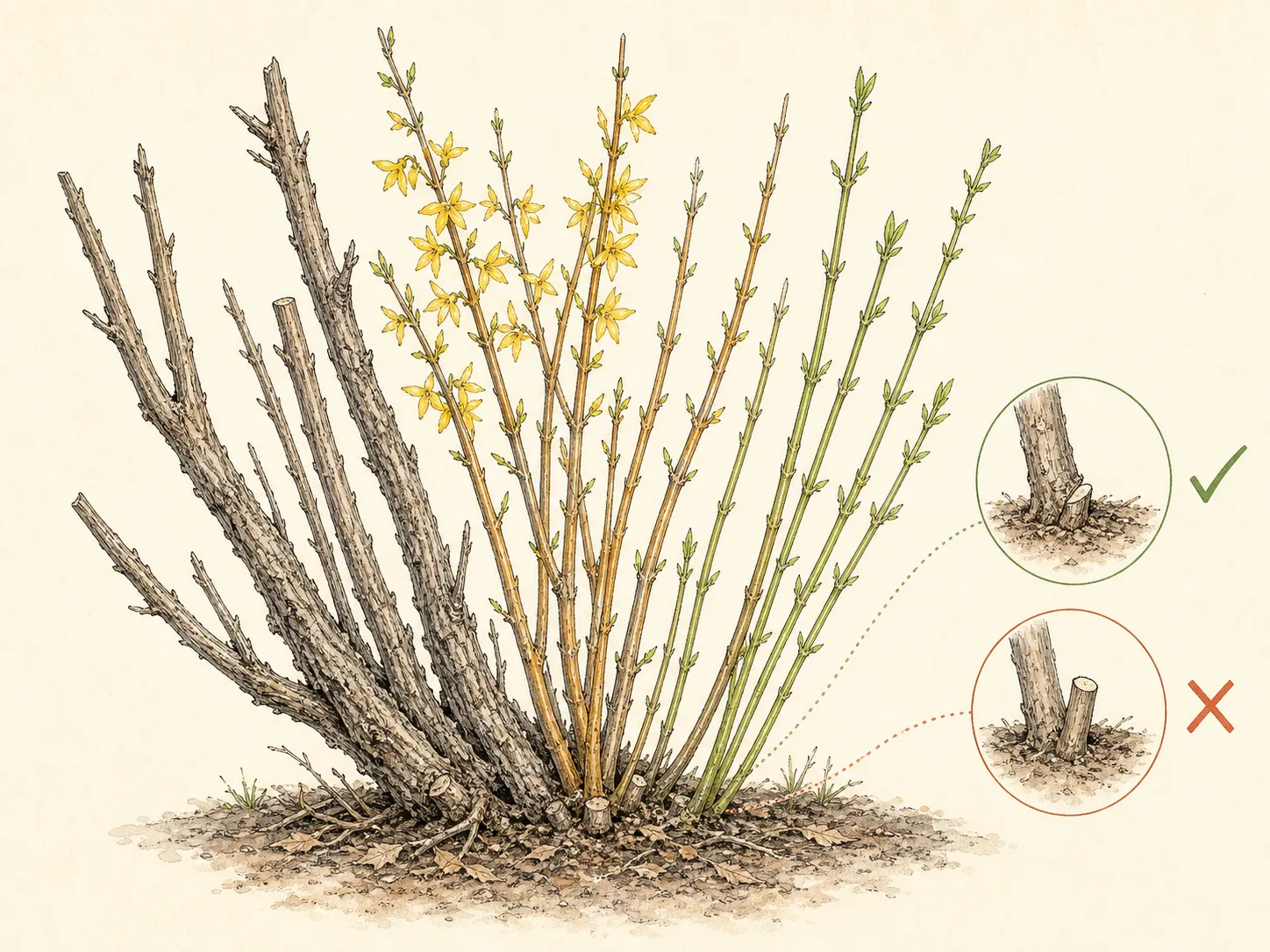
After each major removal, step to the fixed photo point and inspect base openings, flower-bearing young wood, and the fountain outline. Continue until the chosen fraction is reached, then remove tape and count the surviving age classes. A uniform hedge-shear pass over the exterior would leave old congestion at the crown and stimulate dense tips exactly where the shrub was already overgrown.
Protect roots, crowns, and new growth after the work
Carry every twig off the crown and restore mulch over the surrounding root zone with cane origins left visible. Forsythia prefers medium moisture in well-drained soil, so check actual moisture during dry weather and water the roots when needed. RHS guidance includes mulch and feed after pruning; match any fertilizer to local soil conditions and the product label.
Protect new basal shoots from hoses, mowers, and foot traffic through summer. Wind may move newly exposed arches more than it did inside the old thicket, yet sound flexible stems usually settle into the natural fountain form. Remove a shoot only when it breaks or grows into a documented access conflict.
A weak replacement flush is evidence to reduce or pause next year’s fraction. Keep the retained leaf area, examine shade and moisture, and let the current young wood mature. Forcing a second cut or heavy feeding during the same season obscures whether the crown still has the vigor needed for staged renovation.
Check the opened crown after a summer storm. A retained arch that rested on an old cane may settle lower once that support is gone, yet its flexibility and flowering value can still justify keeping it. Redirect a path-conflicting tip to a strong lateral after assessing the whole stem, and preserve basal replacements from string trimmers and foot traffic. The renovation succeeds through new cane development, so protecting those shoots matters more than holding every remaining branch in its pre-cut position.
Diagnose a weak response before adding another treatment
Read the first response in midsummer. Count new basal canes, compare their length and color with retained young stems, and note whether light reaches the opened crown. Strong replacements distributed around the base support another staged pass next year; a flush confined to one sector points to shade, root competition, or local crown damage.
Read the flowering response the following spring. Buds and flowers along retained one- and two-year-old arches show that the age map worked. Vigorous green growth with fewer flowers may reflect the expected removal of old flowering wood, while weak growth plus poor bloom indicates broader stress.
Separate weather injury from pruning timing. Bud failure after temperatures below −5°F or a late freeze can occur even on correctly retained stems. Flower loss concentrated on shoots cut after mid-July points toward removal of formed buds, and consistently sparse bloom in shade fits the site response described by North Carolina State.
Persistent dieback, crown galls, lesions, or wilting across an otherwise watered plant merits local diagnosis. Retain healthy comparison canes and isolate suspect debris. Another round of thinning before the cause is known can erase the boundary between a pruning response and disease progression.
Flower position can also reveal which canes belong in stage two. Dense bloom on the outer tips of an old, bare-based cane shows that it still carries buds but contributes little productive wood near the crown; vigorous flowers distributed along a younger arch argue for retention. Mark those differences while the shrub is yellow. By leaf-out the display evidence has disappeared, and easy tool access can become a misleading substitute for cane age.
Leave a record for the next seasonal decision
Update the cane map with the date, removal fraction, numbers cut, and young arches deliberately retained. Photograph the open base and the full fountain outline from the fixed point. Leave the surviving oldest canes numbered for consideration next year, without treating those numbers as an automatic cutting order.
Add a midsummer note on replacement-cane count, moisture stress, and path clearance, followed by a flower-distribution photograph next spring. Record severe winter temperatures or late freezes beside the bloom result. That sequence separates the effects of cane age, weather, and site exposure.
Approve the next stage only when the crown produced vigorous replacements and retained stems flowered acceptably. The next pass may remove another source-bounded fraction, pause for recovery, or end because the age structure is balanced. For each old cane left in place, note whether it preserves bloom, fills an important side, or awaits a younger replacement. A shrub that still overwhelms its site after successful renewal is a candidate for relocation or replacement, not perpetual annual reduction.
Steps
- Level
- moderate
- Time
- One focused session, followed by scheduled checks
- Tools
- Bypass pruners, Loppers, Pruning saw, Tarp
- Materials
- Mulch if the existing layer is depleted
- 1Wait until flowering finishes
Start as the spring flowers fade, while their distribution still identifies productive younger wood. Complete staged live-cane removal well before mid-July so the replacement growth can mature and carry future buds. An uncertain identity or widespread bud injury limits the first pass to dead and broken wood.
- 2Map stem ages from the base
Trace dead stems, coarse branched old canes, smooth one- and two-year-old arches, and new basal shoots to their origins. Number the oldest live canes twice and sketch younger stems reserved for bloom. Compare the available space with the 8- to 10-foot height and 10- to 12-foot width reported for border forsythia.
- 3Select this year’s old canes
Clear dead wood, then choose up to one-fifth of ageing stems for a conservative RHS pass or roughly one-quarter to one-third for a vigorous, severely congested crown following Missouri guidance. Retain younger flowering arches throughout the shrub. Cover hidden companions and test tool access at every selected origin.
- 4Remove old canes at ground level
Cut each numbered old cane close to its origin while a helper controls the arching top beyond the blade path. Move the basal end onto the tarp first. Keep younger stems at varied natural lengths, using a heading cut only where a specific branch can return to a strong outward young shoot.
- 5Keep the opened crown visible
Lift all twig debris, count the completed basal removals, and photograph the openings before replacing mulch beyond the cane bases. Water during dry conditions according to root-zone moisture. Protect new shoots and retain the irregular outer arches that carry the fountain shape.
- 6Stage the next year from bloom evidence
Count replacement canes in midsummer and photograph flower coverage the following spring, noting severe cold or late freezes. Select another source-bounded fraction only when regrowth was strong and younger wood flowered. Pause for weak recovery, finish when age classes are balanced, or replace a shrub whose mature spread remains incompatible with the site.
Sources
- Pruning shrubs. Royal Horticultural Society. Source record · Accessed 2026-08-30.
- Forsythia. North Carolina State Extension. Source record · Accessed 2026-08-30.
- Pruning Ornamental Shrubs. University of Missouri Extension. Source record · Accessed 2026-08-30.