Grow · wisteria two season pruning
Prune Wisteria by Its Two-Season Spur-Building Cycle
Build a permanent trained framework, shorten green summer whips, return in winter to form flowering spurs, and keep vigorous growth out of structures.
Published Last updated
In this guide
Map the permanent framework first
Begin by identifying the permanent framework: the trunk, main arms, and selected secondary branches that belong on the support for years. Everything else is either a temporary extension being trained into a gap or a lateral that will be shortened into a flowering spur. Without that map, summer and winter cuts become random shortening and the vine quickly returns to gutters, windows, rooflines, or nearby trees.
Inspect the support before touching the vine. Wisteria can reach 30–40 feet and becomes very heavy, so posts, anchors, wires, and the wall behind them must be structurally sound. RHS wall training uses strong horizontal wires about 30 cm, or 1 foot, apart. Replace corroded fittings and restore clearance before retaining new wood that the support cannot safely carry.
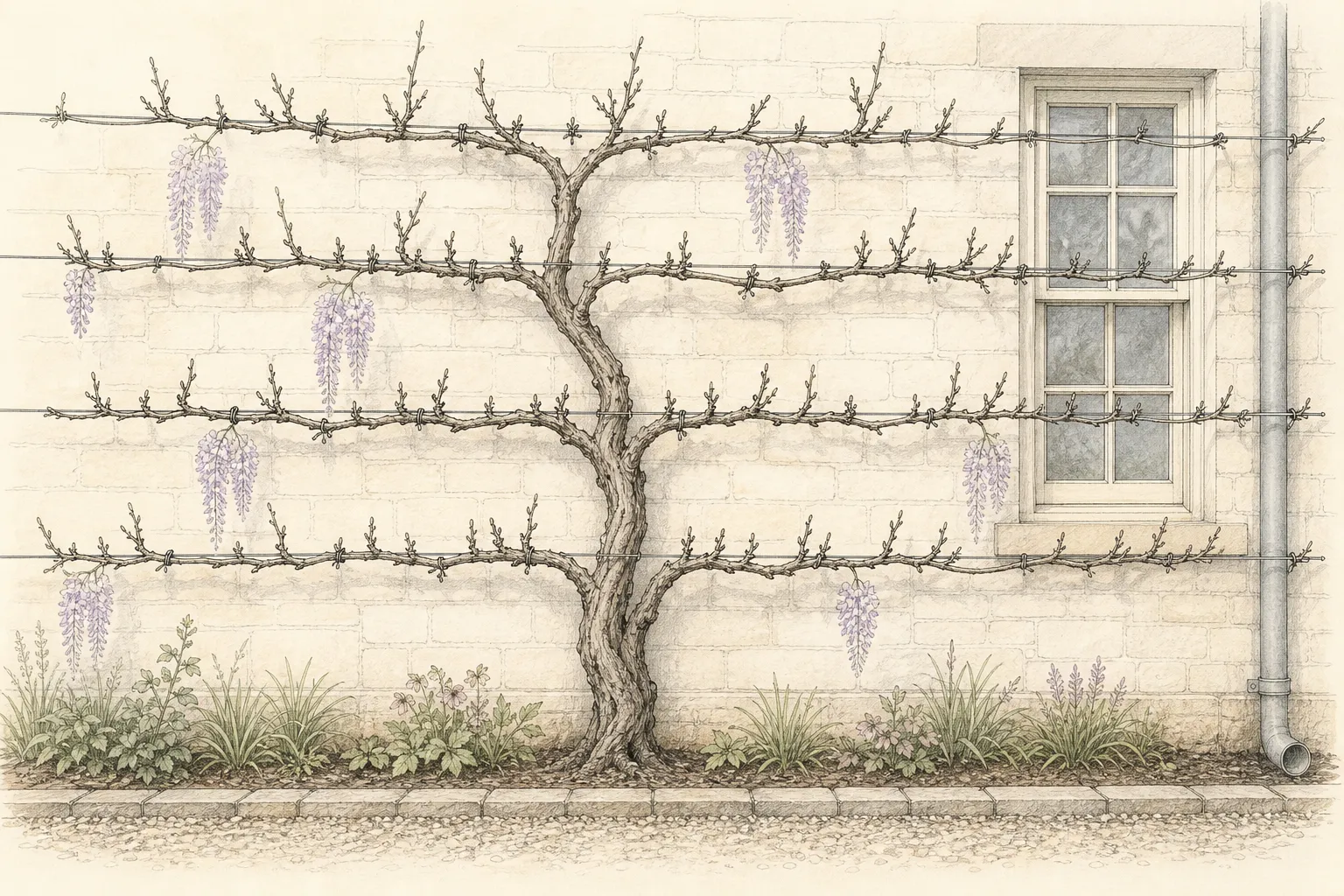
Trace each main arm from the trunk and decide its boundary. A useful framework distributes flower-bearing laterals where racemes can hang freely and where pruning can be reached from a stable position. Remove plans for extensions into eaves, tiles, gutters, window mechanisms, utility lines, or living tree canopies. A soft new whip becomes a difficult woody problem if it is accepted in the wrong direction.
Photograph the leafless framework and mark chosen extensions with loose ties. The record prevents a summer shoot needed to fill a real gap from being cut with the disposable whips. It also shows whether the same arm repeatedly overwhelms one side. Keep the natural twining direction of the identified species when guiding a new extension; forcing a woody stem backward around a post invites cracks and broken ties.
Separate extension shoots from flowering spurs
An extension shoot lengthens the permanent framework; a flowering lateral grows from established wood and is repeatedly shortened into a spur. Keep only the few extensions needed for planned coverage. Tie them along the support as they grow. Treat the many other long green whips as temporary growth to be shortened in the two-season cycle.
Old spurs appear as short, knobbly clusters close to main branches, often with several past cuts and buds. Recognize these short knobbly clusters as the productive spur structure. They are the structure the pruning system is designed to build. Thin only where spurs have become crowded, dead, weak, or unable to carry flowers without rubbing.
Basal shoots need a decision at their origin. Retain one only if it is a planned replacement emerging from the named cultivar above a graft. Shoots from below a graft belong to the rootstock and lack the cultivar identity. Trace the union before tying a basal stem into the framework, and remove unwanted growth while it is small enough to handle safely.
Distinguish a spur from a cut stub. A living spur carries buds and short branching close to an arm; a long bare stub beyond its last live bud contributes nothing and may die back. Make the next cut just outside sound tissue without slicing into the main branch. Where a spur cluster remains vigorous and well spaced, keep it even if neighboring laterals look younger and smoother.
Use summer and winter cuts for different jobs
Summer pruning controls extension and exposes young wood to light. In July or August after flowering, RHS guidance shortens current-season green whips to five or six leaves from the main branch. This stops them reaching buildings, improves air and light around the base of the growth, and helps the retained wood ripen and form flower buds.
Winter pruning converts those summer-shortened laterals into compact spurs. In January or February, when the vine is dormant and leafless, shorten them again to two or three buds, roughly 2.5–5 cm from older wood. The framework is visible then, so cuts can be placed without leaving a dense tangle that hides flowers behind leaves.
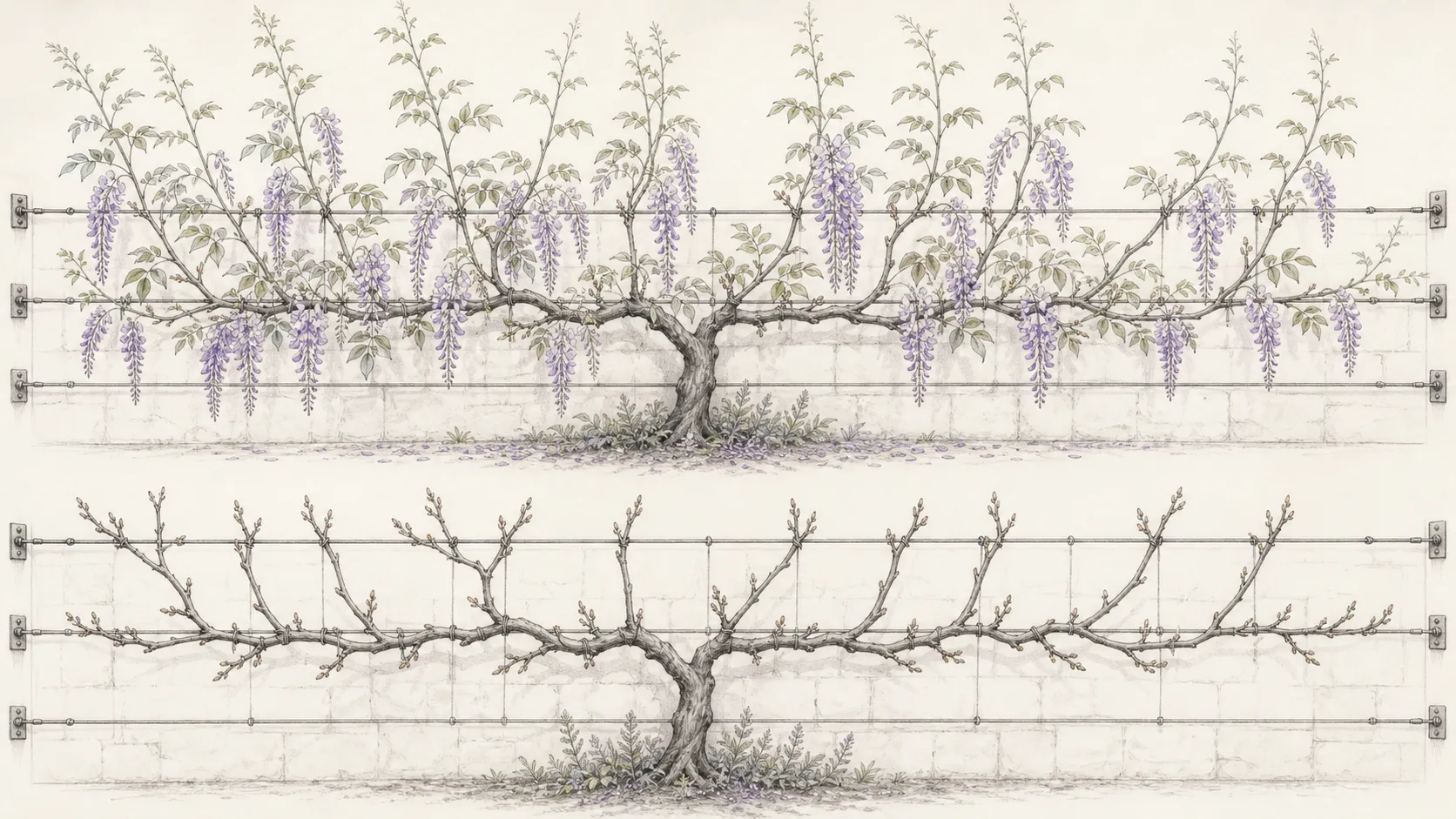
The two cuts have different jobs and should not be collapsed into one severe session. Summer work checks vigorous green length and chooses extensions; winter work refines buds on a visible framework. Skipping summer allows whips to invade structures. Skipping winter leaves long laterals and flowers farther from the main arms. Repeating both builds a readable spur system over time.
Treat the named months as regional examples tied to growth stage. RHS guidance uses July–August and January–February in the UK; Oregon State likewise recommends summer and winter pruning but gardeners in colder interiors may reach dormancy earlier or later. Summer follows the main bloom and current extension; winter means leafless dormancy before spring growth. Prune thawed wood at the correct growth stage for the local season.
Make summer cuts without losing extensions
Start summer work by following each whip back to the branch that produced it. Remove growth already entering gutters, windows, roof spaces, or the crown of another plant. On ordinary laterals, count five or six leaves from the main branch and cut just above the selected leaf. Keep the cut clear of a developing bud and avoid tearing the soft green stem.
Carry each planned extension to its mapped boundary. Lay it along the empty wire or beam, preserving the natural twining direction, and secure it with soft loose ties. Remove competing shoots that would create several leaders in the same narrow space. Once the extension reaches its intended boundary, its future laterals can enter the routine spur cycle.
Untangle crossed green shoots before cutting. A whip may loop through several retained stems, and pulling its cut end can strip buds or snap young laterals. Cut it into manageable sections and unwind them. Keep long racemes, leaves, and chosen extensions free to hang; the goal is a flatter, better-lit framework, not a tightly bundled rope.
Revisit the vine later in summer if strong whips grow after the first cut. RHS guidance shortens those later shoots to five or six buds during winter, but early removal is appropriate when they enter a prohibited structure. Use one deliberate summer pass, with later cuts reserved for shoots entering prohibited structures.
Maintain ordinary root-zone moisture while next year's buds develop. The RHS problem guide identifies dry soil from July through September as one cause of aborted buds. That does not mean keeping the soil waterlogged; Phytophthora and other root problems are favored by poor drainage. Check the actual soil, water deeply when needed, and avoid high-nitrogen feed that drives more whips at the expense of flowering.
Build winter spurs on readable laterals
Winter exposes the exact relationship among trunk, main arms, summer stubs, and old spurs. Begin with dead, damaged, or structurally unsafe wood, then find every lateral shortened in summer. Cut it to two or three healthy buds from its base. Make a clean angled cut just beyond the chosen bud without removing the spur collar or leaving a long dead stub.
Space productive spurs along the main arms. Where several clusters rub or shade one another, remove the weakest at its origin and keep the best placed. Retain productive older spurs while opening only genuine congestion. The useful test is whether individual clusters have room for leaves and hanging flowers and can be reached again next season.
Check ties and wires while the plant is leafless. Loosen anything biting into bark, replace degraded material, and move ties away from swelling junctions. A mature arm should rest on the support without being girdled. If the support is failing, stop pruning and arrange structural repair before the retained vine gains another season of weight.
Leave the main framework long enough to fill its assigned structure. Routine winter pruning targets laterals, not the permanent arms. Shortening a main branch is renovation and triggers vigorous replacement growth. Make that cut only for a documented boundary, damaged branch, or support repair, and anticipate fewer flowers while the new structure develops.
Count buds from the lateral's true base. The final two or three buds should sit close to the permanent arm, where short shoots and racemes can be supported. If a lateral begins far from useful framework or crosses behind several branches, remove it at origin; placement takes priority over a numeric bud count.
Treat renovation as a separate project
Treat a severely overgrown wisteria as a renovation project, not an exaggerated routine prune. Trace and label major branches before cutting because twining stems cross repeatedly and the visible end may originate far away. Remove growth from roofs, windows, and unsafe supports first, then decide which old arms can be shortened to a strong younger branch.
Stage large reductions where practical. RHS guidance warns that hard pruning stimulates strong new growth and that flowering may take two or three years to resume while replacement branches are trained. Let roots support renovation regrowth without high-nitrogen feed. Direct a few useful shoots into gaps and return the remaining laterals to the summer-winter cycle.
Use an arborist or qualified contractor when heavy branches, high walls, electrical service, fragile roofs, or structural repairs exceed safe ground-based work. Wisteria wood can bind tools and release suddenly. A renovation that damages masonry, a pergola, or the gardener is not justified by flowering. Establish a support and access plan before the vine is allowed to regrow.
Map replacement growth before the first large cut. A younger branch near the base of an old arm can be trained into the same space, but a shoot several feet away may not recreate the line without crossing windows or other arms. Lower one section, tie the planned replacement, and let it establish before removing the next major piece when continuity of shade or screening matters.
Record the flower response
Record where flowers appear in relation to the spurs and cuts. Photograph the vine in bloom and again leafless. A good response places racemes along the established arms with enough space to hang and without a surge into prohibited structures. Use that map to retain productive spur clusters and to identify framework gaps that need one planned extension.
Poor flowering is not always a pruning failure. Seed-grown plants may take many years to flower; newly planted cultivars can need time to establish. RHS also identifies shade, dry soil while buds develop from July to September, spring frost, excess nitrogen, and disrupted pruning as causes. Check those factors before cutting harder or adding fertilizer.
Keep the cycle consistent but not automatic. Summer prune when green whips have extended and flowering is over; winter prune when the leafless framework is readable. Adjust individual shoots for cultivar, climate, support, and planned coverage. The enduring result is a strong framework with short renewable spurs, safe clearance, and a manageable route for the next two visits.
When a named cultivar still refuses to flower, record its age, purchase condition, sun, July–September moisture, frost exposure, and fertilizer before changing the framework. Seed-grown vines can remain juvenile for many years, whereas a grafted or cutting-grown cultivar bought in bloom should establish a more predictable identity. Root pruning and other stress treatments need local expert guidance and are not a substitute for correcting shade, drainage, or excessive nitrogen.
Inspect support load again after leaves and racemes expand. Wires that looked sound in winter may sag, anchors may move in wet masonry, and long flower clusters can catch wind. Transfer weight to sound hardware, add clearance, and schedule repairs after bloom with the framework mapped. Keep the vine's growth boundary synchronized with the structure's real capacity so pruning and engineering solve the same problem.
After repair, assign one trained extension to any genuine framework gap and remove competing whips early. This keeps future weight predictable and restores flowering spurs close to secure hardware.
Steps
- Level
- advanced
- Time
- 1–3 hours twice yearly
- Tools
- bypass pruners, loppers, stable ladder or platform, soft ties
- Materials
- strong horizontal wires and anchors
- 1Trace permanent wood
Trace the trunk, main arms, existing spurs, graft if present, and every boundary near roofs, gutters, windows, trees, and utilities. Mark the few extensions needed to fill real gaps, and confirm that posts, wires, anchors, and access can support the mature vine.
- 2Secure the support
Separate permanent arms and chosen extensions from ordinary current-season laterals. Preserve short established spur clusters unless they are dead, weak, rubbing, or excessively crowded. Remove unwanted rootstock shoots from below the graft at their origin.
- 3Summer-prune whips
After flowering in July or August, follow each green whip to its main branch and shorten ordinary laterals to five or six leaves, cutting just above a leaf. Remove shoots entering prohibited structures and dismantle tangled growth in sections to preserve retained stems.
- 4Tie chosen extensions
Lay each chosen extension along the intended wire or beam in its natural direction and secure it with soft loose ties. Remove competing leaders from the same gap, preserve clearance for hanging racemes, and stop the extension when it reaches the mapped framework boundary.
- 5Winter-prune laterals
In January or February, find the laterals shortened in summer and cut them again to two or three healthy buds, about 1–2 inches from older wood. Keep permanent arms intact, place clean cuts beyond buds, and leave enough productive spurs along each branch.
- 6Thin crowded spurs
Thin only congested, dead, weak, or rubbing spur clusters. Check and loosen ties, replace failing hardware, and stop if the support needs structural repair. Treat any cut into a main arm as renovation, with vigorous regrowth and a possible multi-year flower loss.
- 7Audit flowers and structure
Photograph bloom location and the winter framework, then record summer and winter cut dates, dry periods, frost injury, and unwanted regrowth. Use the record to keep productive spurs, select the next extension, and investigate non-flowering before pruning more severely.
Sources
- Wisteria Pruning Guide. Royal Horticultural Society. Source record · Accessed 2026-08-30.
- Wisteria Problems: FAQs. Royal Horticultural Society. Source record · Accessed 2026-08-30.
- Vines for Maryland Gardens. University of Maryland Extension. Source record · Accessed 2026-08-30.
- Prune wisteria to keep its spring show in bounds. Oregon State University Extension Service. Source record · Accessed 2026-08-30.