Grow · redtwig dogwood renewal pruning
Prune Red-Twig Dogwood for Better Winter Stem Color
Renew selected old stems at the base, preserve a mixed-age framework, and avoid turning a colorful winter shrub into a weak annual stump.
Published Last updated
In this guide
Confirm the shrub and its design job
Confirm that the shrub is a winter-stem dogwood before using a renewal schedule. Red-osier or red-twig dogwood, Cornus sericea, forms a spreading North American shrub; common or blood-twig dogwood, C. sanguinea, is Eurasian; cultivated C. alba selections are also common. All can carry colored young stems, but mature size, suckering, wildlife value, and regional behavior are not interchangeable.
Read the cultivar label for the color and habit the plant was selected to display. Red, coral, yellow, and near-black stems age differently, and compact cultivars may not need the same reduction as a vigorous species shrub. A variegated selection also contributes summer foliage. Pruning solely for maximum juvenile bark can remove flowers, fruit, height, screening, and habitat that the garden was using.
Decide whether the design job is a natural thicket, an informal screen, a mixed shrub, or a low stool grown almost entirely for winter stems. A six- to nine-foot C. sericea at a wet edge can be allowed a mixed-age framework; a formal winter display in front of evergreens may justify more intensive renewal. Write that job down before choosing cuts.
Inspect the site as well as the stems. C. sericea prefers consistently moist, organically rich soil and can spread by underground stems; drought stress in full southern sun reduces vigor. C. sanguinea tolerates a broader well-drained range. Renewal pruning stimulates shoots only when the root system, light, moisture, and available space can support them.
Use the correct species source for regional decisions. The retained RHS profile describes European C. sanguinea, while the North Carolina Extension addition describes North American C. sericea and its wetland habit, colony spread, and southern heat response. Their shared winter-stem effect supports the pruning concept, but one species' native status, disease profile, or moisture tolerance must not be transferred automatically to the other.
Read color as an age map
Use winter color as an age map after the leaves fall. The youngest vigorous stems usually show the clearest red or yellow; older stems become duller, grayer, thicker, and more branched. Color also varies with cultivar, sun, and health, so compare stems within the same shrub while verifying age from diameter, branching, and bark texture.
Trace a candidate stem from its colored tip to the crown. A bright twig may arise from an older main cane, and cutting only the twig does not renew the framework. Conversely, one dull outer surface does not prove the entire cane is unproductive. Look for stem diameter, branching density, bark texture, dieback, and where younger replacements already emerge.
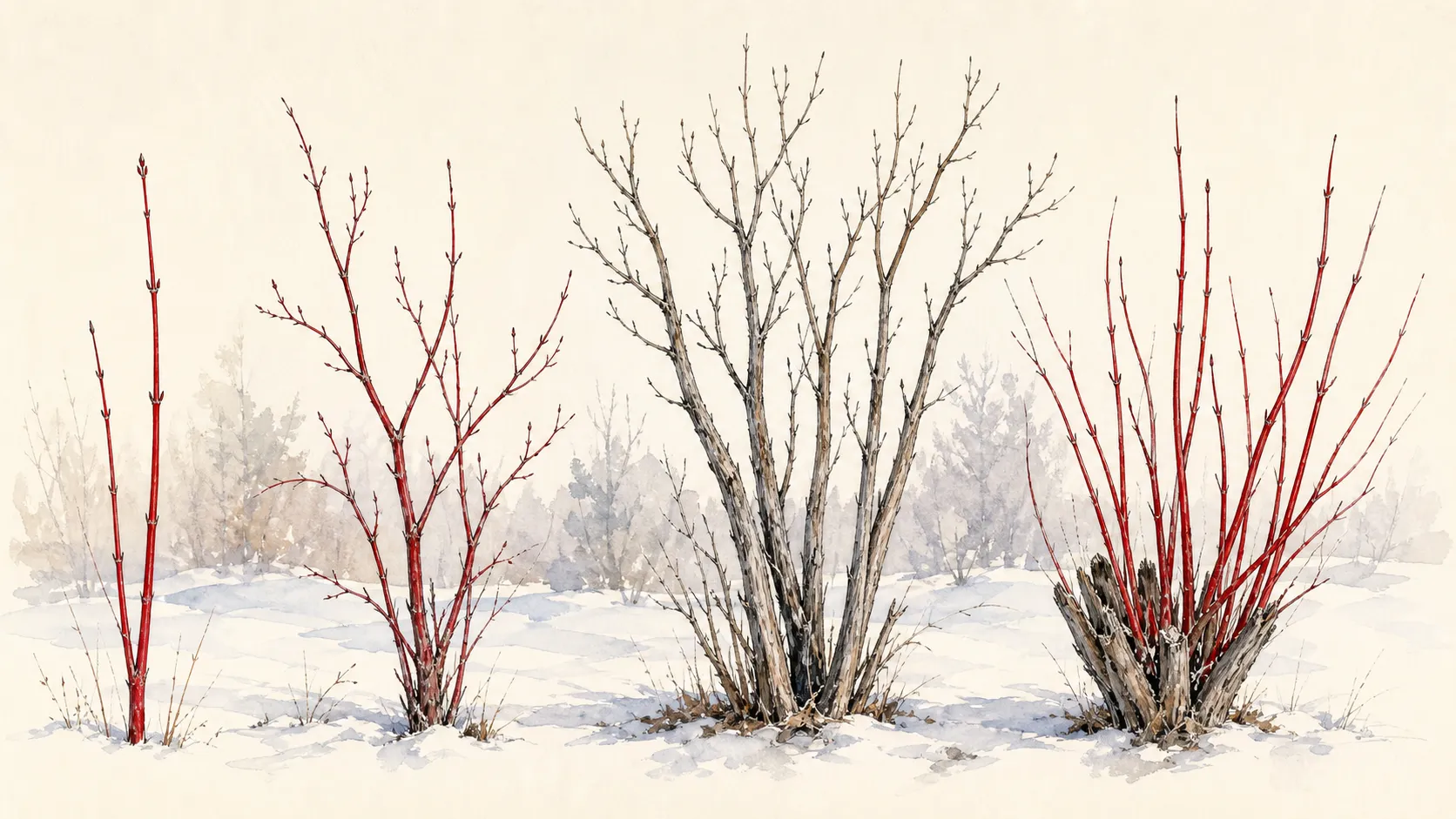
Mark age classes before pruning: a small set of oldest dull canes, a middle cohort that still supports form and flowering, and young replacement stems. The mixed map prevents an all-or-nothing cut. It also exposes a shrub with no young renewal, which may need improved light or root-zone care before any further established stem is removed.
Observe the color from the main winter viewpoint, not only at arm's length. Stems lit by low sun can appear brighter than shaded stems of the same age, and snow or a dark evergreen background changes contrast. Mark canes before moving around the shrub so aesthetic selection remains connected to actual age and placement while ignoring temporary lighting effects.
Choose selective renewal or renovation
Choose selective renewal when the shrub contributes height, fruit, screening, or a natural outline. Remove a portion of the oldest stems at ground level and retain well-spaced middle-aged and young canes. University of Maryland's general renewal guidance removes weak and unhealthy stems first, then older branches, and can stagger major work by taking roughly one stem in three over successive years.
Choose hard coppicing only for an established, vigorous dogwood being managed specifically for juvenile stem color. Current RHS guidance cuts established plants to about 5–7.5 cm from the ground from late winter to mid-spring. That system produces a low stool and a flush of young stems, but it also sacrifices the current season's flowers and fruit and removes winter cover.
A neglected shrub can be renovated in stages. First remove dead, broken, rubbing, and diseased canes; then take a limited number of the oldest sound stems. Watch the response for one full growing season. If strong replacements emerge and mature, continue renewal next spring. If regrowth is weak, diagnose shade, drought, root damage, or unsuitable species placement before cutting more.
Newly planted or recently divided shrubs need establishment before aggressive renewal. Their root systems are already supporting transplant recovery, and severe top removal changes the balance again. Limit early pruning to damage and obvious defects unless the nursery form requires correction, then begin the chosen color-renewal cycle after the shrub is growing strongly in its permanent site.
Time hard renewal before vigorous spring extension but after the winter display has served its purpose. RHS guidance spans late winter to mid-spring in its UK context; colder or warmer regions require local timing. The biological cue is a dormant or just-waking established shrub with workable soil, not a universal calendar date copied across climates. Avoid late-season hard cuts that provoke tender growth before winter.
Remove selected old stems at their origin
Make renewal cuts at the stem's point of origin close to the crown without slicing neighboring bark. Use bypass pruners for small canes, loppers for medium stems, and a pruning saw for material too large to cut cleanly. Place every basal cut at its origin; tall stubs die back, catch debris, and obscure replacement shoots.
Remove one marked stem at a time and step back. The opening should distribute light through the clump and distribute openings around the crown. If a cane is intertwined with younger shoots, free its branches in sections and lower them carefully. Pulling a whole branched stem through the crown can strip bark from retained canes and break the very replacements the cut was meant to favor.
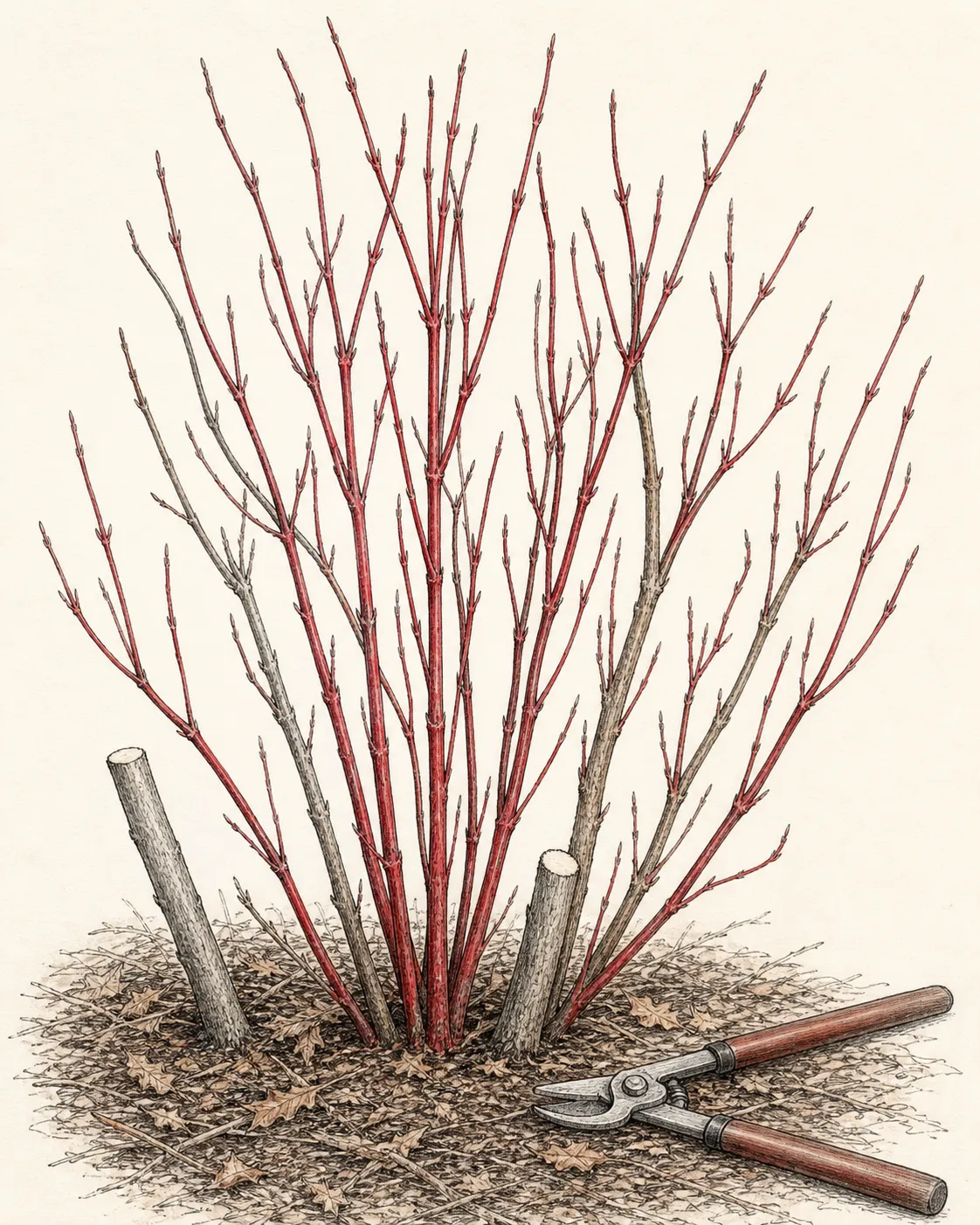
Keep basal shoots that are well placed and true to the cultivar. Remove damaged, crossing, or outward-running suckers only when they conflict with the intended boundary. On C. sericea, underground spread is part of the species habit; root pruning may be needed where a colony is unwanted, but top pruning alone will not stop new shoots outside the original crown.
Place each basal cut just outside the swollen collar or at the true point of origin; keep the swollen collar and crown intact. A clean cut closes more predictably than a torn stub. If a large cane binds the saw, support its weight and use staged cuts so bark does not split into retained tissue when the final fibers release.
Preserve the natural outline
Preserve the fountain or thicket outline with selective basal cuts. Shearing shortens every tip, stimulates dense branching near the surface, and hides the contrast between stem ages. Selective basal removal creates color from new canes while leaving the remaining stems at their natural length, which is more legible against snow, grasses, or an evergreen background.
Keep enough mature framework for the design. Older canes carry branch architecture, spring flowers, summer leaves, and fruit used by birds. A wildlife planting may renew fewer stems each year than a display stool. The brightest possible bark is not automatically the best result if the garden also depends on screening or food. Set a proportion that serves the actual site.
Use a compact cultivar where the site requires a permanently small footprint. Heading makes dense regrowth below the cut, and the plant resumes its genetic size. If paths, windows, or neighboring shrubs require repeated major reduction, move the dogwood or replace it with a compact cultivar and end the cycle of repeated major reduction.
Retain access around the clump for the next renewal. A narrow approach causes feet and tools to crush new basal shoots, especially in moist soil. Move competing perennials before they hide the crown, or establish a stepping point outside the occupied root zone. The pruning system works only when individual old stems can be traced and removed without damaging replacements.
Consider fruit and nesting season before optional cuts. Red-osier dogwood flowers and fruits support insects and birds, and a dense thicket can provide cover. Dormant renewal generally avoids active nests, but always inspect before work and follow wildlife law. Where habitat is the primary job, rotate smaller renewal zones so one part of the shrub retains structure while another produces bright juvenile stems.
Support replacement growth
After pruning, keep mulch shallow and pulled back from the crown so new shoots and stem bases remain visible. C. sericea appreciates even moisture, but renewal does not justify saturated soil around a species or cultivar that lacks wet-site tolerance. Water according to actual soil moisture and weather, spreading irrigation over the root zone across the full root zone, keeping the cut crown dry.
Routine high-nitrogen feeding is not a substitute for site fit. Excess soft growth may color well briefly but can be weak, disease-prone, or poorly hardened. Use a soil test and regional guidance before fertilizing. A vigorous established shrub often needs only adequate light, appropriate moisture, and the age-selective cut to produce useful replacement stems.
Watch new shoots through summer. Keep several well-spaced replacements and remove only those that are damaged, clearly misplaced, or escaping an agreed boundary. Avoid repeated summer clipping, which branches the canes and reduces the long clean lines valued in winter. Let chosen shoots mature and harden before evaluating their final color.
If replacement growth wilts, spots, or dies back, evaluate drainage, disease, and moisture before changing pruning intensity. North Carolina Extension lists canker, root rot, leaf and twig blights, and several foliar diseases on stressed C. sericea. Check drainage, moisture, and the pattern of injury, remove diagnosed diseased wood appropriately, and clean tools before returning to healthy shrubs.
Audit the next winter display
Evaluate the shrub after leaf fall, when stem color and spacing are visible. Photograph the same view before and after winter weather, and compare the marked retained, middle-aged, and new canes. The useful measure is not perfect uniformity: it is a continuing supply of bright young stems distributed through a stable framework without a congested crown.
Record how much old wood was removed and whether replacement shoots emerged near those cuts. If the shrub produced abundant strong canes, the renewal interval may be appropriate. If it responded with weak sparse shoots, delay further removal and assess moisture, light, root competition, and health. A poor response is evidence to reduce intensity, not permission to cut harder.
Adjust the next spring's plan to the design job. Continue annual stooling only where a low juvenile-stem display is intentional and vigorous. Continue staged renewal where height, flowers, fruit, and habitat remain important. Stop pruning once the chosen proportion of old stems is removed; leaving some age diversity is a deliberate outcome, not unfinished work.
Use a three-year sequence when uncertainty is high. Year one can remove deadwood and a few oldest canes; year two tests the color and strength of replacements; year three either repeats the measured renewal or pauses it. This staged evidence is more informative than cutting the entire shrub low and then guessing whether poor regrowth came from species, site, weather, disease, or excessive intensity.
If young stems remain dull, check cultivar identity, sun exposure, nitrogen, drought, and stem age before increasing cut severity. A shaded cane can color less strongly than an equally young cane in open light, and soft late growth may harden poorly. Move or thin the source of shade when appropriate, maintain species-compatible moisture, and let a full winter reveal mature bark color before removing another age class.
Steps
- Level
- moderate
- Time
- 30–90 minutes per shrub
- Tools
- bypass pruners, loppers, pruning saw
- Materials
- none beyond labels and normal mulch
- 1Identify and map ages
Confirm the dogwood species, cultivar, mature size, and intended job. Decide whether the shrub is a natural thicket, screen, mixed-age specimen, or low stool for winter color; keep C. sericea, C. sanguinea, and cultivated C. alba guidance distinct.
- 2Set a pruning intensity
After leaf fall, trace stems to the crown and mark young bright canes, useful middle-aged framework, and the oldest dull, thick, branched, damaged, or weak stems. Judge age within the same cultivar and exposure using diameter, branching, and bark texture with color.
- 3Remove oldest stems
Choose staged renewal for shrubs that must retain height, flowers, fruit, or habitat. Remove dead and unhealthy stems first, then a limited portion of the oldest canes. Reserve hard early-spring coppicing for vigorous established plants intentionally managed as low color stools.
- 4Keep replacements distributed
Cut selected old stems at their origin with a tool sized for the cane. Work one stem at a time, lower branched pieces without stripping retained bark, avoid tall stubs, and distribute openings through the clump while keeping all sides represented.
- 5Clear the maintenance route
Retain well-placed replacement shoots and a mixed-age framework. Remove only damaged, crossing, or boundary-conflicting suckers. Preserve the natural fountain or thicket outline; use selective basal renewal and a cultivar matched to the site.
- 6Support growth from the root zone
Pull mulch back from the crown, maintain species-appropriate moisture across the root zone, and avoid automatic fertilizer. Let selected new canes grow long and harden through summer, protecting them from feet, tools, and repeated clipping.
- 7Review in winter
Review stem color after leaf fall and record the proportion removed, location of replacement shoots, and vigor. Continue, reduce, or pause renewal from that response, keeping annual stooling and staged mixed-age pruning as distinct management systems.
Sources
- How to grow winter stem colour dogwoods. Royal Horticultural Society. Source record · Accessed 2026-08-30.
- Cornus sanguinea. Royal Horticultural Society. Source record · Accessed 2026-08-30.
- Pruning Shrubs and Hedges in the Home Garden. University of Maryland Extension. Source record · Accessed 2026-08-30.
- Red-osier Dogwood - Cornus sericea. North Carolina Extension Gardener Plant Toolbox. Source record · Accessed 2026-08-30.