Grow · hardy annual flower direct sowing
Direct-Sow Hardy Annual Flowers for a Deliberate Spring Drift
Match hardy annual flower seed to the site, prepare a clean seedbed, sow at species-appropriate depth, thin decisively, and stage a longer ornamental display.
Published Last updated
In this guide
- Choose species before choosing a date
- Let the named seed set the sowing and thinning decisions
- Give the drift a maintained edge
- Prepare a seedbed without pulverizing it
- Match sowing depth to the seed
- Label what cannot yet be recognized
- Manage emergence as a moisture problem
- Thin while roots are small
- Stage the display without creating a patchwork
- Steps
Choose species before choosing a date
Read the packet and an authoritative regional source for outdoor timing and any dormancy treatment. Hardy annual is not one germination rule. Schedule the work when species guidance permits outdoor sowing and soil can be raked without clods or smearing. Confirm the choice by inspecting soil workability, seed size, germination pattern, seedling spacing and the bed’s weed history. The safe finish is reached when identified seedlings stand at useful final spacing in a weedable ornamental pattern.
Select named species whose mature height, spread and behavior fit the ornamental bed. Avoid anonymous wildflower mixes.
Check current invasive guidance and seed provenance. A prolific self-sower may be wrong beside natural land. In this case, success means identified seedlings stand at useful final spacing in a weedable ornamental pattern. Let the next inspection test whether identified seedlings stand at useful final spacing in a weedable ornamental pattern; the workday shows only the starting condition.
“Hardy annual” describes cold tolerance, not one universal sowing date. Penn State lists bachelor button, love-in-a-mist, pincushion flower, sweet alyssum, sweet pea, and pansy among annuals that tolerate frost, while tender zinnias and marigolds belong to a later window. The packet still controls because cultivars, dormancy, and regional recommendations differ. Choose a short named palette whose mature heights, bloom periods, and self-sowing behavior fit the same bed before opening any packet.
Let the named seed set the sowing and thinning decisions
Match each species to its outdoor timing, treatment and covering requirement before sowing. Keep positions labeled so emerging crops can be separated from weeds. Thin for mature plants once identification is clear, and schedule a later sowing only within the species' regional growing window. The words hardy annual do not supply a shared germination or succession rule.
Give the drift a maintained edge
Draw the intended flowering shape at mature spread and reserve a narrow access route. Seed follows soil, not a sketch.
Use broad repeated bands or loose blocks, and keep each species in a marked band. Distinct zones make weeds identifiable. Record soil workability, seed size, expected germination, seedling spacing, and the bed's weed history for every marked band. Use named regionally suitable seed in draining soil and leave unknown or invasive mixtures out of the drift.
Keep tall annuals behind low permanent crowns and away from path pinch points. Read final height, not seedling scale. The finished work must allow identified seedlings stand at useful final spacing in a weedable ornamental pattern. Weather and new growth can clarify soil workability, seed size, germination pattern, seedling spacing and the bed’s weed history during a measured pause.
Recheck give the drift a maintained edge after the first settling rain or growth flush. Changes in soil workability, seed size, germination pattern, seedling spacing and the bed’s weed history reveal whether the correction is holding or the original site constraint is still active.
A maintained edge makes an informal drift readable and gives the gardener somewhere to stand. RHS guidance notes that drills are easier to distinguish from weed seedlings than a broadcast area; changing drill direction between bounded patches can soften the row effect. Curved bands should still have marked ends and enough width for the mature plants. Keep a narrow unsown route beside or through the bed so thinning, watering, and deadheading keep feet off hidden seedlings.
Prepare a seedbed without pulverizing it
Remove established perennial weeds and allow a flush of annual weeds to be cleared when time permits. Seedbed history matters. Separate seasonal timing from cosmetic urgency. The useful window is when species guidance permits outdoor sowing and soil can be raked without clods or smearing.
Rake workable soil into a level crumb with no large clods. Powdered wet soil can crust after rain. Compare that setting with soil workability, seed size, germination pattern, seedling spacing and the bed’s weed history.
Preserve drainage and add amendments only when a soil test or bed history supports them. Excess fertility can produce soft foliage and fewer balanced flowers. Stop once identified seedlings stand at useful final spacing in a weedable ornamental pattern.
The useful seedbed is level, crumbly, and firm enough to hold moisture around seed. Working wet soil creates smeared clods and damages pore space; pulverizing dry soil leaves a crust-prone surface that erodes under a hose. Remove perennial weeds and large stones first, then rake only the upper layer. A stale-seedbed interval, where practical, lets one flush of weeds emerge and be removed before sowing. Use modest fertility matched to the named annual so leafy growth does not delay flowers.
Match sowing depth to the seed
Use species instructions for light requirement and cover depth. Fine seed may need surface contact while larger seed accepts shallow cover. Seed packets and institutional guidance control depth, timing, and final spacing for each named annual. A bounded drift works only when every species is regionally appropriate, identifiable as a seedling, and compatible with the bed's drainage.
Distribute seed thinly in a shallow drill or bounded band. Mixing with a neutral carrier can improve evenness for tiny seed. Record soil workability, seed size, germination pattern, seedling spacing and the bed’s weed history before the work begins.
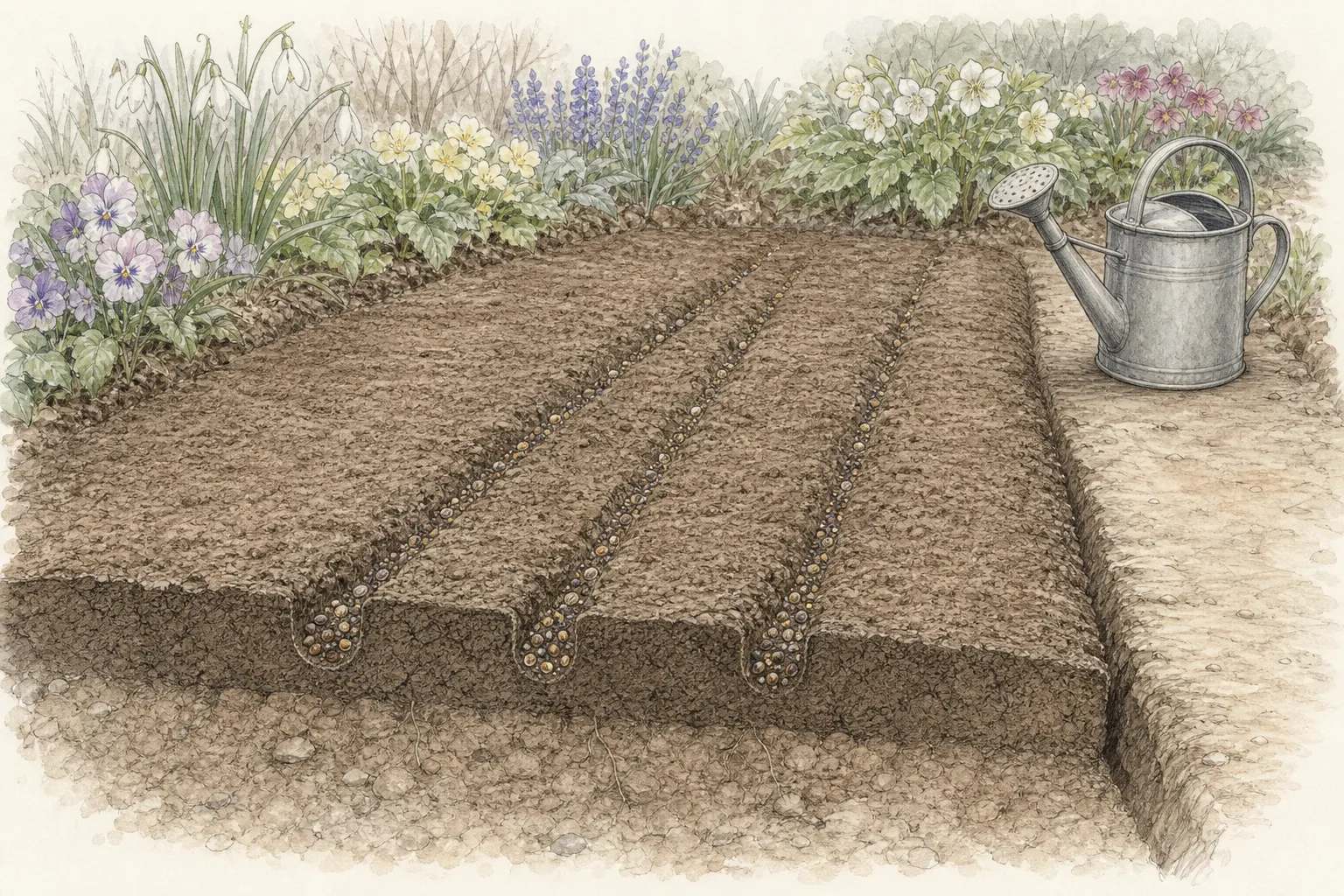
Firm gently for seed-to-soil contact and water with a fine rose. A hard stream moves seed into piles.
Use the match sowing depth to the seed stage to compare soil workability, seed size, germination pattern, seedling spacing and the bed’s weed history across the whole planting, including one unaffected reference point. Continue only where that evidence agrees with identified seedlings stand at useful final spacing in a weedable ornamental pattern.
Depth is a species requirement. The RHS uses two to three times seed size as a general guide but directs gardeners back to the packet, especially for tiny seed that needs light or only surface contact. Fine seed can be mixed with dry sand for more even broadcasting. Larger seed can be placed individually in holes or wider drills. Firming after cover improves contact; it does not mean compacting the bed. A fine rose or mist settles the surface without floating seeds into the lowest corner.
Label what cannot yet be recognized
Mark species, cultivar, source and sowing date at both plan and bed. Seedlings are easiest to confuse with weeds. Curved or offset drills can read as an informal drift while still revealing where seedlings belong. Keep labels at both ends of each band and retain a paper plan so selective weeding remains possible if a marker disappears.
Keep a small unsown reference strip or a pot sample when identification is difficult. Comparison prevents broad accidental hoeing. Use soil workability, seed size, germination pattern, seedling spacing and the bed’s weed history to decide whether the task is corrective, preventive, or unnecessary. That distinction controls timing and scale.
Photograph cotyledons and first true leaves once confirmed. The record improves future selective weeding. Compare cotyledons and first true leaves with a reliable reference before pulling unfamiliar growth. Delay thinning until the intended seedlings can be distinguished, then act while roots are small enough that removing one plant will not uproot its neighbor.
Labels protect both seedlings and design. Record the botanical or cultivar name, source, sowing date, band, and packet germination range in a notebook as well as at the bed. Photograph confirmed cotyledons and first true leaves, because those features are more useful for weeding than a flower image. If the marker disappears, leave unknown seedlings until identification is possible. Pulling every unfamiliar plant early can erase the planned drift, while retaining every volunteer can let weeds overwhelm slow-germinating annuals.
Manage emergence as a moisture problem
Keep the shallow seed zone evenly moist during the species’ germination window without saturating deeper soil. Check beneath the surface.
Use a light breathable cover only where weather and local guidance justify it. Remove it as seedlings emerge.
Protect from crusting and washouts by adjusting watering and surface texture. Repeated reseeding without fixing runoff repeats failure. Include soil workability, seed size, germination pattern, seedling spacing and the bed’s weed history.
Germination needs moisture and oxygen together. Water gently when the sown layer begins to dry, then check beneath the surface, not following a daily ritual. Saturated soil limits oxygen and favors seed decay; repeated surface drying kills newly emerged roots. Packet timing defines when absence becomes suspicious. If one band fails while adjacent species emerge, check depth, crusting, seed age, and temperature before resowing the whole bed. Mesh can protect vulnerable seedlings where local pest pressure warrants it.
Surface crust can block tiny seedlings even when soil below remains moist. Break only the thin crust between marked drills with a small tool, leaving the seed line undisturbed. If heavy rain washed seed downhill, remap the band before thinning and correct the watering method before any resowing.
Birds, slugs, and insects can remove seedlings unevenly, but protection should match observed damage. Use fine mesh or another locally recommended barrier only when it can be supported above seedlings and removed before it restricts growth. Record the affected band so a pest loss is not mistaken for poor germination.
Thin while roots are small
Identify true seedlings before thinning and follow final spacing for the named species. Crowding reduces branching and airflow. Track soil workability, seed size, germination pattern, seedling spacing and the bed’s weed history.
Remove weak or misplaced seedlings in stages if a sudden gap would expose the soil. Keep the strongest well-positioned plants.
Water retained seedlings after disturbance when soil is dry. Cut or lift competitors while their roots remain small enough to protect neighboring seedlings.
Thinning converts germination into final plant spacing. Work when seedlings are small, soil is slightly moist, and true leaves confirm identity. Remove weak or crowded plants without disturbing the roots of those retained, then water if the soil shifted. Final spacing follows the named plant's branching width, not the number of seedlings that happened to emerge. Thin patches can remain open for later branching; transplanting pulled seedlings is worthwhile only for species and root systems known to tolerate it.
Stage the display without creating a patchwork
Repeat a second sowing only for species and climates where succession is useful. Heat may end germination before the calendar interval.
Too many dates and colors dissolve the drift.
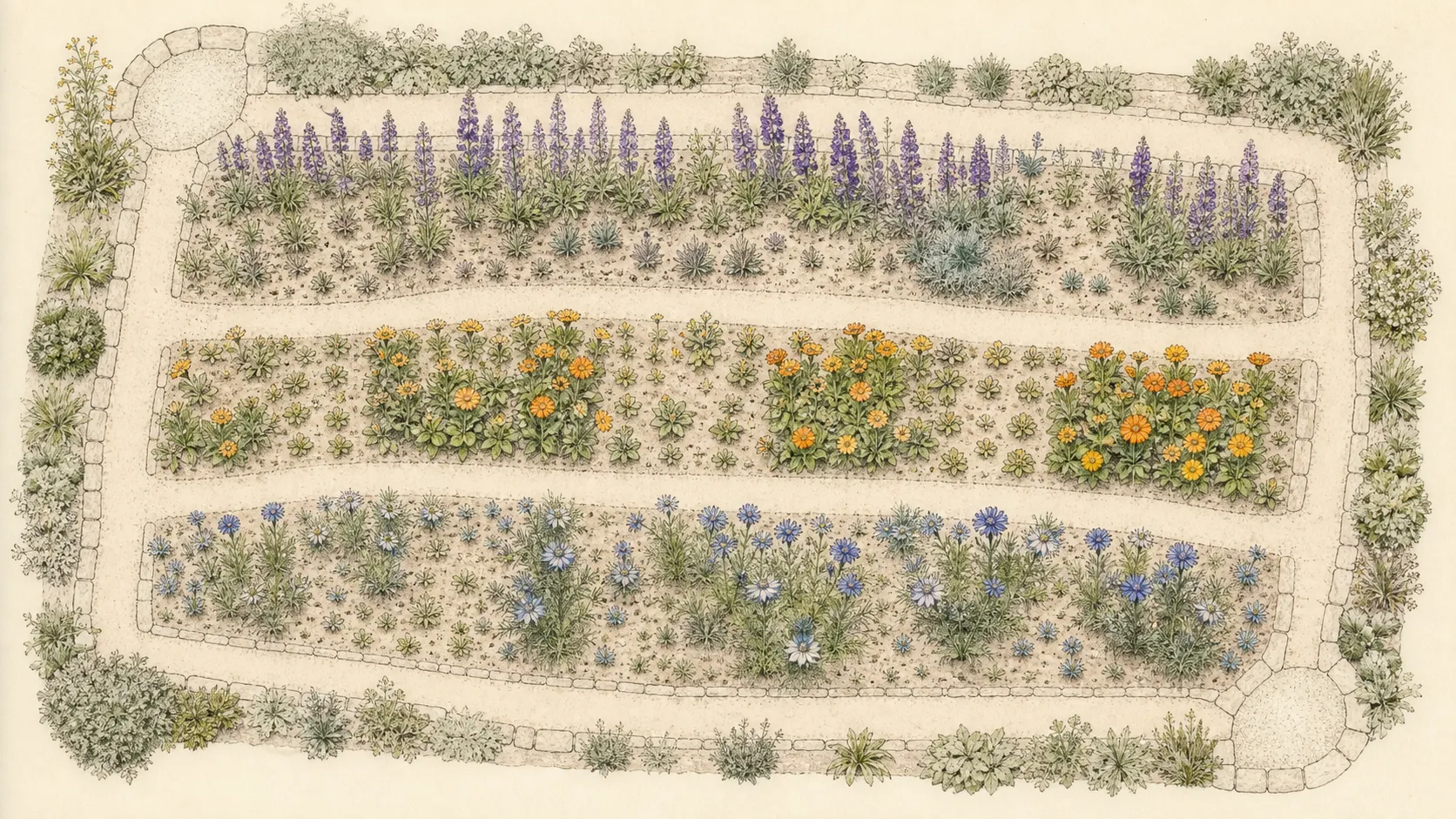
Allow selected seedheads only where reseeding and winter structure are wanted. Cut the rest before seed escapes the design boundary.
A deliberate annual drift changes through the season. Succession sowing works only when the species can still mature before adverse heat or frost, so use packet days and regional climate, not a fixed interval. Deadhead selected plants to prolong bloom, and leave seed only where future volunteers can be identified and contained. At season's end, map which bands flowered, lodged, or self-sowed. That record guides next year's density and palette without turning the bed into an unmanaged seed mixture.
For one spring drift, use three named bands, not a mixed scatter: a low early edge of sweet alyssum, a middle band of bachelor buttons, and a taller rear or central band of love-in-a-mist where each is regionally suitable. Follow each packet for sowing time, depth, and final spacing; the names illustrate height roles, not universal dates. Curve and offset the drills, label both ends, and keep one access edge. Record germination and thin to the mature pattern. If one species fails, leave its band open until depth, temperature, seed age, and moisture are checked. Later sowings should repeat the same palette only when enough cool growing season remains.
Steps
- Level
- moderate
- Time
- 45–90 minutes plus thinning
- Tools
- rake, hand hoe, line or edge guide, watering can with rose, labels
- Materials
- fresh named flower seed, fine dry soil or species-appropriate cover
- 1Select a bounded palette
Choose two to four named hardy annual flowers with compatible light, soil and regional behavior. Assign each a mature height and a clear band in the bed. Use packet directions to separate annuals that tolerate early outdoor sowing from tender flowers that need warm soil. Avoid anonymous mixtures when the species, regional behavior, or final heights cannot be checked before sowing.
- 2Prepare and mark
Clear perennial weeds, rake workable soil and mark bands plus an access edge. Retain the plan and seed packet information. RHS guidance favors a fine, crumbly, level seedbed with perennial weeds removed. Lay out curved or staggered drills within each band, label species and date, and preserve one narrow edge for watering and hand weeding.
- 3Sow by seed requirement
Place each seed at its documented depth and spacing pattern, firm lightly and water with a fine rose without washing the band. Small seed receives shallower cover; the RHS general rule is roughly two to three times the seed's size unless the packet states a light requirement. Dampen drills first and use a fine spray after covering so seed stays in place.
- 4Label and monitor
Record species, cultivar and date. Maintain moisture through the expected germination window and compare emerging seedlings with a reference. Keep only the sown layer evenly moist, not saturated, through the packet's expected germination period. Compare cotyledons and first true leaves with a trusted image before deciding that an unfamiliar seedling is a weed.
- 5Thin for mature plants
Keep sound well-spaced seedlings and remove competitors while roots are small. Use final spread and branching habit, not an arbitrary count. Thin while seedlings are small, retaining the strongest plants at the packet's final spacing. Adequate air and root room reduce competition and disease; an instantly dense green line is not the goal.
- 6Edit the season
Make a documented succession sowing only where climate supports it, then manage seedheads according to the desired future drift and local guidance. A second sowing belongs only within the species' regional season and remaining days to bloom. Deadhead where self-sowing is unwanted, or allow selected named annuals to seed into mapped openings that can be monitored next spring.
Sources
- How to Sow Seeds Outdoors. Royal Horticultural Society. Source record · Accessed 2026-08-30.
- Growing Annual Plants from Seed. Colorado State University Extension. Source record · Accessed 2026-08-30.
- Direct Seeding Vegetables and Annuals: Preparation and Care. Iowa State University Extension and Outreach. Source record · Accessed 2026-08-30.