Gardens · small ornamental meadow plug design
Design a Small Ornamental Meadow from Plugs, Not a Mystery Mix
Build a garden-scale meadow from named plugs, repeated plant roles, maintained edges, and a route for weeding before the matrix closes.
Published Last updated
In this guide
Define the garden boundary first
Choose a bed with a visible maintained edge and main viewing direction. A meadow still needs a designed limit. Schedule the work when soil is workable and nursery plugs can establish before summer heat. Confirm the choice by inspecting plug identity, mature spread, soil moisture, weed pressure, access and which species persist through winter. The safe finish is reached when repeated species overlap into a legible matrix while edges and stepping access remain open.
Map utilities, drainage and existing perennial weeds. Plug density cannot suppress established bindweed or woody roots.
Reserve a stepping route from the start. Maintenance from the perimeter alone fails in a deep bed. In this case, success means repeated species overlap into a legible matrix while edges and stepping access remain open. Let the next inspection test whether repeated species overlap into a legible matrix while edges and stepping access remain open; the workday shows only the starting condition.
Use the define the garden boundary first stage to compare plug identity, mature spread, soil moisture, weed pressure, access and which species persist through winter across the whole planting, including one unaffected reference point. Continue only where that evidence agrees with repeated species overlap into a legible matrix while edges and stepping access remain open.
A small meadow succeeds when its edge, access, and long-term editing are designed before the palette. University of Maryland recommends starting with a few hundred square feet or less, which makes a 12-by-18-foot bed realistic for close observation. Remove turf and perennial weeds thoroughly, and plan how lawn roots and mower clippings will be kept out. A paved, cut, or mown perimeter reads as intention while three stepping stones reach the center without trampling crowns. Place the bed outside routine play and traffic routes that compact soil.
Site preparation determines whether plugs compete with a seed bank of turf and perennial weeds. Remove sod and established weed roots before planting; on a small bed this can be done in stages that keep bare soil observable. Avoid tilling simply to make the surface look finished, because turning soil can expose more weed seed and damage structure. If herbicide is considered for existing vegetation, follow current local law and the product label exactly; the planting plan does not depend on chemical preparation.
Build a short list from site traits
Choose named grasses and flowers that share light and moisture. Flower color is secondary to establishment fit.
Assign matrix, seasonal accent and structural roles. Every species does not need equal quantity. Map plug identity, mature spread, soil moisture, weeds, access, and winter persistence across the whole bed. Use named plants with bounded behavior and compatible moisture; exclude anonymous mixes and aggressive uncontained species.
Check mature height, spread, self-seeding and regional status. A small bed magnifies aggressive behavior. The finished work must allow repeated species overlap into a legible matrix while edges and stepping access remain open. Weather and new growth can clarify plug identity, mature spread, soil moisture, weed pressure, access and which species persist through winter during a measured pause.
Match plants to at least six hours of sun, drainage, soil moisture, deer pressure, and the local ecoregion. Maryland's example uses 50–70 percent grasses for stability, with flowering forbs woven through them. For the Upper Midwest sketch, a locally appropriate little bluestem can supply the matrix, aromatic aster late bloom, and smaller coneflower and bounded mountain mint accents. These roles travel; the names may not. Buy propagated plants from a nursery that can explain origin and mature behavior.
Plot the matrix and access together
Draw plug centers from documented mature spread, then test reach from stones and edges. Empty spring soil is expected. Separate seasonal timing from cosmetic urgency. The useful window is when soil is workable and nursery plugs can establish before summer heat.
Repeat the matrix species across the whole bed in varied clusters. Isolated singles make a dotted display. Compare that setting with plug identity, mature spread, soil moisture, weed pressure, access and which species persist through winter.
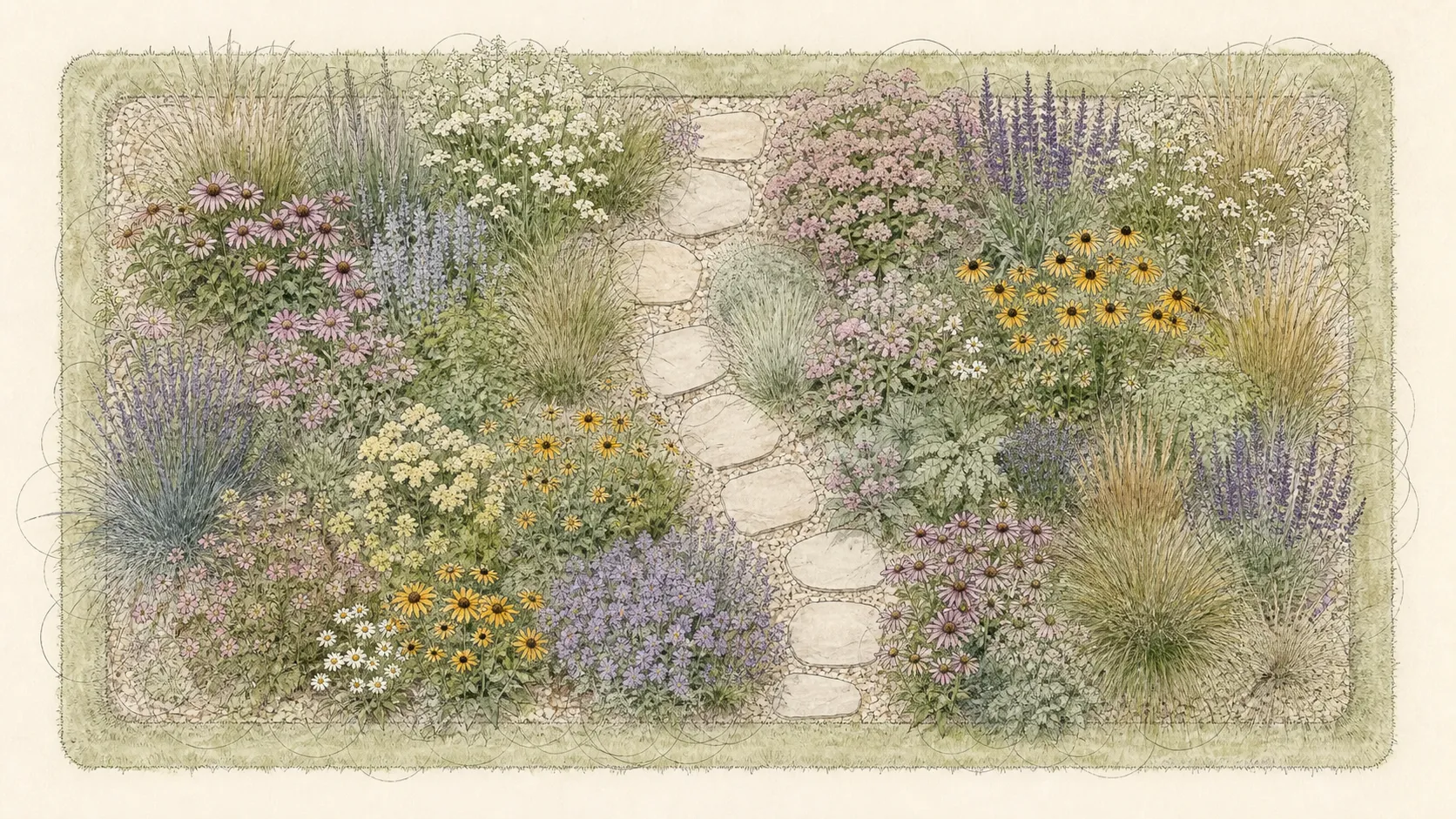
Keep tall accents away from the terrace sightline and narrow path. Preserve the principal view. Stop once repeated species overlap into a legible matrix while edges and stepping access remain open.
Draw each plug at mature width and distribute the grass matrix across the entire bed. Cluster late flowers in several repeated groups so they remain legible through the grasses. Use accents less often and place stepping stones where every plant can be reached. One plug per square foot is Maryland's high-density example for faster canopy closure, but species width can require another spacing. A numbered plan prevents accidental weeding and shows whether the intended canopy can close without one aggressive plant occupying every opening.
At Maryland's example density of one plug per square foot, a 12-by-18-foot bed contains about 216 planting positions. A 50–70 percent grass share translates to roughly 108–151 matrix-grass positions, leaving 65–108 for repeated flowering groups and restrained accents. Mature widths can change those counts, so plot circles at scale before ordering. This arithmetic prevents a flower-heavy shopping list from displacing the structural grass layer and exposes whether the budget can support the desired rate of canopy closure.
Order a small reserve of the matrix grass only when replacement stock can be kept healthy until needed. Leave planned gaps open until browsing, drainage, and planting depth explain any failed position.
Use a bounded worked planting
Use a 12-foot-wide by 18-foot-long trial plot in an Upper Midwest Zone 5 garden with full sun and dry-to-medium, well-drained soil. Choose five Schizachyrium scoparium, two Symphyotrichum oblongifolium and one Echinacea purpurea, confirming local suitability and nursery identity before ordering. The NC State profiles support their sun and drainage requirements. Reserve a conservative 4-foot circle for each position, including smaller flowering plants, so this example demonstrates adult scale and access instead of rapid closure from tightly packed plugs.
Measure x across the 12-foot width and y along the 18-foot length. Keep x=4.5 to x=7.5 as a continuous 3-foot service strip. Place four centers at x=2.25 and four at x=9.75, using y=2, 6.5, 11 and 15.5 feet in both rows. Even a 4-foot circle stays within the plot and outside the service strip. Successive circles in each row have half a foot between them. Confirm that the actual gardener and tools can use the strip; it is a design allowance, not an accessibility-code specification.
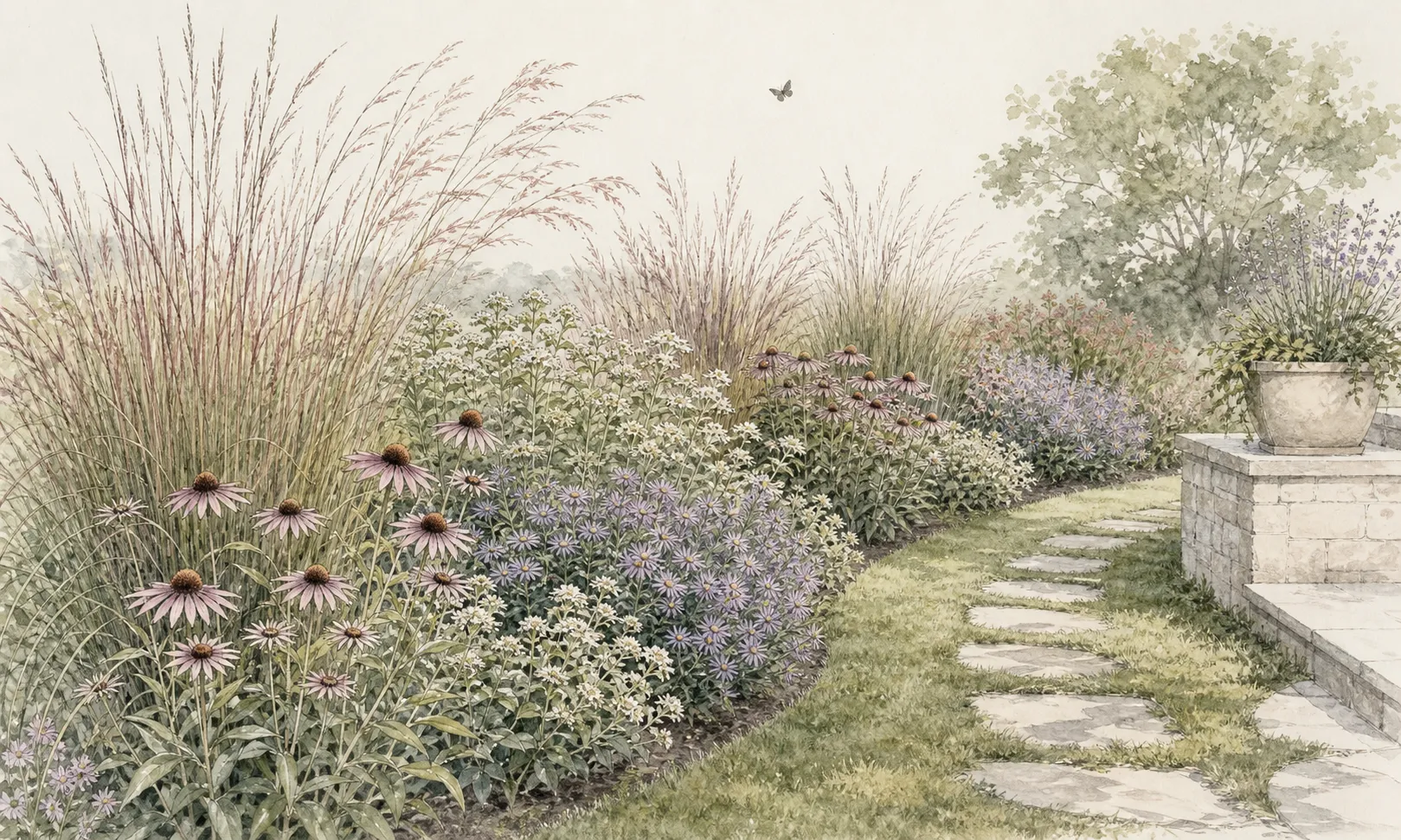
In the left row, assign little bluestem, aromatic aster, little bluestem and little bluestem from front to back. In the right row, use little bluestem, purple coneflower, aromatic aster and little bluestem. This gives eight plants: five grass clumps, two late-flowering aster mounds and one summer-flower accent. The grass share is five of eight plants by count, not a measurement of ground cover. Omit mountain mint from this compact version so an additional spreading plant does not complicate the first trial.
Keep open ground weeded and the service strip clear while the plugs establish. This intentionally sparse arrangement is not the dense one-plug-per-square-foot example discussed elsewhere, and it does not promise immediate canopy closure. Record survival, adult width, aster spread, lodging and the effort needed to maintain the gaps before changing density. If local stock exceeds the allocated footprint or the soil stays wet, choose a better-fitting documented plant or redesign the plot. The existing illustrations are schematic; these stated coordinates define the numerical example.
Install plugs without dismantling roots
Water trays, harden if needed and keep them shaded until planting. Push plants from cells, while handling plugs from the cell base. Water plug trays before planting and push plants from the cells without pulling their shoots. Set each crown at nursery depth, then leave measured establishment gaps that can be weeded until neighboring foliage overlaps.
Set every plug at the nursery crown depth and firm soil contact. Buried crowns and air gaps both delay establishment. Use plug identity, mature spread, soil moisture, weed pressure, access and which species persist through winter to decide whether the task is corrective, preventive, or unnecessary. That distinction controls timing and scale.
Label the plan even if bed labels are discreet. Early meadow seedlings are hard to identify. Keep a numbered plan because small plugs and first-year shoots are easy to confuse with weeds. The matrix succeeds through canopy closure and repeated editing, not through adding unverified species whenever bare soil appears.
Finish install plugs without dismantling roots by testing access as well as appearance. The planting should remain reachable for watering and inspection while repeated species overlap into a legible matrix while edges and stepping access remain open.
Water the plug trays before work and harden greenhouse-grown plants if their nursery conditions differ sharply from the garden. Push plugs from the cell base, and handle shoots only from the root cell, tease only circling outer roots, and set crowns at nursery depth. Water each small root ball individually, then check the surrounding soil. Mulch can help in a shade meadow, but Maryland discourages imported mulch in a dry sunny meadow where it can carry weed seed and change the intended lean surface. Labels remain essential.
Set out all plugs on the numbered grid before opening holes, then inspect the composition from the main view and from the stepping stones. Keep grasses distributed across the whole bed and shift a flower group only when mature circles still fit. Plant on a cool overcast day when possible, shade trays awaiting installation, and finish one watering zone before beginning another. Recheck every crown after the first thorough watering because small plugs can settle below grade or tip in loose soil. Correct those positions immediately while roots remain intact and the plan is still visible.
Manage the open-soil year
Weed by identification before neighboring crowns knit. The first season is not low maintenance.
Water the plug root zone according to soil and weather, then extend intervals as roots establish. Let the soil surface drain while individual plug root balls remain evenly moist.
Replace failed plugs only after diagnosing cause. Repeating a moisture mismatch wastes plants. Include plug identity, mature spread, soil moisture, weed pressure, access and which species persist through winter.
The first season is a weed-management year. Identify volunteers while the planned soil gaps are still open, and remove perennial weeds before their roots cross multiple plugs. Water deeply as root balls begin to dry, then lengthen intervals; let the rest of the bed drain. Expect limited first-year bloom. Replace a failed plug only after checking root depth, moisture, shade, browsing, and competition, because repeating the same site mismatch wastes plants. Direct mower discharge away from the edge.
Keep a first-year weed log by location and species. Annual weeds can be removed before seed set, while perennial weeds must be traced far enough to remove the regenerative root or rhizome without lifting nearby plugs. Inspect after rain when weed seedlings are visible and soil releases roots cleanly. Establish plugs without broadcast fertilizer, following the Maryland guidance. Excess fertility favors some weeds and can produce weak meadow growth that lodges.
Edit for persistence, not peak bloom
Review spring emergence, summer flower, autumn seedheads and winter bases. Retain structural intervals between bloom peaks. Track plug identity, mature spread, soil moisture, weed pressure, access and which species persist through winter.
Thin self-sown plants that erase paths or overwhelm slower matrix species. Naturalistic does not mean unedited.
Record mature spread after two seasons and shift only proven conflicts. Early overediting prevents the matrix from forming.
After two summers, edit for persistence, not one peak photograph. Map survival, mature spread, lodging, seedling recruitment, weed pressure, and access. Thin a successful spreader before it buries slower crowns, and add plants only where the canopy truly failed to close. Leave selected stems through winter when they provide structure and habitat, then use the regionally appropriate spring cutback. Expanding by a second bounded bed is easier to evaluate than enlarging every edge at once; seed from known plants can support that later phase.
A late-winter or early-spring cut can remove old stems before new growth, but the exact height and timing follow the selected grasses and wildlife goals. Carry cut material off the crowns and inspect the edge for lawn invasion. Expand only after the first plot has two seasons of survival data. A second bounded area can reuse divisions or known seed from successful plants while keeping the original plot available for comparison. That staged approach also limits the area of open soil requiring intensive weeding.
Measure canopy closure by photographing a fixed square near each stepping stone at planting, late summer, and the second summer. The useful trend is less bare soil with all selected species still represented, not one plant covering the frame. When a matrix grass fails, inspect that position for drainage, browsing, and root depth before using the reserve plug. When an accent spreads too quickly, remove its outer divisions before they enter another group. These small mapped edits preserve the intended proportions and make future expansion depend on observed persistence, not first-year flower count.
Design ideas
- Style
- garden-scale naturalistic meadow
- Space
- sunny residential bed
- Climate
- The worked example is a 12-by-18-foot sunny Upper Midwest bed with draining soil, no irrigation-dependent wet pocket, and a maintained edge. The named plants are a design demonstration, not a universal native palette; verify local ranges, cultivars, mature dimensions, soil and invasive guidance. This Upper Midwest example must be rebuilt with plants native or reliably adapted to the reader's own ecoregion. Site preparation, six or more hours of sun, drainage, deer pressure, and a realistic first-year weeding route are prerequisites.
- 112-by-18-foot frame
Place the long edge toward the main view and retain the crisp perimeter. In the worked version, a continuous 3-foot service strip divides the two planting rows. Keep the full strip open as plants reach their allocated mature circles, and check that it accommodates the actual maintenance tools and gardener before planting. Do not narrow it later to fit additional plugs.
- 2Matrix role
Use the named Schizachyrium scoparium as the dominant repeated form in the worked trial, checking local stock against the allocated mature width. Five of eight plants are grasses by count; that is not a measured ground-cover percentage. Maintain their distribution through both rows so the grass framework remains visible when the flowering accents are quiet.
- 3Late flower role
Place the two Symphyotrichum oblongifolium in different rows and at different positions along the plot so late flowers recur through the grass framework. Keep each mound reachable from the service strip or perimeter. Monitor its spreading edge and reduce or relocate an encroaching clump before it closes the access reserved in the measured plan.
- 4Midseason accents
Use the single Echinacea purpurea as a restrained summer accent in the worked planting, preserving its documented adult footprint. Mountain mint is deliberately omitted from this version. Add another species only after reviewing local suitability, mature spread, seasonal role and the open access, then recalculate quantities instead of inserting an unmeasured extra plug.
- 5Open establishment gaps
Leave measured soil between plugs, label the plan and weed those gaps until mature crowns begin to overlap. One plug per square foot is Maryland's example for quick native canopy closure, but actual spacing follows each species' mature width. Label open gaps and weed them frequently during the first establishment year.
- 6Edge maintenance
Keep a mown, cut or paved boundary clear enough to show intention and stop spreading plants before they enter adjacent lawn or paving. A cut, mown, or paved edge blocks lawn encroachment only when it is inspected. Direct mower discharge away from the meadow and remove rhizomes or seedlings before they cross into paving joints.
- 7Substitution rule
Outside the worked region, preserve plant jobs and proportions while replacing every species with locally documented equivalents. For another region, retain a dominant grass matrix, repeated late flower, restrained midseason accents, and a fixed access route. Replace every taxon with locally documented plants for the same sun and soil moisture.
- 8Two-season audit
Measure survival, spread, weed pressure and access after the second summer before adding density or moving established crowns. Judge the young meadow by survival, rooting, and weed control before flower count. After two summers, map survival, canopy closure, weed pressure, lodging, and path access before filling gaps or dividing successful plants.
Sources
- How to Make a Meadow. University of Maryland Extension. Source record · Accessed 2026-08-30.
- Successfully Establishing Meadows from Seed in Delaware and the Mid-Atlantic. University of Delaware Cooperative Extension. Source record · Accessed 2026-08-30.
- Wildflower Meadows: Plant Selection and Establishment. University of New Hampshire Extension. Source record · Accessed 2026-08-30.
- Schizachyrium scoparium. NC State Extension. Source record · Accessed 2026-09-09.
- Symphyotrichum oblongifolium. NC State Extension. Source record · Accessed 2026-09-09.
- Echinacea purpurea. NC State Extension. Source record · Accessed 2026-09-09.