Gardens · rose border companion plants working access
Design a Rose Border with Companion Plants and Working Access
Plan roses by mature spread, light, airflow, irrigation, pruning access, support, and companion layers that enrich the display without crowding the crown or blocking care.
Published Last updated
In this guide
- Draw mature roses and access before companions
- Measure the companions after drawing mature roses
- Match rose class, site, and support
- Layer companions without enclosing the roses
- Build a complete Maryland border
- Coordinate irrigation, mulch, and feeding
- Design for pruning and tying
- Carry the display across seasons
- Audit the border at full volume
- Design ideas
Draw mature roses and access before companions
Start with the rose circles and the gardener's route. Mark the public path, windows, utilities, irrigation, wall rain shadows, and existing roots at measured scale. Draw each named rose at its documented mature height and width, including arching prickly stems. Leave enough clear ground to reach the base with pruners, remove diseased foliage, inspect mulch, and service an emitter without stepping through a companion crown.
Access must survive peak summer volume. A paver visible in March can vanish beneath a four-foot rose and a three-foot perennial by June. Reserve a continuous rear service strip where space permits, then connect it to the front with fixed stepping spurs between rose circles. Keep thorny growth away from gates, seating, play routes, and the normal shoulder line of a narrow walk. Plant quantity should decrease before the route does.
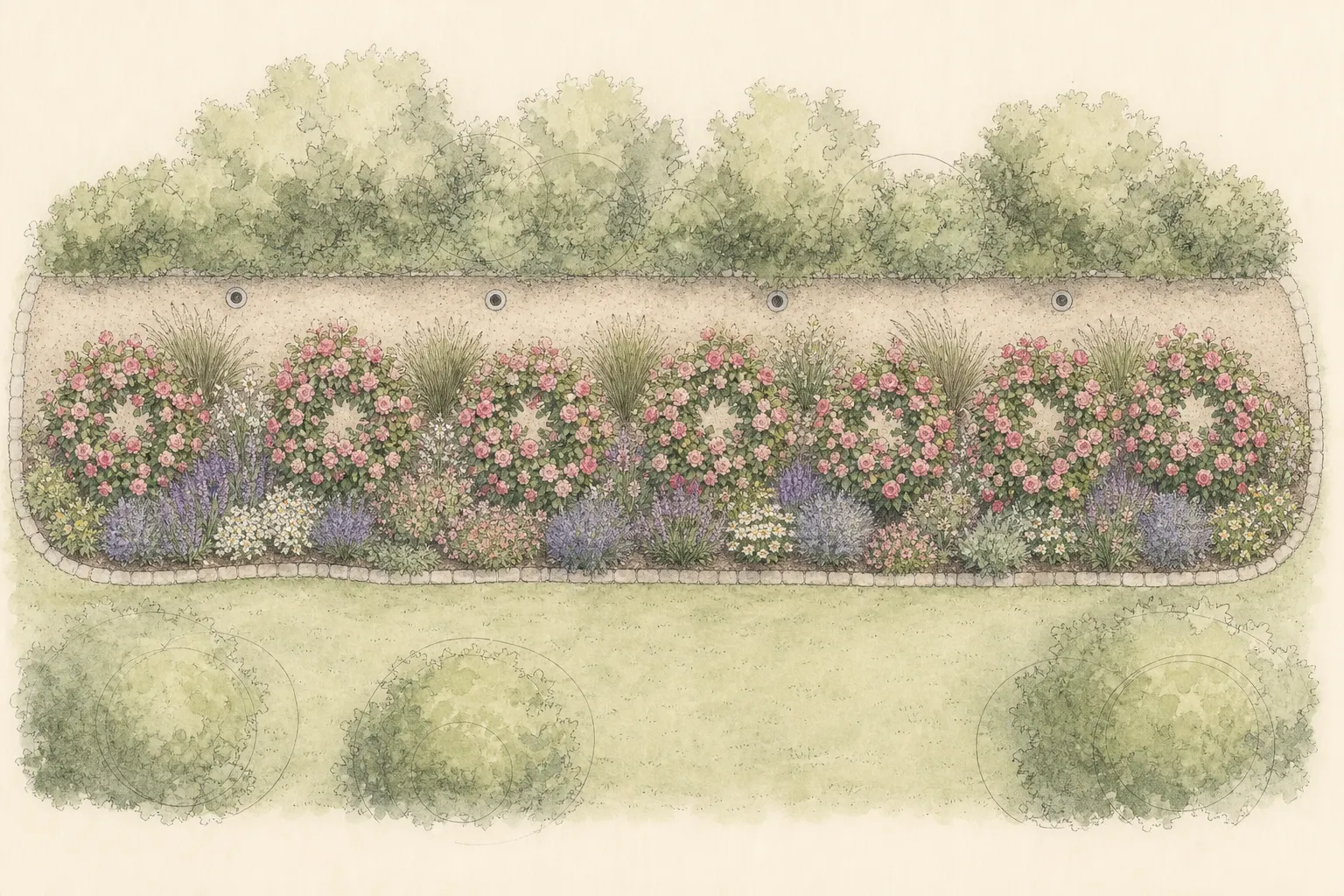
Use open mulch as part of the design. A bare inspection band around the rose base exposes suckers, fallen leaves, irrigation, and soil moisture. Companion plants begin beyond that band and repeat as separate drifts. The result can look full from the path while still opening into working bays from behind. A dense edge that blocks hands and air is not mature abundance; it is a maintenance conflict drawn too late.
Measure the companions after drawing mature roses
Retain the Maryland plan's rose footprints, rear service strip and paver access before adding foreground plants. Check the whole combination at summer volume and keep watering hardware reachable. A companion that repeatedly hides rose bases or blocks selective pruning has failed its position, even if its flowers match. Revise that placement without automatically changing the rose-care routine.
Match rose class, site, and support
Rose class determines the structure and yearly work. A rounded shrub can stand free, a climber needs a durable plane, and a rambler may exceed a small border even when its flowers look suitable. The Maryland example below uses Rosa Knock Out Group 'Radrazz', a freestanding landscape shrub. NC State gives the group a mature size of 3 to 4 feet high and wide, so the plan reserves a full four-foot circle for each plant.
University of Maryland Extension recommends at least six hours of direct sun for most roses, with morning sun helpful for drying leaves. It also calls for rich, loamy, well-drained soil and spacing that allows air movement. Measure sun in the leafed season and follow water after rain. A downspout pocket, compacted path edge, or wall rain shadow can defeat a cultivar chosen only from a hardiness-zone label.
Disease resistance lowers risk without creating immunity. Maryland notes that Knock Out cultivars are strongly resistant to black spot in its landscapes, yet they can be susceptible to Cercospora leaf spot during warm rainy summers. Keep the base visible and the foliage reachable for inspection. A companion that closes air and hides lower leaves undermines the very cultural conditions used to reduce disease pressure.
A climbing-rose substitution changes the plan. Install a freestanding trellis or sound wall wires before planting, leaving room for air and maintenance behind the canes. RHS advises a lowest horizontal wire 18 inches above ground and later wires 12 inches apart for climbing roses. Those values apply to climbers, not to the freestanding 'Radrazz' shrubs in the worked composition.
Layer companions without enclosing the roses
Companions should occupy a different height, root position, or season while sharing the bed's sun, drainage, and realistic water regime. Place the lowest layer toward the public edge and the narrowest accents between rose circles. A rear grass belongs beyond the rose canopy, not inside it. Preserve a mulch window at every base and a clear approach from either the path or service strip.
Geranium 'Rozanne' makes a mounding front layer 1 to 1½ feet high and 1 to 2 feet wide according to NC State. Its violet-blue flowers begin in late spring and may continue through summer. Allium 'Millenium' forms a narrower 10- to 15-inch clump, 1 to 1½ feet high, with rounded purple flowers in mid- to late summer. Both stay below the rose canopy when their mature widths are respected.
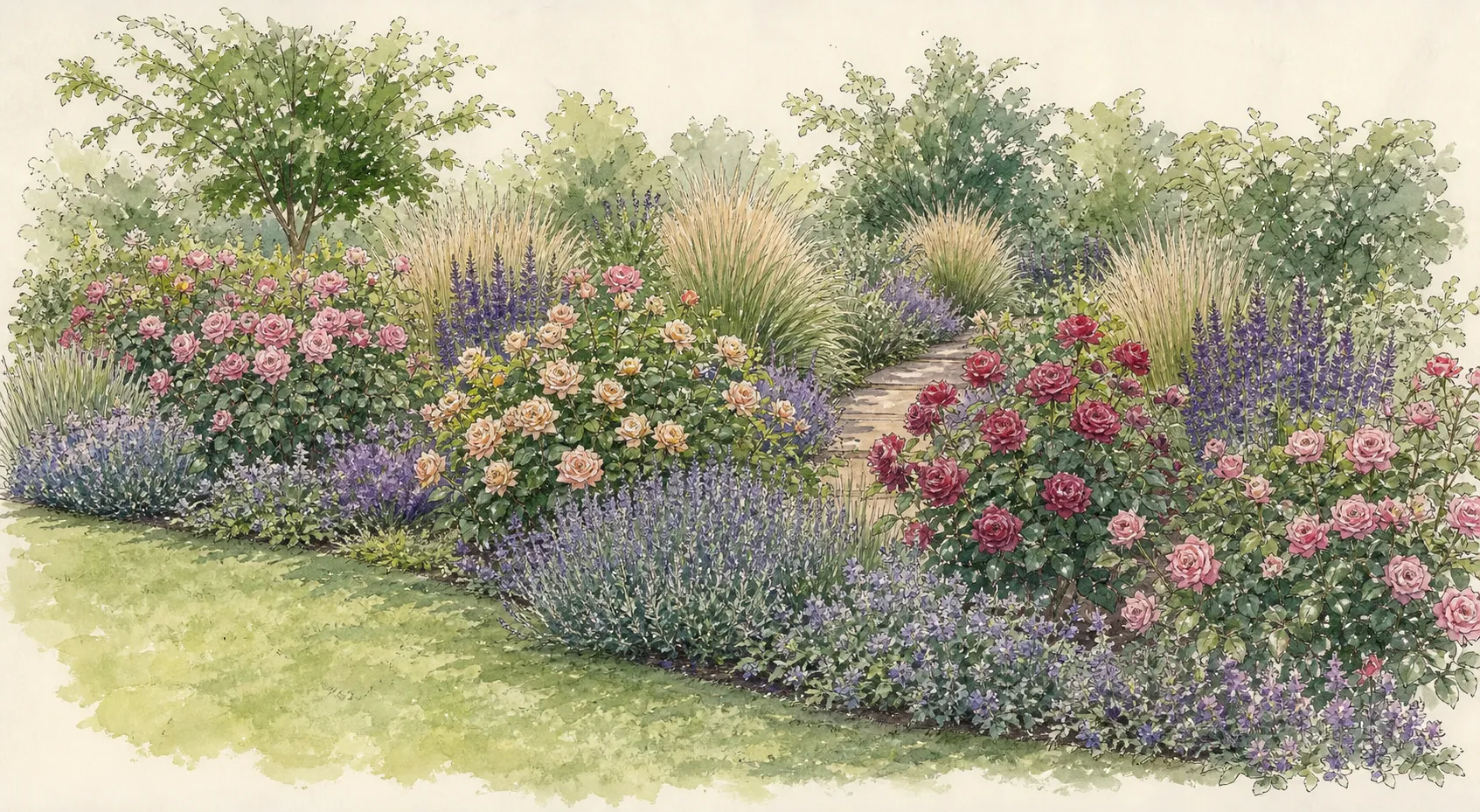
Panicum virgatum 'Northwind' supplies the tall, fine-textured counterpoint. NC State records it at 4½ to 5 feet high and 2½ to 3 feet wide, with late-summer panicles and yellow-beige autumn foliage. Place it behind the roses where its full width avoids the service route. Rich, overly moist soil or shade can loosen its upright form, and humid climates can bring rust, so it remains a conditional regional choice.
No companion in this plan is presented as pest control. Fragrance, flower color, and membership in the onion family provide no evidence of protection for a neighboring rose. Select each plant for measured structure, season, and site fit. Current local invasive lists, heat performance, wildlife concerns, and nursery identity may rule out a named choice even when its size seems ideal.
Build a complete Maryland border
This worked composition is for a 24-by-12-foot residential border in central Maryland, with humid summers and periodic drought. It receives at least six hours of sun with morning exposure, has well-drained loam, and can be watered at soil level. The public path runs along the south edge. A 30-inch private service strip occupies the north edge, with two 18-inch paver spurs between roses. These maintenance dimensions are not claims about code-compliant accessible routes.
Set three Red Knock Out roses, Rosa Knock Out Group 'Radrazz', in the middle band on 7-foot centers. Draw each as a 4-foot-wide, 4-foot-high shrub, the upper end of the NC State group range. Their cherry-red to hot-pink flowers repeat from spring through fall. Place the centers far enough from the public path that the mature circles leave a clear edge, then keep all companion crowns outside those circles.
During the first growing season, protect those circles even when the young shrubs leave broad gaps. Keep mulch off the stems, base-water in response to rainfall and soil moisture, and inspect new leaves from both routes. Keep short-lived fillers outside the future canopies. Mark each reserved circle on the bed plan and verify it after the first full summer, when rose canes and companion foliage reveal the true work bay. By the second spring, compare each shrub with its four-foot outline, correct a blocked emitter or encroaching perennial, and allow healthy plants time to occupy the space reserved for them.
Repeat five 'Rozanne' geraniums along the front in separated groups, each allowed up to 2 feet of width. Leave both paver spurs open and retain a mulch interval opposite every rose base. Tuck nine Allium 'Millenium' into three groups between the geraniums and roses, reserving 15 inches for each clump. Geranium begins the low blue-violet field; allium adds compact rounded flowers as the rose display moves through summer.
Place two 'Northwind' switchgrasses near the rear corners, each given a full 3-foot width and kept outside the rear service strip. They frame the rose group without forming a screen. Their late panicles and winter stems carry the upper line after the rose leaves fall. Where rust, local fire guidance, or overly rich wet soil makes switchgrass a poor choice, substitute a locally proven clumping grass with the same mature envelope.
The plan uses one irrigation zone only if all root areas receive suitable moisture without saturating the allium or leaving the roses dry. Otherwise, separate the rose emitters from the leaner edge layer. Place hose connections, flush ends, and valves in the service strip, outside the four-foot shrub canopies, so repair stays clear of prickles and the front drift.
A rose substitution must match the 4-foot circle, repeat-flowering role, Maryland disease record, and pruning rhythm. A climber cannot occupy the same freestanding position without a new support plane and different access. Companion replacements need comparable mature dimensions, full-sun and drainage fit, seasonal function, and acceptable local status. Leave a bay mulched until those checks are complete.
Coordinate irrigation, mulch, and feeding
Maryland Extension advises watering roses when weekly rainfall is below 1 inch, aiming early-day water at the base to limit leaf wetness. Treat that as regional guidance, then check actual soil and rainfall at the site. A brief shower may not reach the active root zone, while heavy clay may remain wet. Deliver water slowly across the rose root area and inspect each emitter from a stepping spur.
Mulch the continuous bed to moderate moisture and reduce weeds, keeping material away from rose stems and companion crowns. Preserve a visible base around every shrub. Keep fallen diseased leaves visible and collect them before successive mulch layers cover them. Maryland recommends spring replacement of old mulch as part of sanitation for rose pests and pathogens; follow current local guidance on handling diseased material rather than assuming every municipal compost stream accepts it.
Use a soil test before major fertility or pH corrections. Maryland places the preferred rose pH at 6.0 to 6.5 and sets early August as the final fertilization cutoff for its region. Feed the whole bed only for a demonstrated need. Excess soft growth can close the planned air gaps, while unneeded fertilizer may move beyond the root zone. Apply only the indicated product amount under its current label.
Design for pruning and tying
The worked 'Radrazz' shrubs need no trellis. Reach each from the rear strip or front spur, remove dead or damaged canes, and prune for size at the locally appropriate late-winter stage. NC State describes Knock Out roses as needing lighter size management than many roses. Keep their rounded habit; narrow sheared boxes create a cycle of repeated correction.
Wear eye and hand protection appropriate to prickly canes, keep tools sharp, and plan a direct debris route. A cut cane should move to the service strip without sweeping across geranium crowns or catching a passerby. Preserve enough space to trace a damaged stem to its origin. If an entire companion drift must be tied back for every pruning session, its mature position conflicts with the rose work bay.
For a climber elsewhere in the border, tie main shoots to the support plane with soft adjustable ties and room for thickening. RHS distinguishes repeat-flowering climbers from once-flowering ramblers and gives different pruning implications. Confirm the class before shortening canes. Keep the base and lowest wire reachable, lay long shoots out without standing on companions, and inspect ties at least after winter weather and strong summer growth.
Carry the display across seasons
In spring, new rose foliage rises behind low geranium mounds. The main rose flush becomes the dominant woody flowering mass, while 'Rozanne' extends the cool-colored lower field. 'Millenium' adds mid- to late-summer spheres without matching the rose flower scale. As Maryland heat slows some rose bloom, the companions maintain shape; later rebloom returns above a border that already has a legible structure.
By late summer, 'Northwind' panicles lift the rear corners and the rose group remains a broad middle rhythm. Deadhead repeat-flowering roses if the desired display and cultivar care support it. If hips are a goal on another cultivar, stop deadheading at the appropriate time. Maintain access openings and remove diseased material as the edge begins to seed or sprawl.
Winter leaves the three rose frameworks and two grass columns above open mulch and dormant companion crowns. Keep sound grass stems where local fire and safety conditions allow, then cut them before spring growth. Roses remain visible enough for dormant inspection and pruning. Adding a dense evergreen behind this plan could shade leaves and close the service strip, so winter interest must fit the same mature access drawing.
Audit the border at full volume
Review the border during the main flush, after a soaking rain, and after late-winter pruning. Confirm that every rose base, emitter, and inner cane remains reachable. Watch for 'Rozanne' across a paver, allium hidden under rose branches, or grass leaning into the service strip. Move the plant that exceeds its bay and let every remaining layer keep its documented mature size.
Inspect lower rose leaves for black spot, Cercospora-like lesions, yellowing, and premature drop. Maryland stresses that resistant cultivars can still develop disease and that weather changes severity. Identify the problem before treatment, remove affected material as advised, and preserve air and base watering. Any pesticide decision must follow the current label and local Extension guidance; companion planting is not a substitute for diagnosis.
Replace a rose when its mature habit or health cannot fit the allotted position with reasonable care. A wider cultivar should not be held at four feet by constant hard pruning, and a climber should not be treated as a freestanding shrub. Update the plan after structural changes so irrigation, access, and companion circles remain accurate. Success is a flowering border that can still be watered, inspected, pruned, and cleaned safely at full volume.
Design ideas
- Style
- Layered ornamental planting with legible seasonal structure
- Space
- Home ornamental garden bed, border, courtyard, or seasonal container
- Climate
- The worked plan is for a sunny, well-drained central Maryland home border with humid summers, periodic drought, and base irrigation. Colder, hotter, wetter, deeply shaded, salt-exposed, or fire-sensitive sites require different roses, companions, spacing, and winter care.
- 1Repeat roses in compatible groups
Repeat three Rosa Knock Out Group 'Radrazz' shrubs on 7-foot centers, drawing each at 4 feet high and wide. That spacing leaves separate canopies and work bays at maturity. Another rose must fit the same circle, Maryland disease pressure, and pruning rhythm; a larger shrub or a climber requires a new plan rather than tighter annual restraint.
- 2Run a fine-textured foreground
Use five separated Geranium 'Rozanne' mounds along the front, each allowed up to 2 feet of spread. Their violet flowers continue below the roses without hiding the shrub bases. Break the rhythm at both stepping spurs and relocate a mound that repeatedly crosses access; the gaps are part of the composition, not unfinished planting.
- 3Thread spring bulbs through open ground
Optional spring bulbs belong in mapped pockets outside rose inspection bands and paver routes. Choose exact cultivars with local hardiness, planting depth, mature foliage, and toxicity understood. Their leaves must complete the plant-specific post-bloom period without being tied over a rose emitter. Leave the pockets mulched when no bulb meets those conditions.
- 4Create permanent stepping points
Keep a 30-inch rear service strip and two 18-inch paver spurs in this private border. They carry pruning debris, a watering wand, and a gardener in thorn protection. These figures do not define an accessible public route. Preserve the openings at mature volume, and route emitters so valves and flush points can be reached without crawling beneath the roses.
- 5Give climbers a separate plane
When a separate climber is desired, install its trellis or wires before planting and keep companions below the cane-working plane. RHS starts wall wires 18 inches above ground and spaces later wires 12 inches apart. Confirm climber versus rambler before pruning, and leave enough clear floor to lay out, tie, and remove long prickly shoots safely.
- 6Repeat a late-season vertical
Frame the rear corners with two 'Northwind' switchgrasses at their documented 2½- to 3-foot width. Late panicles and winter stems extend the vertical line after rose flowering slows. Substitute where rust, rich wet soil, shade, invasive status, or fire guidance makes the cultivar unsuitable, preserving a clumping habit and the same mature envelope.
- 7Keep one quiet mulch interval
Maintain a visible mulch band around every rose base. It exposes fallen leaves, suckers, emitter flow, and soil moisture, while separating companions from the main pruning zone. Refresh mulch according to Maryland sanitation guidance without piling it against stems. If a drift closes the band, divide or relocate that drift and keep the evidence exposed.
- 8Carry winter with structure, not clutter
Let the three rose frameworks and two grass columns describe winter. Keep sound grass stems where local rules permit, remove diseased rose debris, and preserve the rear route for dormant pruning. Hips belong only on cultivars and stems chosen for that role. Keep dense evergreens outside positions where their mature crowns would shade roses or block the service strip.
Sources
- Rose: Identify and Manage Problems. University of Maryland Extension. Source record · Accessed 2026-08-30.
- How to grow roses. Royal Horticultural Society. Source record · Accessed 2026-08-30.
- Rose pruning: climbing roses. Royal Horticultural Society. Source record · Accessed 2026-08-30.
- Coral Knock Out® Rose - Rosa Knock Out® Group. NC State Extension Gardener Plant Toolbox. Source record · Accessed 2026-08-30.
- Allium 'Millenium'. NC State Extension Gardener Plant Toolbox. Source record · Accessed 2026-08-30.
- Geranium 'Rozanne'. NC State Extension Gardener Plant Toolbox. Source record · Accessed 2026-08-30.
- Panicum virgatum 'Northwind'. NC State Extension Gardener Plant Toolbox. Source record · Accessed 2026-08-30.